Primary Text: Cornish Pilchard Fishery
Dublin Core
Title
Primary Text: Cornish Pilchard Fishery
Description
An 1872 text describing the methods used to catch and package pilchards along the Cornish coast of England.
Creator
J. C. O.
Type
ebook
Publisher
Hathi Trust
Date
12 December 2021
Contributor
Rebecca Miller & Tori O'Dea
Subject
Fishing
Text Item Type Metadata
Text
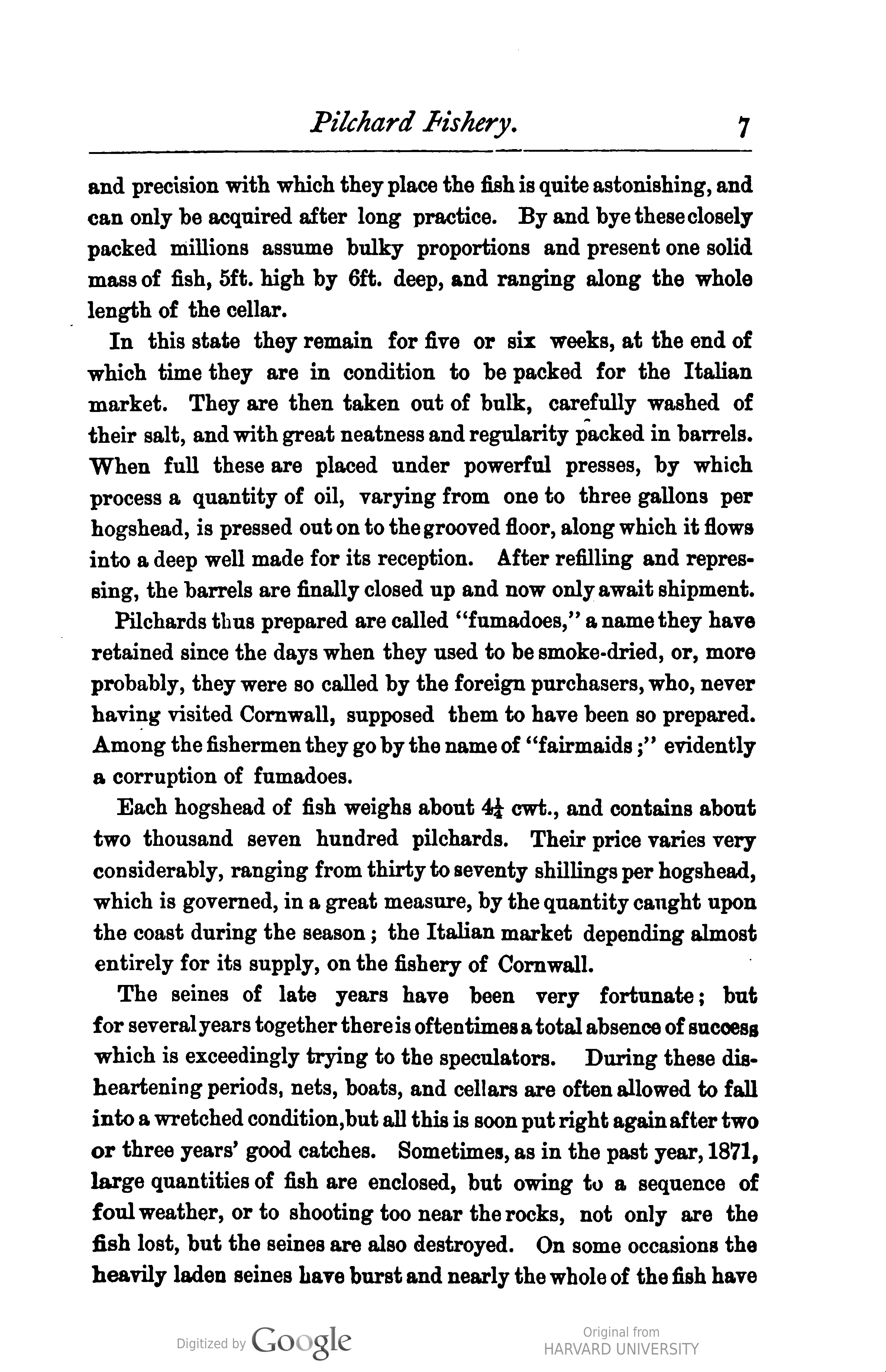
THE Earnish Pilchard Fishery. Upon the Cornish Coast, to which the pilchard fishery is almost confined (the only other place in the United Kingdom where it is practised being the south coast of Ireland), there are two distinct systems by means of which it is carried on ; the one by means of the drift net, the other by means of the seine. The former mode is practised chiefly on the south coast. A net half-a-mile in length, with one end attached to the boat, is allowed to drift about in deep water, whither the tide may carry it. Passing shoals in their course are intercepted by it, and in their efforts to pass through, many fish become entangled in the meshes. The number thus caught of a night often amounts to several thousands per boat, but the fish are usually smaller than the seine fish. The fishing upon the north coast is, however, carried on almost exclusively by means of the seine, the principle of which is alto- gether different from that of the drift net, whilst the machinery is on a far more extensive scale. The success, too, of the seine fishery is more uncertain and the catches less frequent, although, when they do occur, the quantities are immense, one seine not un- frequently securing as many as 2000 hogsheads; many years ago, a seine at St. Ives took up as many as 5000 hogsheads. On account of the expense incurred in the prosecution of the undertaking (the seine apparatus, altogether, costing about £1500), a company is formed to supply the requisite funds. Each “concern” consists of three boats, having different names and distinct offices : first, there is the Seine-boat, which is 37ft. long; next comes the Vollier or Follower, of about the same size ; and then the Lurker, a much smaller boat, but which does all kinds of useful work, dodging about in search of the fish and hanging near the “school,” or shoal, when found. In order to avoid confusion and dispute among the different companies engaged in the fishery, (there are nine such “concerns” at Newquay) an arrangement is made between them by which each has allotted to it, during the season, a distinct portion of the bay. The stations, however, are changed daily or weekly, according to agreement: and out of its “turn” no seine may shoot, except in the absence of those deputed to occupy the adjoining stations. Along the hills and cliffs of Newquay the visitor will scarcely fail to observe posts fixed into the ground at certain intervals. The relative positions of these indi. cate to the boats out at sea their proper and distinct boundaries. The general complement to each seine is twenty men,or thereabouts, who besides their wages and allowances of drinkables, have a share in the fish caught; not a bad plan, as it ensures their best endea- vours to catch all they can. Sometimes these men, during a season, perhaps within a fortnight, will make as much as forty and fifty pounds each. Among those engaged the most conspicuous, and per- haps the most important, man is the“ huer.” It is his duty to watch all day upon the cliff or beacon for the approach of shoals of fish, which these old hands are very expert in detecting even miles away. The season during which they expect the fish to pass up and down this coast, begins generally about the month of August, and lasts until that of November. There is, however, not much success usually until the end of September or the beginning of October; the best catches being generally made in the last month. The early fish are not thought so much of, the shoals being usually lighter and the fish smaller, although they yield, proportionately, a larger quantity of oil. Let us now imagine that one of these huers, stationed upon the cliffs or beacon, sees, not far out upon the quiet sea, a momentary flash as of a silver streak. It looks, to his experienced eye, like a “break” of fish. He watches intently the same spot through his spy-glass; it breaks again ; it is without doubt a shoal of pilchards. The flashes come nearer, and now he is able to observe that there is “colour,” indicating that a large body of fish is present. The prize is worth securing, and no time must be lost. He takes his great trumpet, four feet in length, places it to his mouth, and with all his might raises the “Cry.” The sounds reverberate along the cliffs and hill-sides, and in the town; everyone both far and near hears the well-known sound. The alarm is taken up by other trum- peters, and in a few moments, upon the beacon where several of these huers are stationed, a scene of frantic excitement ensues ; each huer calling upon and cheering his own men in such terms as these : —“Hurrah the Rose," "Hurrah the Speculation,” “Hurrah the Unity,” and so on, according to the name of the seine: so that a person who knew not the cause of all this noise and excitement, might well fear that an enemy's forces were landing. These calls are momentarily responded to; for immediately along the streets are seen running, men, women, and children who call; as they run “ Hurrah, the cry is up:” the first are in breathless haste to gain and man the boats, whilst the others are all deeply anxious to wit- ness the success of an enterprise which, they know, may bring to them and to hundreds of poor homes, riches and comforts to cheer the winter gloom. In five minutes the pier is crowded with men in a state of the wildest excitement. Some eager to get on board their craft, are jumping from boat to boat, some are throwing over the mooring, whilst others are getting out the oars; so that in a wonderfully short time, one after another of these six-oared galleys emerges from the quay amidst the hurrahing and shouting of the huers, and are being rowed with racing speed to take up their respective positions, in readiness to intercept the sighted shoal. The huer, in whose "turn” the “school” may be, is always the most excited, and his crews are always the most eager to be out. The little fleet have all got out and are waiting in their turns the re-appearance of the fish, which, for a time, let us imagine, have been lost sight of. All eyes on board the boats are directed towards the huers, who from the hill and cliffs can generally discern the fish even better than those who are near. The huer directs all the movements of the crews, and by calling to them through his trum- pet and by making signals, informs them when to pull, when to ease their oars, and when to shoot the seine. The fish have again appeared. The huer, in whose turn the fish are, immediately gives orders to his seine, to pull ahead and intercept them; and the mo- ment they are in position the signal is given to shoot. The men, who have been standing in readiness at the seine for some time, throw away as fast as hands can move, the boat at the same time pulls ahead, encircling, if it can, the whole “ school ;" so that, in about five minutes, 110 fathoms of heavy net, 70 feet in depth, with leads and corks, have been cast overboard, and now the next seine boat looks out in readiness to shoot; for it is seldom that one seine succeeds in enclosing the whole of a large shoal. The first seine, then, having enclosed, the boats begin warping the net against the tide, at the same time bringing together and making secure the two ends. This being done the fish are effect- ually shut in; but they are even yet unsafe, for they are probably in deep water where a strong current is also running, there is danger therefore lest the net should get lifted, or lest the body of fish being so great should force an opening underneath, so that great care and vigilance have still to be exercised to prevent their escape. The next thing, then, is to get the seine into shallow water, and this is done by those in the boats hauling away with ropes upon the net, until it is brought in near the shore. It is only now that feel. ings of safety may be indulged in. · The fish usually come into the bay on the flood tides and frequently not before the day is drawing to a close, so that the work of warping has oftentimes to be continued through the night. Deep anxiety is felt, meanwhile, by those on shore, as to the safety of the fish, but they are re-assured at intervals during the night, by hearing the sound of distant cheering wafted across the water. This is the hurrahing of the men as they every now and then observe the jump or sparkle of the fish within the seine. The seine, then, with its living freight having been safely moored in shallow water, the process of "tucking” is commenced. When there is a heavy enclosure, they must be careful not to begin this too soon before the fish are sufficiently tame, lest by sudden fright or panic among them, a rush in one direction should force the seine and allow the fish to make their escape. The tucking forms a busy, interesting, and beautiful sight. Two boats, the seine boat and the lurker, first pull alongside the seine, which lies anchored a short dis- tance out. The larger boat has on board a net of comparatively small dimensions, which they commence shooting into the middle of the captured shoal, the smaller boat, meanwhile, by means of the splashing of oars, &c., driving the fish into the quarter where they may most easily be caught. The tuck-net is then gradually drawn up at each end, the space within the seine becoming less and less until by and bye the fish begin to swarm within their contracted limits. The net is still drawn closer to the side of the boat, and now the fish have no longer room to swim, but have acquired the appearance of one boiling, bubbling mass, whilst the silvery scales of the leaping fish sparkle with dazzling brilliancy in the shining sun. Without delay they commence getting them on board. Men sitting astride the gunwale, with one leg in the water and the other in the boat, begin with deep baskets, dipping into the seething mass. At each successive stroke they bring up a basketful of jumping, glistening fish, which they unceremoniously throw into the bottom of the boat, where they continue to jump and glitter, until borne down and covered by those that follow. As the process of emptying the tuck is continued, the net is constantly being drawn up in order to keep the fish en masse, and the baling is carried on, until at last the net is quite empty, when it is again shot and another "tuck” is made. By and bye the boat becomes laden to the gunwale. She is then rowed into the pier, whilst another takes her place at the seine. On arriving at the quay, the laden boat is at once surrounded by eager purchasers, who, in their anxiety to get served, wade up to their waists in water, or drive their carts so far out that they almost swim; and it is a most ludicrous sight on these occasions to witness the efforts made to reach the shore again; for, owing to the burden deposited in the cart, its wheels sink deeply into the sand, and the poor beast, almost drowned by the rising of the tide, is quite unable to move the load a single inch. The excitement at the pier, at these times, is tremendous, and the scene, altogether, is one worthy the pencil of Hogarth; once witnessed it can never be forgotten. During a heavy catch in which several seines have been successful, six or seven of these great boats, laden with fish, lie in the pier at one time, with all hands on board as busy as they can be, filling, with their broad wooden spades, flasket after flasket and cart after cart. During the great catch of 1866, the streets of Newquay were lined for more than half a mile with carts and carriages; and it was calculated that in one day 1300 vehicles, of all kinds, entered the town, whilst the bay was full of boats, which came from all parts of the coast to carry back a cargo of pilchards. During the time that the demands of purchasers are being attended to, cartloads of fish are being filled and carried off to the respective cellars, where preparations have been made for the "bulking” or curing. This kind of excitement continues at the quay day after day until all the fish have been taken up and disposed of. Sometimes, the catch is so great that the nets have to remain in the water a whole fortnight, before the last of the fish can be landed, during which time, the little creatures noses are rubbed quite raw in consequence of continued contact with the net in their efforts to free themselves. Whilst all this busy turmoil has been going on, in and about the quay, an equally busy and interesting scene has been carried on both day and night, in the fish cellars, by those engaged in the "bulking.” Let us pay them a visit. As we enter we shall be struck with the great hubbub and confusion of voices. The women, whom we see ranged in a long line along the side of the cellar, are in the majority, few men being present. On the floor there are great heaps of fish, from which boys and girls are seen running to and fro with baskets, supplying the wants of the bulkers; others are engaged in supplying them with salt, which lies stored at one end of the cellar. The women, then, being thus supplied with fish and salt, go on day after day and night after night, building from the ground upwards, alternate layers of fish and salt. The rapidity and precision with which they place the fish is quite astonishing, and can only be acquired after long practice. By and bye these closely packed millions assume bulky proportions and present one solid mass of fish, 5ft. high by 6ft. deep, and ranging along the whole length of the cellar. In this state they remain for five or six weeks, at the end of which time they are in condition to be packed for the Italian market. They are then taken out of bulk, carefully washed of their salt, and with great neatness and regularity packed in barrels. When full these are placed under powerful presses, by which process a quantity of oil, varying from one to three gallons per hogshead, is pressed out on to the grooved floor, along which it flows into a deep well made for its reception. After refilling and repres- sing, the barrels are finally closed up and now only await shipment. Pilchards thus prepared are called “fumadoes,” a name they have retained since the days when they used to be smoke-dried, or, more probably, they were so called by the foreign purchasers, who, never having visited Cornwall, supposed them to have been so prepared. Among the fishermen they go by the name of “fairmaids;" evidently a corruption of fumadoes. Each hogshead of fish weighs about 41 cwt., and contains about two thousand seven hundred pilchards. Their price varies very considerably, ranging from thirty to seventy shillings per hogshead, which is governed, in a great measure, by the quantity caught upon the coast during the season; the Italian market depending almost entirely for its supply, on the fishery of Cornwall. The seines of late years have been very fortunate; but for several years together there is oftentimes a total absence of success which is exceedingly trying to the speculators. During these dis- heartening periods, nets, boats, and cellars are often allowed to fall into a wretched condition, but all this is soon put right again after two or three years' good catches. Sometimes, as in the past year, 1871, large quantities of fish are enclosed, but owing to a sequence of foul weather, or to shooting too near the rocks, not only are the fish lost, but the seines are also destroyed. On some occasions the heavily laden seines have burst and nearly the whole of the fish have been washed in upon the shore. Once this happened upon a Sunday, and adequately to describe the scene upon the beach upon that occa- sion would be impossible. Every place of worship in Newquay and the neighbourhood around, if not quite empty, was nearly so, for cartloads of fish were to be had merely for the trouble of gathering them together. For weeks after, the beach was strewn with their remains. The pilchard is a very beautiful fish to look at. Not very large, being something less than the size of a herring, silvery bright with a tinge of pink here and there upon its scales, it has large lustrous, gold and black eyes; and not only are they beautiful to view but deliciously savoury to the taste when eaten fresh. Many of the poor live on them throughout the winter, and not only so but are clothed and housed and warmed by the money brought in by the fishery.
Original Format
Book
Files




Collection
Citation
J. C. O. , “Primary Text: Cornish Pilchard Fishery,” ENGL 433: A Seminar on Virginia Woolf and Modernism, accessed September 6, 2026, https://ctsdh.org/ENGL433/items/show/105.