"Domestic Tyrants"
Dublin Core
Title
"Domestic Tyrants"
Description
A newspaper article parodying the relationship between domestic workers and their employers, discusses how servants were demanding higher pay for their work.
Creator
The London Illustrated News
Source
https://link.gale.com/apps/doc/HN3100199703/ILN?u=loyolau&sid=bookmark-ILN&xid=40d8e879
Type
Newspaper Article
Publisher
Gale Primary Sources
Date
6 December 2021
Contributor
Rebecca Miller & Tori O'Dea
Subject
Domestic Servants
Text Item Type Metadata
Text
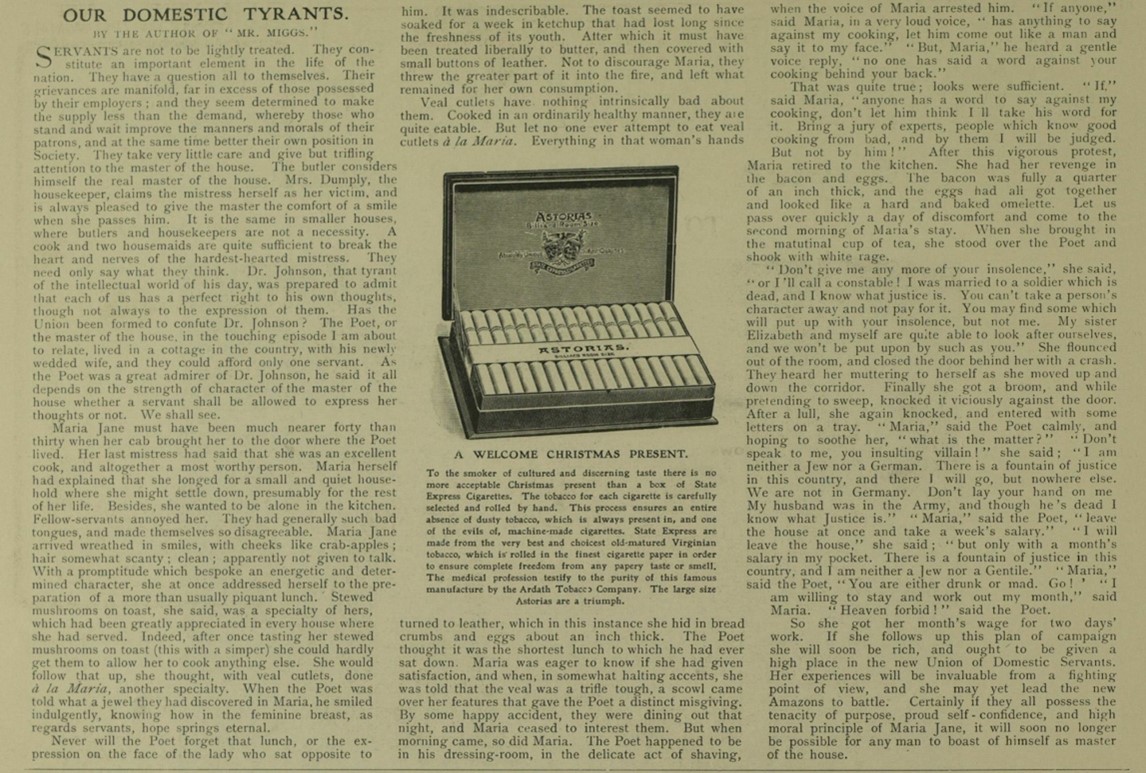
Servants are not to be lightly treated. They constitule an important element in the life of the nation. They have a question all to themselves. Their grievances are manifold, far in excess of those possessed by their employers; and they seem determined to make the supply less than the demand, whereby those who stand and wait improve the manners and morals of their patrons, and at the same time better their own position in etv. "They've take very little care and give but trifling attention to the master of the house. The butler considers himself the real master of the house. Mrs. Dumply, the housekeeper, claims the mistress herself as her victim, and is alwavs pleased to give the master the comfort of a smile when she passes him. It is the same in smaller houses, where butlers and housekeepers are not a necessity. A cook and two housemaids are quite sufficient to break the heart and nerves of the hardest-hearted mistress. They need only say what they think. Dr. Johnson, that tyrant of the intellectual world of his day, was prepared to admit that each of us has a perfect right to his own thoughts, though not always to the expression of them. Has the union been formed to confute Dr. Johnson ? The Poet, or the master of the house, in the touching episode I am about to relate, lived in a cottage in the country, with his newly wedded wife, and they could afford only one servant. As the Poet was a greal admirer of Dr. Johnson, he said it all depends on the strength of character of the master of the house whether a servant shall be allowed to express her thoughts or not. We shall see. Maria Jane must have been much nearer forty than thirty when her cab brought her to the door where the Poet lived. Her last mistress had said that she was an excellent cook, and altogether a most worthy person. Maria herself had explained that she longed for a small and quiet household where she might settle down, presumably for the rest of her life. Besides, she wanted to be alone in the kitchen. Fellow-servants annoyed her. They had generally such bad tongues, and made themselves so disagreeable. Maria Jane arrived wreathed in smiles, with cheeks like crab-apples; hair somewhat scanty ; clean; apparently not given to talk. With a promptitude which bespoke an energetic and determined character, she at once addressed herself to the preparation of a more than usually piquant lunch. Stewed mushrooms on toast, she said, was a specialty of hers, which had been greatly appreciated in every house where she had served. Indeed, after once tasting her stewed mushrooms on toast (this with a simper) she could hardly get them to allow her to cook anything else. She would follow that up, she thought, with veal cutlets, done a la Maria, another specialty. When the Poet was told what a jewel they had discovered in Maria, he smiled indulgently, knowing how in the feminine breast, as regards servants, hope springs eternal. Never will the Poet forget that lunch, or the expression on the face of the lady who sat opposite to,him. It was indescribable. The toast seemed to have soaked for a week in ketchup that had lost long since the freshness of its youth. After which it must have been treated liberally to butter, and then covered with small buttons of leather. Not to discourage Maria, they threw the greater part of it into the fire, and left what remained for her own consumption. Veal cutlets have nothing intrinsically bad about them. Cooked in an ordinarily healthy manner, they are quite eatable. But let no one ever attempt to eat veal cutlets a la Maria. Everything in that woman's hands, turned to leather, which in this instance she hid in bread crumbs and eggs about an inch thick. The Poet thought it was the shortest lunch to which he had ever sat down. Maria was eager to know if she had given satisfaction, and when, in somewhat halting accents, she was told that the veal was a trifle tough, a scowl came over her features that gave the Poet a distinct misgiving. By some happy accident, they were dining out that night, and Maria ceased to interest them. But when morning came, so did Maria. The Poet happened to be in his dressing-room, in the delicate act of shaving, when the voice of Maria arrested him. "If anyone," said Maria, in a very loud voice, "has anything to say against my cooking, let him come out like a man and say it to my face." " But, Maria," he heard a gentle voice reply, "no one has said a word against your cooking behind your back." That was quite true; looks were sufficient. "If," said Maria, "anyone has a word to say against my cooking, don't let him think I take his word for it. Bring a jury of experts, people which know good cooking from bad, and by them I will be judged. But not by him!" After this vigorous protest,
Maria retired to the kitchen. She had her revenge in the bacon and eggs. The bacon was fully a quarter of an inch thick, and the eggs had all got together and looked like a hard and baked omelette. Let us pass over quickly a day of discomfort and come to the second morning of Maria's stay. When she brought in the matutinal cup of tea, she stood over the Poet and shook with white rage. "Don't give me any more of your insolence," she said, "or I'll call a constable! I was married to a soldier which is dead, and I know what justice is. You can't take a person's character away and not pay for it. You may find some which will put up with your insolence, but not me. My sister Elizabeth and myself are quite able to look after ourselves, and we won't be put upon by such as you." She flounced out of the room, and closed the door behind her with a crash. They heard her muttering to herself as she moved up and down the corridor. Finally she got a broom, and while pretending to sweep, knocked it viciously against the door. After a lull, she again knocked, and entered with some letters on a tray. "Maria," said the Poet calmly, and hoping to soothe her, " what is the matter ? " " Don't speak to me, you insulting villain!" she said; "I am neither a Jew nor a German. There is a fountain of justice in this country, and there I will go, but nowhere else. We are not in Germany. Don't lay your hand on me My husband was in the Army, and though he's dead I know what Justice is." " Maria," said the Poet, " leave the house at once and take a week's salary." " I will leave the house," she said; " but only with a month's salary in my pocket. There is a fountain of justice in this country, and I am neither a Jew nor a Gentile." " Maria," said the Poet, "You are either drunk or mad. Go! ' "I,am willing to stay and work out my month," said Maria. " Heaven forbid! " said the Poet. So she got her month's wage for two days' work. If she follows up this plan of campaign she will soon be rich, and ought to be given a high place in the new Union of Domestic Servants. Her experiences will be invaluable from a fighting point of view, and she may yet lead the new Amazons to battle. Certainly if they all possess the tenacity of purpose, proud self-confidence, and high moral principle of Maria Jane, it will soon no longer be possible for any man to boast of himself as master of the house.
Maria retired to the kitchen. She had her revenge in the bacon and eggs. The bacon was fully a quarter of an inch thick, and the eggs had all got together and looked like a hard and baked omelette. Let us pass over quickly a day of discomfort and come to the second morning of Maria's stay. When she brought in the matutinal cup of tea, she stood over the Poet and shook with white rage. "Don't give me any more of your insolence," she said, "or I'll call a constable! I was married to a soldier which is dead, and I know what justice is. You can't take a person's character away and not pay for it. You may find some which will put up with your insolence, but not me. My sister Elizabeth and myself are quite able to look after ourselves, and we won't be put upon by such as you." She flounced out of the room, and closed the door behind her with a crash. They heard her muttering to herself as she moved up and down the corridor. Finally she got a broom, and while pretending to sweep, knocked it viciously against the door. After a lull, she again knocked, and entered with some letters on a tray. "Maria," said the Poet calmly, and hoping to soothe her, " what is the matter ? " " Don't speak to me, you insulting villain!" she said; "I am neither a Jew nor a German. There is a fountain of justice in this country, and there I will go, but nowhere else. We are not in Germany. Don't lay your hand on me My husband was in the Army, and though he's dead I know what Justice is." " Maria," said the Poet, " leave the house at once and take a week's salary." " I will leave the house," she said; " but only with a month's salary in my pocket. There is a fountain of justice in this country, and I am neither a Jew nor a Gentile." " Maria," said the Poet, "You are either drunk or mad. Go! ' "I,am willing to stay and work out my month," said Maria. " Heaven forbid! " said the Poet. So she got her month's wage for two days' work. If she follows up this plan of campaign she will soon be rich, and ought to be given a high place in the new Union of Domestic Servants. Her experiences will be invaluable from a fighting point of view, and she may yet lead the new Amazons to battle. Certainly if they all possess the tenacity of purpose, proud self-confidence, and high moral principle of Maria Jane, it will soon no longer be possible for any man to boast of himself as master of the house.
Original Format
Newspaper Article
Files
Collection
Citation
The London Illustrated News, “"Domestic Tyrants",” ENGL 433: A Seminar on Virginia Woolf and Modernism, accessed September 6, 2026, https://ctsdh.org/ENGL433/items/show/88.