
Britain the Enemy of Peace
Dublin Core
Title
Britain the Enemy of Peace
Description
A newspaper article published by The Times
Creator
Times Newspapers Limited: (from Our Correspondent)
Source
Gale Primary Sources: The Times Digital Archive
https://link.gale.com/apps/doc/CS118294081/TTDA?u=loyolau&sid=bookmark-TTDA&xid=30ea971b
https://link.gale.com/apps/doc/CS118294081/TTDA?u=loyolau&sid=bookmark-TTDA&xid=30ea971b
Type
Newspaper Article
Publisher
Gale Primary Sources
Date
Feb. 1, 1916
Contributor
Theo Gray
Subject
German commentary on the continuation of the First World War
Text Item Type Metadata
Text
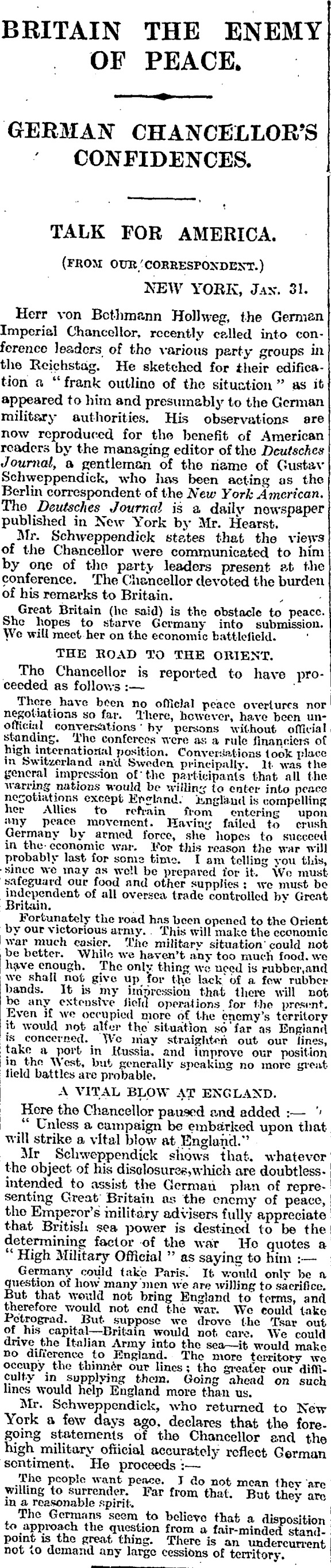
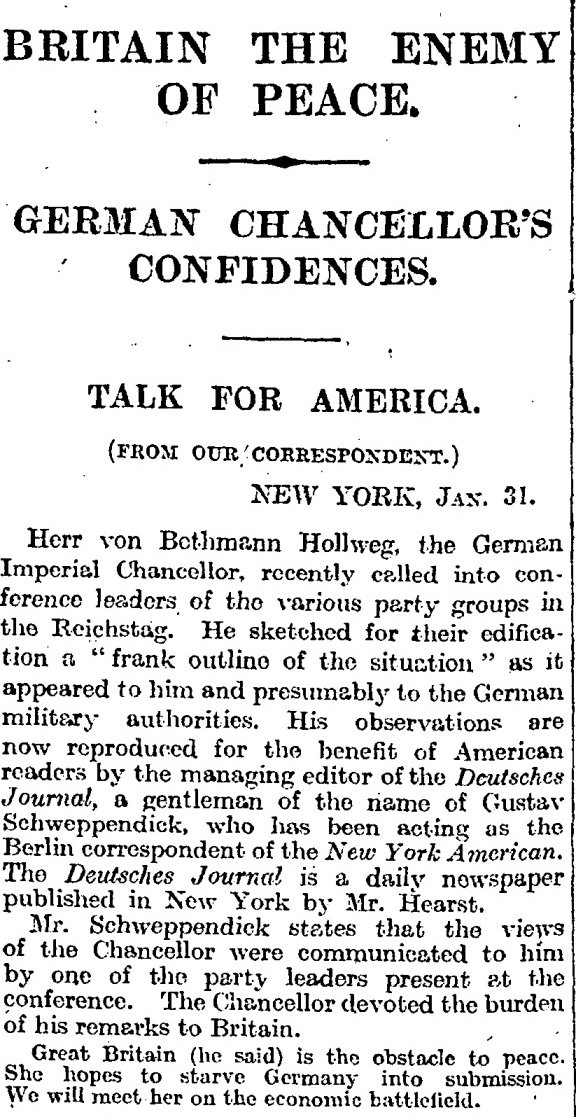
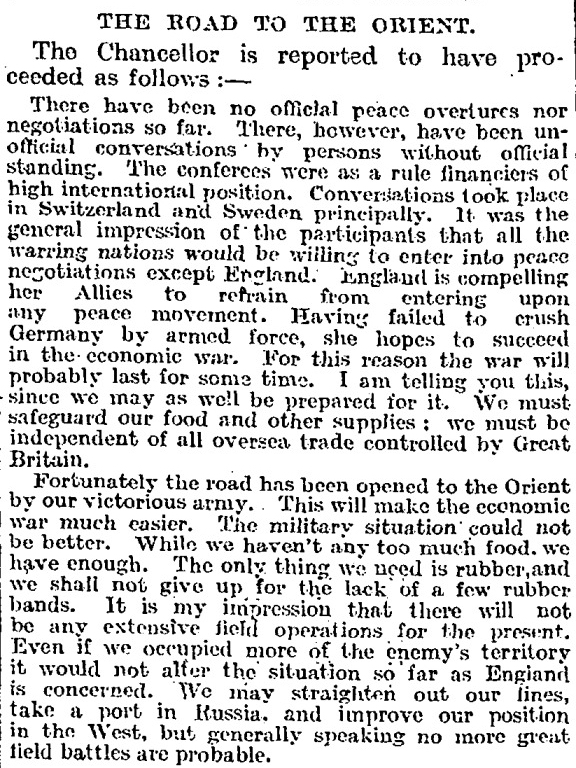
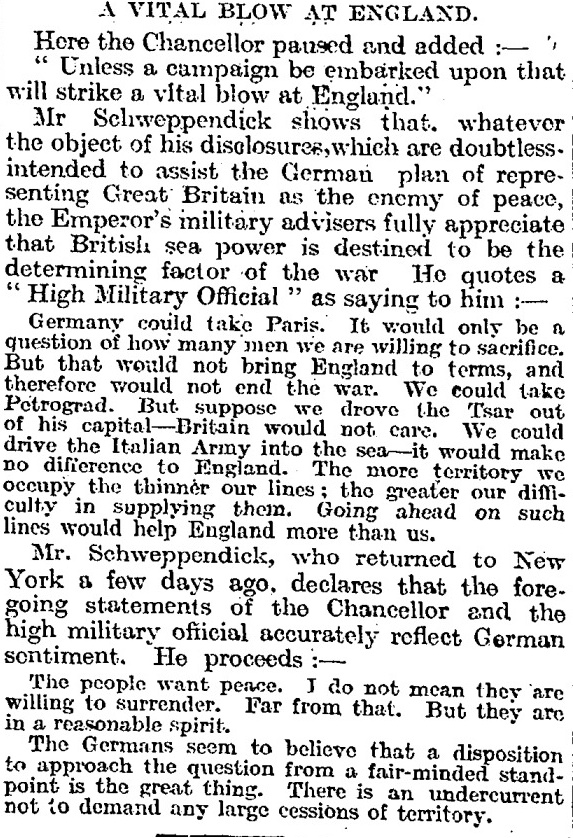
BRITAIN THE ENEM1Y,OF PEACE.,GERMAN CHANCELLORWS,CONFIDENCES.,TALK FOR AMERICA.,(FROMr OUm 'CORRESPOXDENT.),NEW YORK, JAs. 31.,Herr von Bet.hmann Holiweg, the Gerr;an Imperial Uhancellor, recently called into conference leaders of the various party groups il,the Reichstag. He sketched for thieir edification a "frank outline of the situation " as it appeared to him and presumably to the Gernian military aulthorities. His observations are now reproduced for the benefit of American readers by the managing editor of the Dculschcs Journal, a gentleman of the name of Gustav Schweppendick, who Ias been acting as the Berlin correspondent of the New Yorkc American. The Deusches Journal is a daily newspaper published in Newr York by 3Mr. Hearst.,Mr. Schweppendick states that the viewvs of the Chancellor were comraunicated to him by one of t.he party leaders present at the conference. The Chancellor (levoted the burden of his remarks to Britain.,Great Britain (be said) is the obstacle to peace. She hopes to starve Germany into submission. WVe wiU meet her on the economic battlefield.,THE ROAD TO THE ORIENT.,Tho Chancellor is reported to have proceeded as folloNvs:_,There have bein no official peacc overtures nor negotiations so far. There, lbowever, have been unotih:utl converszitions bv persons wvithout official standing. The conferees wnere as a rule financiers of high international position. Convernations took place ini Switzerland and Sweden pirincipally,. it. was the gencral impression of the participants that all the warring nations would be willing to ent-er into peace ne,,otiations except ErThland. hngla&ul is compelling lier Allies to retrain fi om entering luponI any peace movement. lTaving failed to eriush Germany by armed force, she hopes to succeed in th ceconomic war. For this reason the war will probably- last for soma timc. I am telling you this, since wv inay as wel& be prepared for it. iNe must safeguard our food and other supplies ere must be independent of all oversea trade controlled by Great Britain .,Fortunately the road has been opened to the Orient by our victorious amny. This will malec the economic ivar much ejsier. 'Ulie militarv situation could not be better. While wev haven't ;rnv too much food. we,siave enough. The only thing wo ueed is rubber,and we shall not givc up foi tlie laek' of a few rubber bands. It is my iinression that there will not be any extensive ic)ll operations for 1;he present. Even if we occupie(n more of thc evnemy's territory it woould not alf r the' situation so far as Engiandl is concerned. WVe miav straighten out our lines, take a port in Russia. an( itnprove our position in the West, but generally speaking no inore great held battles arc probable.,A VITAL BLOW AT ENGLAN;D. Here the Clhancellor paused and added," Unless a caimipaign be embarled upon that will strike a vItal blow at Englanid.",31r Scliweppendick shio'ws that. Nvhatever the object of his disalosurmp,which are doubtlessintended to assist the C'ernan plan of representing Great Britain as the enemy of peace, the Emperor's inilita.ry adx.isers fully appreciate that British sea power is destined to be the determining factor of the ivr Hie quotes a "High MIilitary Official " as sayin- to him:-,Germany coild take Paris. It vwould only be a question of hoiii mnany nien ive are wvilling to saerificc. But tbat would not bring England to terms, and therefore would not end the war. We eould take Petrograd. But. suppose we drove the Tsar out of his capital-Britain would not care. We could drive the Italian Atrmy into the sea-it would make no difierence to England. The nmore territory wve oceupy the thinner our lines; the greater onr diffleulty in supplying themn. Going ahead on such lines wvould help England more than us.,MIr. Schweppendick, who returned to New York a fewv days ago, declares that the foregoing statements of tho Chancellor and the high military ofiicial accurately reflect German sentiment. HIe proceeds,The people want pe.ace. I do not mean they'are willing to surrender. Far from that. But the'y are in a reasonable spirit.,The Germans seem to believe that a disposition to approach the qnestion from a fair-minded standpoint is the great thing. There is an undercurrent not .o demand any large cessions of territory.
Original Format
Newspaper
Files
Collection
Citation
Times Newspapers Limited: (from Our Correspondent), “Britain the Enemy of Peace,” ENGL 433: A Seminar on Virginia Woolf and Modernism, accessed September 6, 2026, https://ctsdh.org/ENGL433/items/show/66.