Small Tortoise-shell Butterfly
Dublin Core
Title
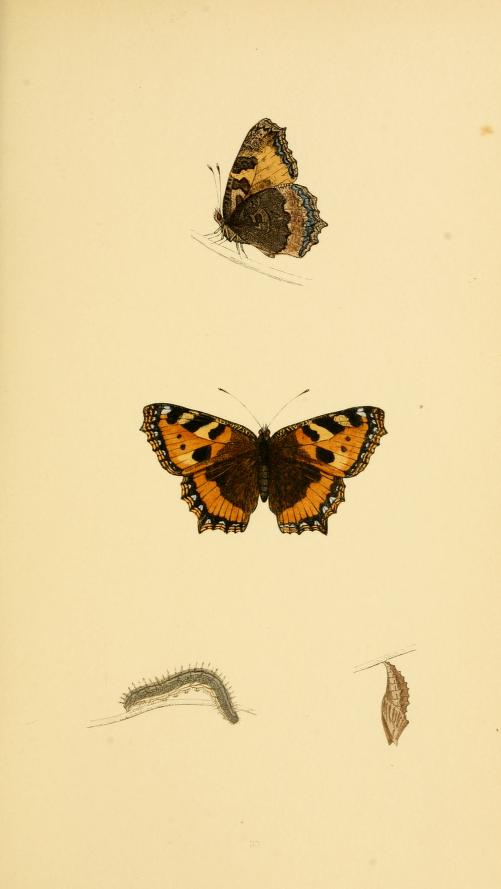
Small Tortoise-shell Butterfly
Description
Engraving and species entry printed in "A History of British Butterflies"
Creator
F. O. (Francis Orpen) Morris, 1810-1893
Source
Holding Institution: Smithsonian Libraries. Digital copy accessed through Biodiversity Heritage Library.
https://www.biodiversitylibrary.org/item/51338#page/142/mode/1up
Type
Book
Publisher
London: Groombridge and Sons.
Date
1853
Contributor
Sami Anders and Olivia Turner
Subject
Environmental Appendix
Rights
Copyright Status: Public domain. The BHL considers that this work is no longer under copyright protection.
Format
JPEG scans of paper book
Text Item Type Metadata
Text
72
SMALL TORTOLSE-SHELL.
PLATE XXX.
Vanessa urticae,
" "
Papilio urticae,
" "
Fabricius. Ochsenheimer. Stephens..
Duncan. Westwood.
Linnaeus. Lewin. Donovan.
Albin. Wilkes.
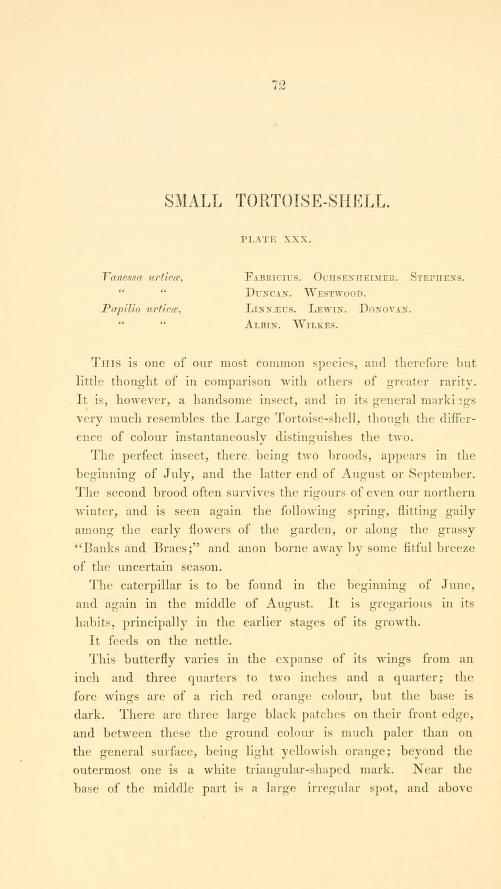
This is one of our most common species, and therefore but
little thought of in comparison with others of greater rarity.
It is, however, a handsome insect, and in its general markings
very much, resembles the Large Tortoise-shell, though the differ-
ence of colour instantaneously distinguishes the two.
The perfect insect, there being two broods, appears in the
beginning of July, and the latter end of August or September,
The second brood often survives the rigours of even our northern
winter, and is seen again the following spring, flitting gaily
among the early flowers of the garden, or along the grassy
"Banks and Braes;" and anon borne away by some fitful breeze
of the uncertain season.
The caterpillar is to be found in the beginning of June,
and again in the middle of August. It is gregarious in its
habits, principally in the earlier stages of its growth.
It feeds on the nettle.
This butterfly varies in the expanse of its wings from an
inch and three quarters to two inches and a quarter; the
fore wings are of a rich red orange colour, but the base is
dark. There are three large black patches on their front edge,
and between these the ground colour is much paler than on
the general surface, being light yellowish orange; beyond the
outermost one is a white triangular-shaped mark. Near the
base of the middle part is a large irregular spot, and above
SMALL TORTOISE-SHELL. 73
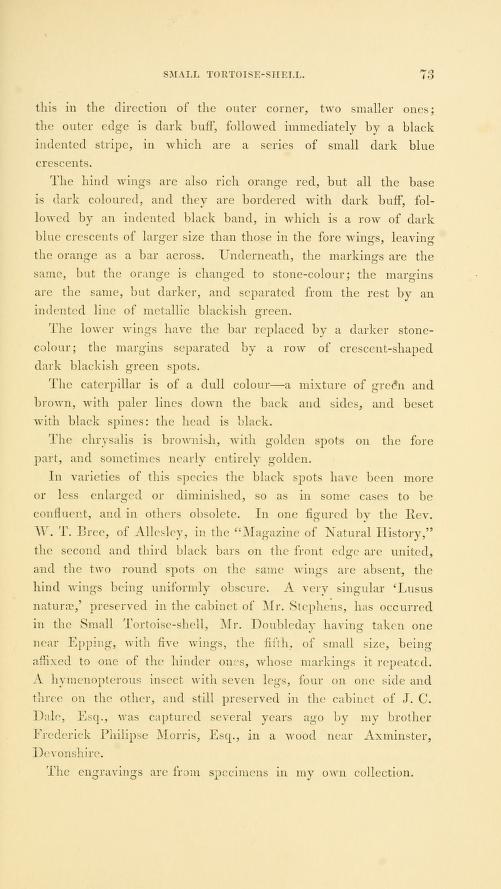
this in the direction of the outer corner, two smaller ones;
the outer edge is dark buff, followed immediately by a black
indented stripe, in which are a series of small dark blue
crescents.
The hind wings are also rich orange red, but all the base
is dark coloured, and they are bordered with dark buff, fol-
lowed by an indented black band, in which is a row of dark
blue crescents of larger size than those in the fore wings, leaving
the orange as a bar across. Underneath, the markings are the
same, but the orange is changed to stone-colour; the margins
are the same, but darker, and separated from the rest by an
indented line of metallic blackish green.
The lower wings have the bar replaced by a darker stone-
colour; the margins separated by a row of crescent-shaped
dark blackish green spots.
The caterpillar is of a dull colour — a mixture of green and
brown, with paler lines down the back and sides, and beset
with black spines: the head is black.
The chrysalis is brownish, with golden spots on the fore
part, and sometimes nearly entirely golden.
In varieties of this species the black spots have been more
or less enlarged or diminished, so as in some cases to be
confluent, and in others obsolete. In one figured by the Rev.
W. T. Bree, of Allesley, in the "Magazine of Natural History,"
the second and third black bars on the front edge are united,
and the two round spots on the same wings are absent, the
hind wings being uniformly obscure. A very singular 'Lusus
naturae,' preserved in the cabinet of Mr. Stephens, has occurred
in the Small Tortoise-shell, Mr. Doubleday having taken one
near Epping, with five wings, the fifth, of small size, being
affixed to one of the hinder ones, whose markings it repeated.
A hymenopterous insect with seven legs, four on one side and
three on the other, and still preserved in the cabinet of J. C.
Dale, Esq., was captured several years ago by my brother
Frederick Philipse Morris, Esq., in a wood near Axminster,
Devonshire.
The engravings are from specimens in my own collection.
SMALL TORTOLSE-SHELL.
PLATE XXX.
Vanessa urticae,
" "
Papilio urticae,
" "
Fabricius. Ochsenheimer. Stephens..
Duncan. Westwood.
Linnaeus. Lewin. Donovan.
Albin. Wilkes.
This is one of our most common species, and therefore but
little thought of in comparison with others of greater rarity.
It is, however, a handsome insect, and in its general markings
very much, resembles the Large Tortoise-shell, though the differ-
ence of colour instantaneously distinguishes the two.
The perfect insect, there being two broods, appears in the
beginning of July, and the latter end of August or September,
The second brood often survives the rigours of even our northern
winter, and is seen again the following spring, flitting gaily
among the early flowers of the garden, or along the grassy
"Banks and Braes;" and anon borne away by some fitful breeze
of the uncertain season.
The caterpillar is to be found in the beginning of June,
and again in the middle of August. It is gregarious in its
habits, principally in the earlier stages of its growth.
It feeds on the nettle.
This butterfly varies in the expanse of its wings from an
inch and three quarters to two inches and a quarter; the
fore wings are of a rich red orange colour, but the base is
dark. There are three large black patches on their front edge,
and between these the ground colour is much paler than on
the general surface, being light yellowish orange; beyond the
outermost one is a white triangular-shaped mark. Near the
base of the middle part is a large irregular spot, and above
SMALL TORTOISE-SHELL. 73
this in the direction of the outer corner, two smaller ones;
the outer edge is dark buff, followed immediately by a black
indented stripe, in which are a series of small dark blue
crescents.
The hind wings are also rich orange red, but all the base
is dark coloured, and they are bordered with dark buff, fol-
lowed by an indented black band, in which is a row of dark
blue crescents of larger size than those in the fore wings, leaving
the orange as a bar across. Underneath, the markings are the
same, but the orange is changed to stone-colour; the margins
are the same, but darker, and separated from the rest by an
indented line of metallic blackish green.
The lower wings have the bar replaced by a darker stone-
colour; the margins separated by a row of crescent-shaped
dark blackish green spots.
The caterpillar is of a dull colour — a mixture of green and
brown, with paler lines down the back and sides, and beset
with black spines: the head is black.
The chrysalis is brownish, with golden spots on the fore
part, and sometimes nearly entirely golden.
In varieties of this species the black spots have been more
or less enlarged or diminished, so as in some cases to be
confluent, and in others obsolete. In one figured by the Rev.
W. T. Bree, of Allesley, in the "Magazine of Natural History,"
the second and third black bars on the front edge are united,
and the two round spots on the same wings are absent, the
hind wings being uniformly obscure. A very singular 'Lusus
naturae,' preserved in the cabinet of Mr. Stephens, has occurred
in the Small Tortoise-shell, Mr. Doubleday having taken one
near Epping, with five wings, the fifth, of small size, being
affixed to one of the hinder ones, whose markings it repeated.
A hymenopterous insect with seven legs, four on one side and
three on the other, and still preserved in the cabinet of J. C.
Dale, Esq., was captured several years ago by my brother
Frederick Philipse Morris, Esq., in a wood near Axminster,
Devonshire.
The engravings are from specimens in my own collection.
Original Format
Engraving and print on paper
Files
Collection
Citation
F. O. (Francis Orpen) Morris, 1810-1893, “Small Tortoise-shell Butterfly,” ENGL 433: A Seminar on Virginia Woolf and Modernism, accessed September 6, 2026, https://ctsdh.org/ENGL433/items/show/17.