The misty Isle of Skye: its scenery, its people, its story. Chapter 1: Characteristics
Dublin Core
Title
The misty Isle of Skye: its scenery, its people, its story. Chapter 1: Characteristics
Description
Offers an overview of the geographic, climate, and cultural characteristics of the Isle of Skye.
Creator
J. A. MacCulloch (1868-1950)
Source
HathiTrust EBook, print book owned by Indiana University, https://hdl.handle.net/2027/inu.39000005762096
Type
Book, EBook
Publisher
Published in Edinburgh, by Oliphant.
Date
1910
Contributor
Sami Anders and Olivia Turner
Subject
Environmental Appendix
Rights
Public Domain in the United States, Google-digitized
Format
JPEG scans of print book
Language
English
Text Item Type Metadata
Text
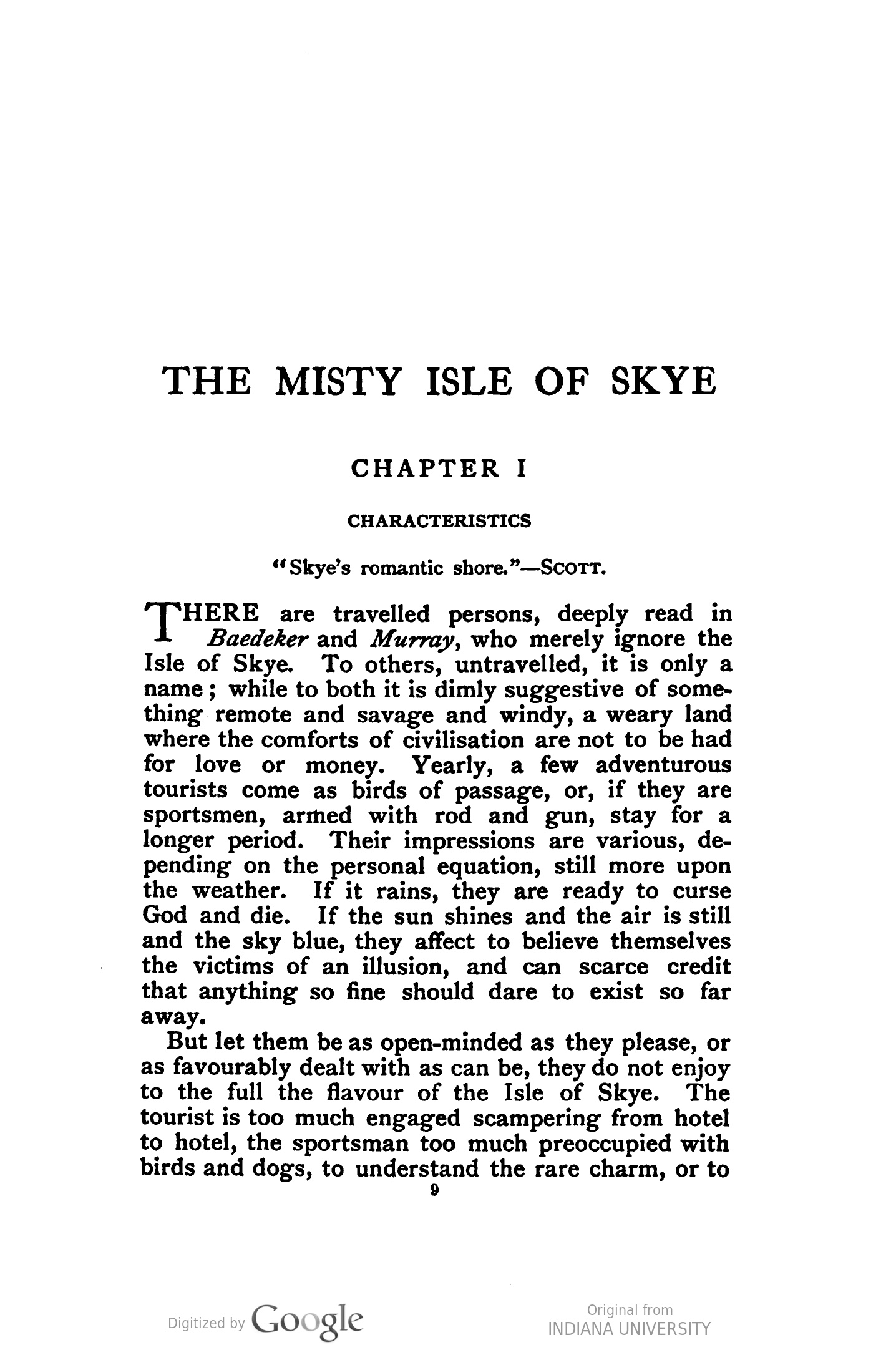
THE MISTY ISLE OF SKYE CHAPTER I CHARACTERISTICS “Skye's romantic shore.”—Scott. THERE are travelled persons, deeply read in 1 Baedeker and Murray, who merely ignore the Isle of Skye. To others, untravelled, it is only a name; while to both it is dimly suggestive of some- thing remote and savage and windy, a weary land where the comforts of civilisation are not to be had for love or money. Yearly, a few adventurous tourists come as birds of passage, or, if they are sportsmen, armed with rod and gun, stay for a longer period. Their impressions are various, de- pending on the personal equation, still more upon the weather. If it rains, they are ready to curse God and die. If the sun shines and the air is still and the sky blue, they affect to believe themselves the victims of an illusion, and can scarce credit that anything so fine should dare to exist so far away. But let them be as open-minded as they please, or as favourably dealt with as can be, they do not enjoy to the full the flavour of the Isle of Skye. The tourist is too much engaged scampering from hotel to hotel, the sportsman too much preoccupied with birds and dogs, to understand the rare charm, or to
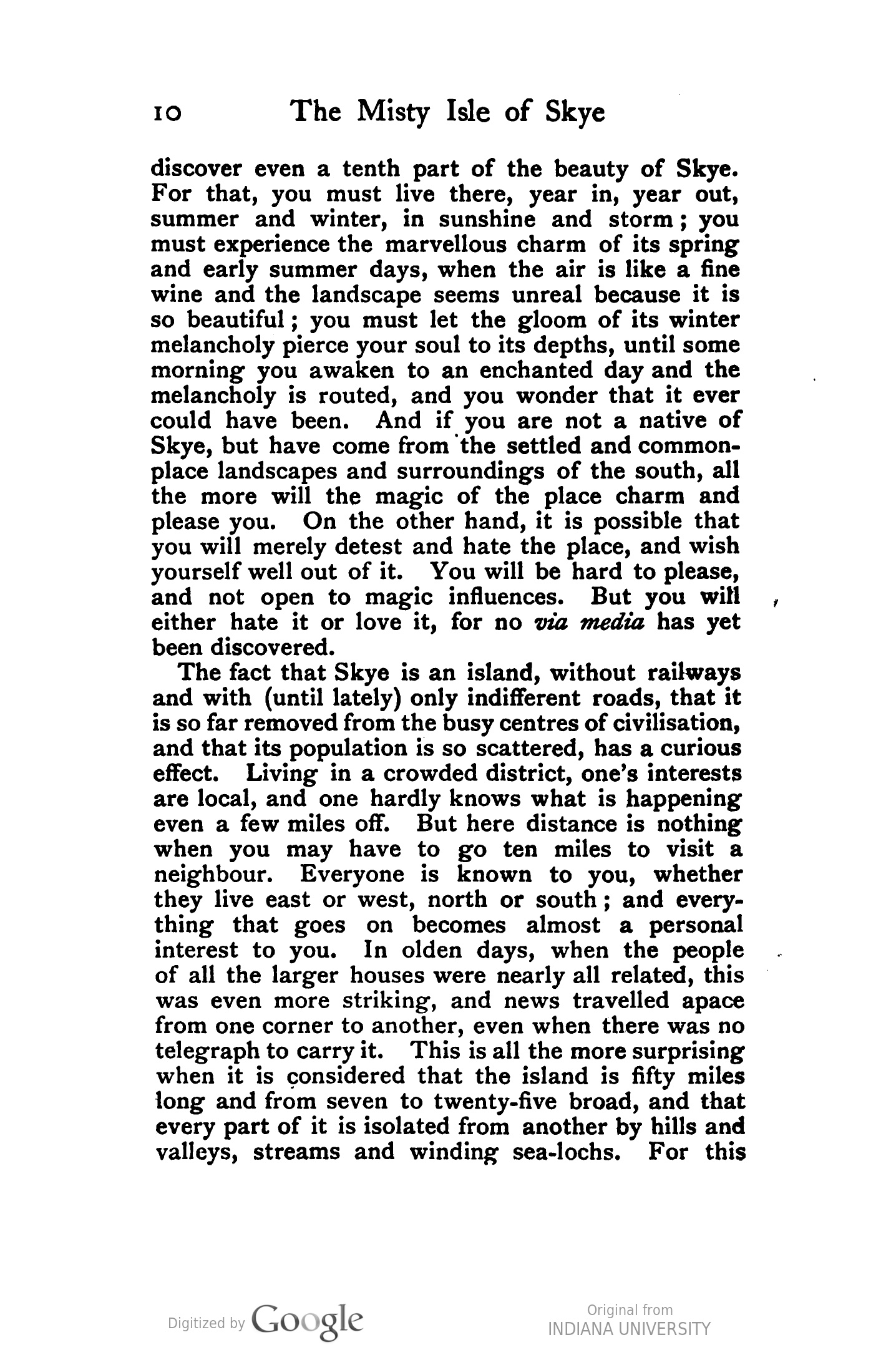
10 The Misty Isle of Skye discover even a tenth part of the beauty of Skye. For that, you must live there, year in, year out, summer and winter, in sunshine and storm; you must experience the marvellous charm of its spring and early summer days, when the air is like a fine wine and the landscape seems unreal because it is so beautiful ; you must let the gloom of its winter melancholy pierce your soul to its depths, until some morning you awaken to an enchanted day and the melancholy is routed, and you wonder that it ever could have been. And if you are not a native of Skye, but have come from the settled and common- place landscapes and surroundings of the south, all the more will the magic of the place charm and please you. On the other hand, it is possible that you will merely detest and hate the place, and wish yourself well out of it. You will be hard to please, and not open to magic influences. But you will either hate it or love it, for no via media has yet been discovered. The fact that Skye is an island, without railways and with (until lately) only indifferent roads, that it is so far removed from the busy centres of civilisation, and that its population is so scattered, has a curious effect. Living in a crowded district, one's interests are local, and one hardly knows what is happening even a few miles off. But here distance is nothing when you may have to go ten miles to visit a neighbour. Everyone is known to you, whether they live east or west, north or south ; and every- thing that goes on becomes almost a personal interest to you. In olden days, when the people of all the larger houses were nearly all related, this was even more striking, and news travelled apace from one corner to another, even when there was no telegraph to carry it. This is all the more surprising when it is considered that the island is fifty miles long and from seven to twenty-five broad, and that every part of it is isolated from another by hills and valleys, streams and winding sea-lochs. For this
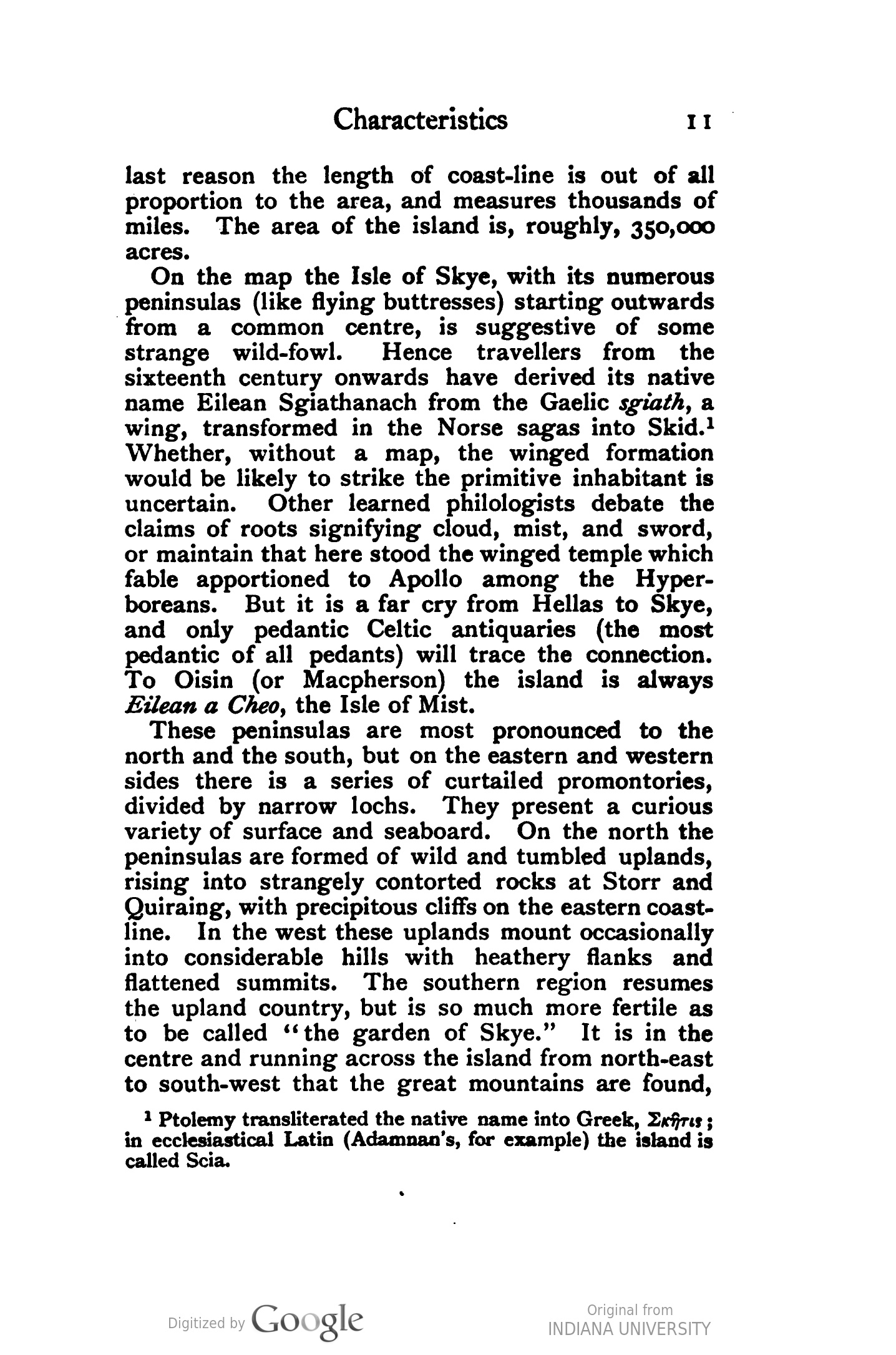
Characteristics Il last reason the length of coast-line is out of all proportion to the area, and measures thousands of miles. The area of the island is, roughly, 350,000 acres. On the map the Isle of Skye, with its numerous peninsulas (like flying buttresses) starting outwards from a common centre, is suggestive of some strange wild-fowl. Hence travellers from the sixteenth century onwards have derived its native name Eilean Sgiathanach from the Gaelic sgiath, a wing, transformed in the Norse sagas into Skid. 1 Whether, without a map, the winged formation would be likely to strike the primitive inhabitant is uncertain. Other learned philologists debate the claims of roots signifying cloud, mist, and sword, or maintain that here stood the winged temple which fable apportioned to Apollo among the Hyper- boreans. But it is a far cry from Hellas to Skye, and only pedantic Celtic antiquaries (the most pedantic of all pedants) will trace the connection. To Oisin (or Macpherson) the island is always Eilean a Cheo, the Isle of Mist. These peninsulas are most pronounced to the north and the south, but on the eastern and western sides there is a series of curtailed promontories, divided by narrow lochs. They present a curious variety of surface and seaboard. On the north the peninsulas are formed of wild and tumbled uplands, rising into strangely contorted rocks at Storr and Quiraing, with precipitous cliffs on the eastern coast- line. In the west these uplands mount occasionally into considerable hills with heathery flanks and flattened summits. The southern region resumes the upland country, but is so much more fertile as to be called “the garden of Skye.” It is in the centre and running across the island from north-east to south-west that the great mountains are found, 1 Ptolemy transliterated the native name into Greek, Kütus; in ecclesiastical Latin (Adamnan's, for example) the island is called Scia.
12 The Misty Isle of Skye rounded and massy and huddled together to the north-east; steep, precipitous, and splintered towards the south-west, where the Coolins dominate the land- scape for many a mile. All these breezy uplands are covered with heather and bent, bracken and bog-myrtle, which, on warm summer days, make the air fragrant with odorous scents such as Keats would have loved. They are given over to sheep, save where in more or less fertile patches the crofting population seek their livelihood from the soil. But they are empty solitudes where one may wander for a whole day and receive no human greeting. As far as eye can reach there are lines of gently swelling hills; you mount one, and still they deploy to the horizon, or suddenly lose them- selves in a narrow loch or the wider sea. Yet in this apparent monotony there is an in- finite variety. The summer glory of these uplands under a sapphire sky, surrounded by azure seas; their autumn and winter melancholy; the splintered summits looming grimly in the distance; here and there steep, windy headlands; green valleys with burns tinkling down to the sea ; the glorious tang of the breeze; the ever-changing mystic lights and shadows-these, with the hoary traditions and tales of eld which are suggested by them at every step, are pleasures which do not easily pall. Thus the Isle of Skye offers such a bundle of delights as are not easily found in any place even less remote than it is from the busy centres of life and the madding crowd. To the exterior eye it presents so many natural features that the bare catalogue of them bewilders, how much more does the joyous experience of them fascinate. Great basalt cliffs hang their steep castellated fronts above a brilliant green slope, and face the sea. From their top you gaze down a thousand feet into a vast abysmal depth of blue water, or across its sundering tide to the dark summits of the northern counties. Far out to sea on the western side are
Characteristics 13 purple islands gleaming on the horizon. Above you are the immeasurable spaces of the sky, across which a seabird now poises itself like some uncertain angel, and now darts off with an incredible swift- ness and dæmonic clamour. Here and there the sea sends long arms far inland, so that the unvoyaged islander (to whom Portree is a metropolis and Glasgow a merely mythical Babylon), confined to his moorland solitudes, can touch the pulse of the unseen and infinite ocean, on which stately ships are hurrying to far lands beyond the sunrise and the sunset, where are busy ports thronged with men and echoing with the hum of endless activity. To speak by the map and the geographer's compass, no part of the island, large as it is, lies four miles from the sea, so much is it broken up by these lochs winding in among the moors and the bases of the hills. This recurring presence of the sea has a strange fascina- tion for the mind. It presents itself in the most unexpected places. The solid masses of the Coolins, or the broad miles of rolling uplands, suggest a land free from these indentations and murmuring waters. But no; you have scarce proceeded half a league when you skirt the upper reaches of a sea-loch, and in the next mile or two you are walking by the edge of a second. Inland and around these lochs the billowy moor- land swells and falls, or mounts up into a con- siderable hill. From these hills the air comes pure from its high elevation and sweet with a hundred rustic odours of upland flowers. Its extent and its mysterious hollows, its black peat-hags, and its strange silence, suggest weird thoughts of ambushes, of hidden deeds, of brooding secrets, until you almost expect some voice, tired of its immemorial silence, to shout them aloud to all the winds. In summer and autumn the moor exhilarates with its omnipresent perfume wafted from bog-myrtle and bracken, while it seems to fling itself to the horizon in a purple garment dappled with emerald green.
14 The Misty Isle of Skye But in winter and early spring that green has become a wan white, and the purple has turned to a dingy brown, and the sombre landscape seems to speak of still deeper mysteries. Every varying expression of the face of the sky, its summer joy, its April doubt, its winter gloom, is reflected with conscientious exactness on this equally expressive moorland countenance. A great part of these uplands forms a rich and happy hunting-ground for the sportsman. Grouse, snipe, woodcock, and hares are found in plenty. Some of the loftier ground gives sanctuary to the red deer, with which the island must have teemed at one time, for in the sixteenth century organised hunts, in which a thousand head were killed, took place among the Red Hills. But the greater part of Skye is let out in sheep-farms, for, like the Homeric Ithaca, it is a pasture - land of sheep, and more pleasant in my sight than one that pastureth horses; for of all the isles that lie and lean upon the sea, none are fit for the driving of horses, or rich in meadow- land, and least of all is Ithaca. The pasture is scanty enough in winter, when the uplands are like a moist sponge with the rains; and the bulk of the hoggs have to be sent to the mainland in autumn, to return in spring, but, like the daffodil, “before the swallow does." Here, too, are none of the active, shaggy, goat-like sheep of Uist and St. Kilda; only the familiar black-face and Cheviot ; but the flavour of their flesh has gained something, and the fame of Skye mutton has passed into a proverb. The crofters, who covet earnestly the best land and would seize it, if they could, re- gardless of ownership, hate sheep-farms and sheep alike, and, in their native Gaelic, which I translate for the mere Sassenach, describe the animals as “ beastly brutes of poll-heads.” As for their language towards farmers and lairds, let the rest be silence! Large fortunes were once amassed 1 Odyssey, iv. 610, Lang's translation.
Characteristics 15 by Skye farmers, and more than one small tenant- farmer, beginning in a humble way, has found himself in the glorious company of the nouveaux riches before he died. But the day for that is over, and much more modest returns must be looked for. Of the hills and mountains of Skye there will be much to say. It is enough here to recall their haunting presence, their magic lights, the solemn grandeur and beauty that is theirs at all times of the year. You look at them across the wide moors, and they touch the last cloud upon the level sky. Steeped in moonlight or clad in glittering snow under a cloudless sky, they seem ethereal, trans- parent. At dawn and sunset, every scaur and hollow, every corrie and precipice, has all the definite clearness of a fine steel engraving. Or when wreaths of mist roll along their flanks, or cloud-masses huddle together around them, they are still grand and impressive. Seeing them under these varied conditions, and with ever-changing nuances of light or colour, you would vow there are no such hills elsewhere. Those who have not so seen them will scoff-and no doubt the vow marks the insular mind; but what is their sneer against the opinion of an eye-witness? Again, there is infinite delight in the colours of the landscape. Mostly these are what the indif- ferent would call sad and monotonous. Yet can the keen eye discover something richer. Even in winter there is variety, and there is a gorgeousness about the moors and the hillsides, when late autumn turns the bracken to a rich brown, and the sun casts blue shadows everywhere, which is not to be gainsaid. Often, too, at high summer noontides there comes a blue Italian sky, which is at once discredited by those who do not know the island when they see it reproduced by the artist. Then the sea is turned to a deeper azure, flecked with whitest foam where it swings unceasingly against the cliffs. The seabird, poising itself overhead,
16 The Misty Isle of Skye has wings of transparent alabaster, through which the blue heaven seems almost visible. Ireland itself cannot have greener valleys than Skye; nor could the choicest English woodland or meadow boast a richer variety or a greater luxuriance of wildflowers. And if the air is still, and you have risen with the lark, and inhaled the rich odour of the moorland air, you will say that nature looks as fresh and as young as it first did on the seventh morning before Paradise had been lost. As day wears on, the blaze of sunshine touches everything with a dull burnish of gold. The island is indolent as ever was the land of the lotus-eaters, and there is no mountain nor crag but has lost its ruggedness and now seems voluptuous with gentle swellings and softened curves. Yet it would be futile to deny the desolation of Skye in some of its aspects. Let the clouds hang low down overhead and everywhere around on a short winter day, as if they would crush the land ; let the rain fall in blinding torrents for weeks, and the morning dawn cheerless over a dripping land. scape ; let the wind rave across the moorland with pitiless incessancy; and let there be the least melancholy in your heart, and then you will know something of the abomination of desolation. You will understand “that distress” (of which Mau- passant writes so grimly) “which sometimes seizes travellers on certain sad evenings, in certain desolate places. It seems that everything is near its ending -existence and the universe itself. You perceive sharply the dreadful misery of life, the isolation of everyone, the nothingness of all things, and the black loneliness of the heart which nurses itself and deceives itself with dreams until the hour of death." So it is, sometimes, in Skye; until there comes a day of sunshine, and all is forgotten, and the desolation passes away as if it had never been. Throughout the island are many houses, bare, unattractive, but strong stone structures, the homes
Characteristics 17 of many generations, standing solitary on the moor, or hidden away under the kindly fold of a hill. To live in them is to call up a hundred phantoms of the past, to touch bygone years, to listen unawares to Time's stolen flight. Nor is there wanting a sense of depression as one thinks how these walls once held so many who have now fallen on sleep. No old house is ever without these sad memories and pallid gleams of past years. But the vast solitudes in which these Skye houses are set, the miles of road traversed to approach them, the brooding silence that hangs around their walls, as if pregnant with some mystery which is always on the point of being revealed, intensify this haunting sense of those who made them their caravanserai. There, in years gone by, the gentlemen tacksmen, cadets sometimes of the great houses, dwelt, and their sons went forth to fight the battles of their country. From one of them it is said that more officers came during the Peninsular War than from any other single house in the British Empire. Many of these houses' are small, and but little better than cottages. They could have contained but few of the luxuries of life; yet from them came scores of the brave soldiers and builders of our empire, and they were often lit up by festive occasions, the dance, the cheerful laughter of unencumbered hearts, the smiles of fair women. Boswell's Journal of the famous tour shows at once the comfort in discomfort which prevailed, and contains many a picture of the happy houseful of friends, who were mostly kinsmen, crowded into a few small rooms, where constant good-humour, aided (can we doubt it) by copious drams, prevailed. The grey and brown landscape seems to forbid such prettiness in architecture as the Swiss châlet, hanging on the mountain-side, exhibits. The crofter's hut, with its low, lichen-covered walls, and its roof thatched with the materials of the surrounding moor, seems to have grown out of its surroundings. It is a product of nature, not of
18 The Misty Isle of Skye art, or rather of the artificer. It rhymes with the sober landscape, and partakes of its shaggy wildness. Even the larger houses have the same unadorned character, plain grey stone walls, four square gables, built for use not beauty. Such a castle as Dunvegan has the same natural appear- ance as these small unarchitectural attempts at house-building. It forms no break in the landscape, but seems only a more shapely form of the rock on which it stands. No bird-haunted lawns, no terraces and stairways, separate stately decorated walls from the surrounding landscape. Grim keep and ancient tower and worn battlements join hand-in- hand with the brown moorland, the shaggy wood- land, and the lapping waves. They who reared it in centuries gone by “built better than they knew," or else had a true sense of the relation of art and nature to each other. But there is a still more remote antiquity than those old stone walls hint of. There are ruined heaps on windy hillocks; mounds of stone under- neath which lie the mighty bones of ancient men, old knights; a few roughly sculptured monuments. They speak silently of old, unhappy, far-of things, and of unremembered wars, which have left no record in history, scarce even has their faint echo been preserved in local tradition. The moor-bird flies around them with its wailing cry, as if regret- ting old mortality, but of the men who placed them there or whose deeds they commemorate, the rest is silence. Norse names, especially in the north and west, testify to raids by these ancient sea-wolves, and of a Scandinavian occupation long enough to have made itself felt in the nomenclature, though it scarcely survives in race. History speaks of Haco and his fleet, and Kyleakin is Haco's Strait; but tradition is once more silent, leaving to the philologist the task of explaining the place names by Norwegian parallels. Of the race earlier than the Celtic — Neolithic,
Characteristics 19 possibly Pictish–there remain still scantier traces, whether of their social life, their manners, or their religion. Yet in these green valleys and along the shores of the sea-lochs they must have formed a dense population. There are to be seen, not plenti- fully but occasionally, “Picts' houses,” stone circles, and burial-chambers, and at times the arms and utensils of these early generations are dug out of the peat. They speak dumbly of the manners and customs of a far-distant past, and hint to us moderns that the same human heart beat then, and cherished such hopes and fears, such loves and hates, then, as it does now. And the story of the rocks of Skye carries the mind back to an unpeopled and illimitable past. Ice-scratched cliffs, rôches - moutonnées, beds of boulder clay, tell of the time when vast glaciers crept down these green valleys to the outer sea. The terraced uplands, the purple Coolins, and the Red Hills, carry us over millions of years to the Tertiary period, when great plateaux of lava were laid down, and within and beneath them internal outbursts took place through an enormous period of time. Beneath these lie beds of strata, crowded with fossils, witnessing to ages of submersion when the island lay beneath the midmost sea. Thus, in Skye, antiquity accompanies one at every step, and the mind has a liberal choice of bygone ages to revel in, from the romantic days of Prince Charlie back through the voiceless generations to those dim ages when the island was built up, stratum by stratum, out of the unknown deep.
10 The Misty Isle of Skye discover even a tenth part of the beauty of Skye. For that, you must live there, year in, year out, summer and winter, in sunshine and storm; you must experience the marvellous charm of its spring and early summer days, when the air is like a fine wine and the landscape seems unreal because it is so beautiful ; you must let the gloom of its winter melancholy pierce your soul to its depths, until some morning you awaken to an enchanted day and the melancholy is routed, and you wonder that it ever could have been. And if you are not a native of Skye, but have come from the settled and common- place landscapes and surroundings of the south, all the more will the magic of the place charm and please you. On the other hand, it is possible that you will merely detest and hate the place, and wish yourself well out of it. You will be hard to please, and not open to magic influences. But you will either hate it or love it, for no via media has yet been discovered. The fact that Skye is an island, without railways and with (until lately) only indifferent roads, that it is so far removed from the busy centres of civilisation, and that its population is so scattered, has a curious effect. Living in a crowded district, one's interests are local, and one hardly knows what is happening even a few miles off. But here distance is nothing when you may have to go ten miles to visit a neighbour. Everyone is known to you, whether they live east or west, north or south ; and every- thing that goes on becomes almost a personal interest to you. In olden days, when the people of all the larger houses were nearly all related, this was even more striking, and news travelled apace from one corner to another, even when there was no telegraph to carry it. This is all the more surprising when it is considered that the island is fifty miles long and from seven to twenty-five broad, and that every part of it is isolated from another by hills and valleys, streams and winding sea-lochs. For this
Characteristics Il last reason the length of coast-line is out of all proportion to the area, and measures thousands of miles. The area of the island is, roughly, 350,000 acres. On the map the Isle of Skye, with its numerous peninsulas (like flying buttresses) starting outwards from a common centre, is suggestive of some strange wild-fowl. Hence travellers from the sixteenth century onwards have derived its native name Eilean Sgiathanach from the Gaelic sgiath, a wing, transformed in the Norse sagas into Skid. 1 Whether, without a map, the winged formation would be likely to strike the primitive inhabitant is uncertain. Other learned philologists debate the claims of roots signifying cloud, mist, and sword, or maintain that here stood the winged temple which fable apportioned to Apollo among the Hyper- boreans. But it is a far cry from Hellas to Skye, and only pedantic Celtic antiquaries (the most pedantic of all pedants) will trace the connection. To Oisin (or Macpherson) the island is always Eilean a Cheo, the Isle of Mist. These peninsulas are most pronounced to the north and the south, but on the eastern and western sides there is a series of curtailed promontories, divided by narrow lochs. They present a curious variety of surface and seaboard. On the north the peninsulas are formed of wild and tumbled uplands, rising into strangely contorted rocks at Storr and Quiraing, with precipitous cliffs on the eastern coast- line. In the west these uplands mount occasionally into considerable hills with heathery flanks and flattened summits. The southern region resumes the upland country, but is so much more fertile as to be called “the garden of Skye.” It is in the centre and running across the island from north-east to south-west that the great mountains are found, 1 Ptolemy transliterated the native name into Greek, Kütus; in ecclesiastical Latin (Adamnan's, for example) the island is called Scia.
12 The Misty Isle of Skye rounded and massy and huddled together to the north-east; steep, precipitous, and splintered towards the south-west, where the Coolins dominate the land- scape for many a mile. All these breezy uplands are covered with heather and bent, bracken and bog-myrtle, which, on warm summer days, make the air fragrant with odorous scents such as Keats would have loved. They are given over to sheep, save where in more or less fertile patches the crofting population seek their livelihood from the soil. But they are empty solitudes where one may wander for a whole day and receive no human greeting. As far as eye can reach there are lines of gently swelling hills; you mount one, and still they deploy to the horizon, or suddenly lose them- selves in a narrow loch or the wider sea. Yet in this apparent monotony there is an in- finite variety. The summer glory of these uplands under a sapphire sky, surrounded by azure seas; their autumn and winter melancholy; the splintered summits looming grimly in the distance; here and there steep, windy headlands; green valleys with burns tinkling down to the sea ; the glorious tang of the breeze; the ever-changing mystic lights and shadows-these, with the hoary traditions and tales of eld which are suggested by them at every step, are pleasures which do not easily pall. Thus the Isle of Skye offers such a bundle of delights as are not easily found in any place even less remote than it is from the busy centres of life and the madding crowd. To the exterior eye it presents so many natural features that the bare catalogue of them bewilders, how much more does the joyous experience of them fascinate. Great basalt cliffs hang their steep castellated fronts above a brilliant green slope, and face the sea. From their top you gaze down a thousand feet into a vast abysmal depth of blue water, or across its sundering tide to the dark summits of the northern counties. Far out to sea on the western side are
Characteristics 13 purple islands gleaming on the horizon. Above you are the immeasurable spaces of the sky, across which a seabird now poises itself like some uncertain angel, and now darts off with an incredible swift- ness and dæmonic clamour. Here and there the sea sends long arms far inland, so that the unvoyaged islander (to whom Portree is a metropolis and Glasgow a merely mythical Babylon), confined to his moorland solitudes, can touch the pulse of the unseen and infinite ocean, on which stately ships are hurrying to far lands beyond the sunrise and the sunset, where are busy ports thronged with men and echoing with the hum of endless activity. To speak by the map and the geographer's compass, no part of the island, large as it is, lies four miles from the sea, so much is it broken up by these lochs winding in among the moors and the bases of the hills. This recurring presence of the sea has a strange fascina- tion for the mind. It presents itself in the most unexpected places. The solid masses of the Coolins, or the broad miles of rolling uplands, suggest a land free from these indentations and murmuring waters. But no; you have scarce proceeded half a league when you skirt the upper reaches of a sea-loch, and in the next mile or two you are walking by the edge of a second. Inland and around these lochs the billowy moor- land swells and falls, or mounts up into a con- siderable hill. From these hills the air comes pure from its high elevation and sweet with a hundred rustic odours of upland flowers. Its extent and its mysterious hollows, its black peat-hags, and its strange silence, suggest weird thoughts of ambushes, of hidden deeds, of brooding secrets, until you almost expect some voice, tired of its immemorial silence, to shout them aloud to all the winds. In summer and autumn the moor exhilarates with its omnipresent perfume wafted from bog-myrtle and bracken, while it seems to fling itself to the horizon in a purple garment dappled with emerald green.
14 The Misty Isle of Skye But in winter and early spring that green has become a wan white, and the purple has turned to a dingy brown, and the sombre landscape seems to speak of still deeper mysteries. Every varying expression of the face of the sky, its summer joy, its April doubt, its winter gloom, is reflected with conscientious exactness on this equally expressive moorland countenance. A great part of these uplands forms a rich and happy hunting-ground for the sportsman. Grouse, snipe, woodcock, and hares are found in plenty. Some of the loftier ground gives sanctuary to the red deer, with which the island must have teemed at one time, for in the sixteenth century organised hunts, in which a thousand head were killed, took place among the Red Hills. But the greater part of Skye is let out in sheep-farms, for, like the Homeric Ithaca, it is a pasture - land of sheep, and more pleasant in my sight than one that pastureth horses; for of all the isles that lie and lean upon the sea, none are fit for the driving of horses, or rich in meadow- land, and least of all is Ithaca. The pasture is scanty enough in winter, when the uplands are like a moist sponge with the rains; and the bulk of the hoggs have to be sent to the mainland in autumn, to return in spring, but, like the daffodil, “before the swallow does." Here, too, are none of the active, shaggy, goat-like sheep of Uist and St. Kilda; only the familiar black-face and Cheviot ; but the flavour of their flesh has gained something, and the fame of Skye mutton has passed into a proverb. The crofters, who covet earnestly the best land and would seize it, if they could, re- gardless of ownership, hate sheep-farms and sheep alike, and, in their native Gaelic, which I translate for the mere Sassenach, describe the animals as “ beastly brutes of poll-heads.” As for their language towards farmers and lairds, let the rest be silence! Large fortunes were once amassed 1 Odyssey, iv. 610, Lang's translation.
Characteristics 15 by Skye farmers, and more than one small tenant- farmer, beginning in a humble way, has found himself in the glorious company of the nouveaux riches before he died. But the day for that is over, and much more modest returns must be looked for. Of the hills and mountains of Skye there will be much to say. It is enough here to recall their haunting presence, their magic lights, the solemn grandeur and beauty that is theirs at all times of the year. You look at them across the wide moors, and they touch the last cloud upon the level sky. Steeped in moonlight or clad in glittering snow under a cloudless sky, they seem ethereal, trans- parent. At dawn and sunset, every scaur and hollow, every corrie and precipice, has all the definite clearness of a fine steel engraving. Or when wreaths of mist roll along their flanks, or cloud-masses huddle together around them, they are still grand and impressive. Seeing them under these varied conditions, and with ever-changing nuances of light or colour, you would vow there are no such hills elsewhere. Those who have not so seen them will scoff-and no doubt the vow marks the insular mind; but what is their sneer against the opinion of an eye-witness? Again, there is infinite delight in the colours of the landscape. Mostly these are what the indif- ferent would call sad and monotonous. Yet can the keen eye discover something richer. Even in winter there is variety, and there is a gorgeousness about the moors and the hillsides, when late autumn turns the bracken to a rich brown, and the sun casts blue shadows everywhere, which is not to be gainsaid. Often, too, at high summer noontides there comes a blue Italian sky, which is at once discredited by those who do not know the island when they see it reproduced by the artist. Then the sea is turned to a deeper azure, flecked with whitest foam where it swings unceasingly against the cliffs. The seabird, poising itself overhead,
16 The Misty Isle of Skye has wings of transparent alabaster, through which the blue heaven seems almost visible. Ireland itself cannot have greener valleys than Skye; nor could the choicest English woodland or meadow boast a richer variety or a greater luxuriance of wildflowers. And if the air is still, and you have risen with the lark, and inhaled the rich odour of the moorland air, you will say that nature looks as fresh and as young as it first did on the seventh morning before Paradise had been lost. As day wears on, the blaze of sunshine touches everything with a dull burnish of gold. The island is indolent as ever was the land of the lotus-eaters, and there is no mountain nor crag but has lost its ruggedness and now seems voluptuous with gentle swellings and softened curves. Yet it would be futile to deny the desolation of Skye in some of its aspects. Let the clouds hang low down overhead and everywhere around on a short winter day, as if they would crush the land ; let the rain fall in blinding torrents for weeks, and the morning dawn cheerless over a dripping land. scape ; let the wind rave across the moorland with pitiless incessancy; and let there be the least melancholy in your heart, and then you will know something of the abomination of desolation. You will understand “that distress” (of which Mau- passant writes so grimly) “which sometimes seizes travellers on certain sad evenings, in certain desolate places. It seems that everything is near its ending -existence and the universe itself. You perceive sharply the dreadful misery of life, the isolation of everyone, the nothingness of all things, and the black loneliness of the heart which nurses itself and deceives itself with dreams until the hour of death." So it is, sometimes, in Skye; until there comes a day of sunshine, and all is forgotten, and the desolation passes away as if it had never been. Throughout the island are many houses, bare, unattractive, but strong stone structures, the homes
Characteristics 17 of many generations, standing solitary on the moor, or hidden away under the kindly fold of a hill. To live in them is to call up a hundred phantoms of the past, to touch bygone years, to listen unawares to Time's stolen flight. Nor is there wanting a sense of depression as one thinks how these walls once held so many who have now fallen on sleep. No old house is ever without these sad memories and pallid gleams of past years. But the vast solitudes in which these Skye houses are set, the miles of road traversed to approach them, the brooding silence that hangs around their walls, as if pregnant with some mystery which is always on the point of being revealed, intensify this haunting sense of those who made them their caravanserai. There, in years gone by, the gentlemen tacksmen, cadets sometimes of the great houses, dwelt, and their sons went forth to fight the battles of their country. From one of them it is said that more officers came during the Peninsular War than from any other single house in the British Empire. Many of these houses' are small, and but little better than cottages. They could have contained but few of the luxuries of life; yet from them came scores of the brave soldiers and builders of our empire, and they were often lit up by festive occasions, the dance, the cheerful laughter of unencumbered hearts, the smiles of fair women. Boswell's Journal of the famous tour shows at once the comfort in discomfort which prevailed, and contains many a picture of the happy houseful of friends, who were mostly kinsmen, crowded into a few small rooms, where constant good-humour, aided (can we doubt it) by copious drams, prevailed. The grey and brown landscape seems to forbid such prettiness in architecture as the Swiss châlet, hanging on the mountain-side, exhibits. The crofter's hut, with its low, lichen-covered walls, and its roof thatched with the materials of the surrounding moor, seems to have grown out of its surroundings. It is a product of nature, not of
18 The Misty Isle of Skye art, or rather of the artificer. It rhymes with the sober landscape, and partakes of its shaggy wildness. Even the larger houses have the same unadorned character, plain grey stone walls, four square gables, built for use not beauty. Such a castle as Dunvegan has the same natural appear- ance as these small unarchitectural attempts at house-building. It forms no break in the landscape, but seems only a more shapely form of the rock on which it stands. No bird-haunted lawns, no terraces and stairways, separate stately decorated walls from the surrounding landscape. Grim keep and ancient tower and worn battlements join hand-in- hand with the brown moorland, the shaggy wood- land, and the lapping waves. They who reared it in centuries gone by “built better than they knew," or else had a true sense of the relation of art and nature to each other. But there is a still more remote antiquity than those old stone walls hint of. There are ruined heaps on windy hillocks; mounds of stone under- neath which lie the mighty bones of ancient men, old knights; a few roughly sculptured monuments. They speak silently of old, unhappy, far-of things, and of unremembered wars, which have left no record in history, scarce even has their faint echo been preserved in local tradition. The moor-bird flies around them with its wailing cry, as if regret- ting old mortality, but of the men who placed them there or whose deeds they commemorate, the rest is silence. Norse names, especially in the north and west, testify to raids by these ancient sea-wolves, and of a Scandinavian occupation long enough to have made itself felt in the nomenclature, though it scarcely survives in race. History speaks of Haco and his fleet, and Kyleakin is Haco's Strait; but tradition is once more silent, leaving to the philologist the task of explaining the place names by Norwegian parallels. Of the race earlier than the Celtic — Neolithic,
Characteristics 19 possibly Pictish–there remain still scantier traces, whether of their social life, their manners, or their religion. Yet in these green valleys and along the shores of the sea-lochs they must have formed a dense population. There are to be seen, not plenti- fully but occasionally, “Picts' houses,” stone circles, and burial-chambers, and at times the arms and utensils of these early generations are dug out of the peat. They speak dumbly of the manners and customs of a far-distant past, and hint to us moderns that the same human heart beat then, and cherished such hopes and fears, such loves and hates, then, as it does now. And the story of the rocks of Skye carries the mind back to an unpeopled and illimitable past. Ice-scratched cliffs, rôches - moutonnées, beds of boulder clay, tell of the time when vast glaciers crept down these green valleys to the outer sea. The terraced uplands, the purple Coolins, and the Red Hills, carry us over millions of years to the Tertiary period, when great plateaux of lava were laid down, and within and beneath them internal outbursts took place through an enormous period of time. Beneath these lie beds of strata, crowded with fossils, witnessing to ages of submersion when the island lay beneath the midmost sea. Thus, in Skye, antiquity accompanies one at every step, and the mind has a liberal choice of bygone ages to revel in, from the romantic days of Prince Charlie back through the voiceless generations to those dim ages when the island was built up, stratum by stratum, out of the unknown deep.
Original Format
Paper book, 320 pages total. Chapter one included here, pp. 9-19.
Files
Collection
Citation
J. A. MacCulloch (1868-1950), “The misty Isle of Skye: its scenery, its people, its story. Chapter 1: Characteristics,” ENGL 433: A Seminar on Virginia Woolf and Modernism, accessed September 6, 2026, https://ctsdh.org/ENGL433/items/show/60.