Cambridge County Geographies: Cornwall, Chapter 7: Natural History
Dublin Core
Title
Cambridge County Geographies: Cornwall, Chapter 7: Natural History
Description
Overview of the history of Cornwall. Chapter 7 briefly covers geological, zoological, and botanical history.
Creator
S. Baring-Gould (1834-1924)
Source
HathiTrust EBook, print book owned by University of Michigan, https://hdl.handle.net/2027/mdp.39015023261194
Type
Resource Book
Publisher
Cambridge University Press
Date
1910
Contributor
Sami Anders and Olivia Turner
Subject
Environmental Appendix
Rights
Public Domain in the United States, Google digitized.
Format
JPEG scans of print book, original ix, 164 p. incl. illus., map, diagrs. 19 cm.
Language
English
Text Item Type Metadata
Text
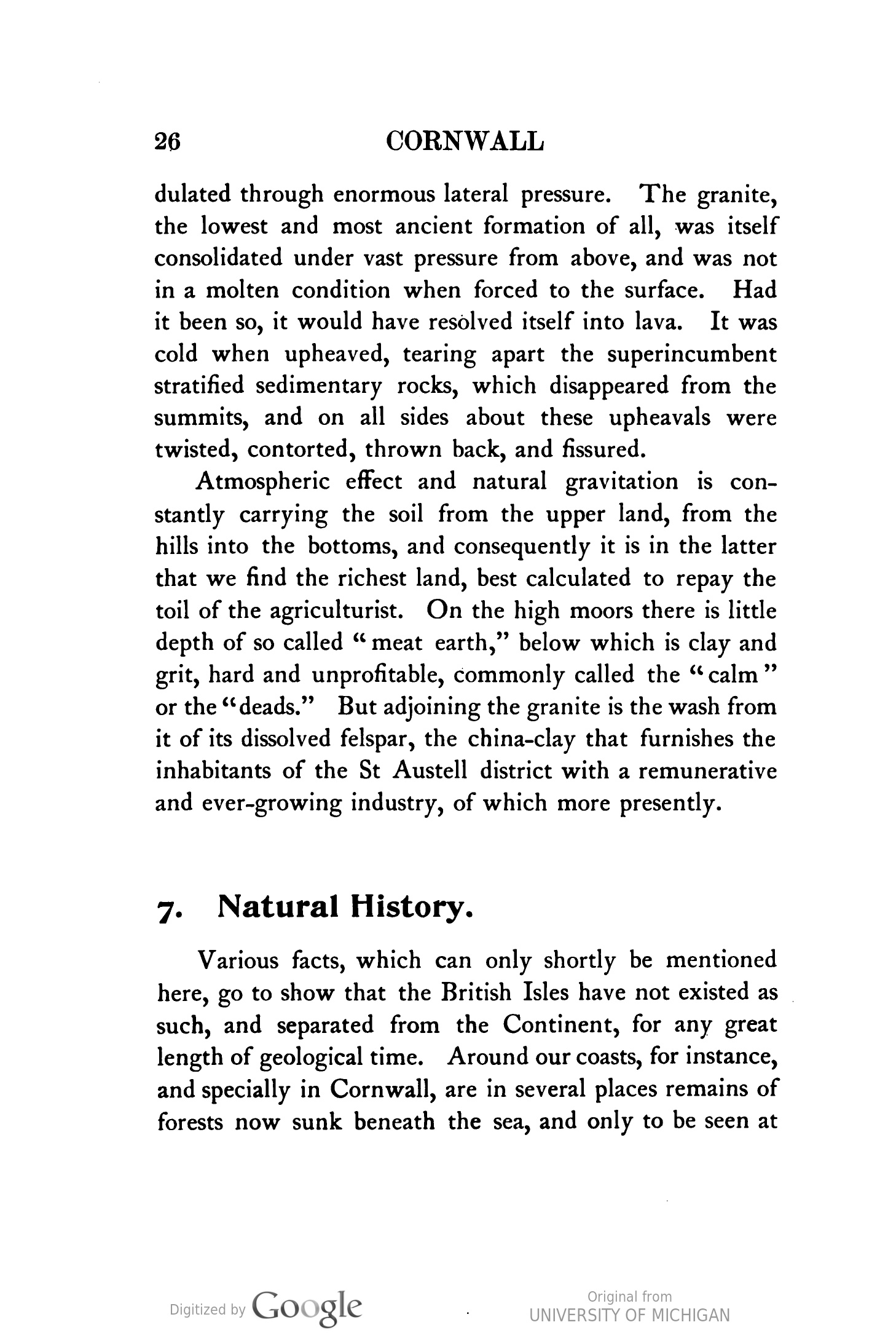
26 CORNWALL dulated through enormous lateral pressure. The granite, the lowest and most ancient formation of all, was itself consolidated under vast pressure from above, and was not in a molten condition when forced to the surface. Had it been so, it would have resolved itself into lava. It was cold when upheaved, tearing apart the superincumbent stratified sedimentary rocks, which disappeared from the summits, and on all sides about these upheavals were twisted, contorted, thrown back, and fissured. Atmospheric effect and natural gravitation is con- stantly carrying the soil from the upper land, from the hills into the bottoms, and consequently it is in the latter that we find the richest land, best calculated to repay the toil of the agriculturist. On the high moors there is little depth of so called “meat earth,” below which is clay and grit, hard and unprofitable, commonly called the “calm ” or the “deads.” But adjoining the granite is the wash from it of its dissolved felspar, the china-clay that furnishes the inhabitants of the St Austell district with a remunerative and ever-growing industry, of which more presently. 7. Natural History, Various facts, which can only shortly be mentioned here, go to show that the British Isles have not existed as such, and separated from the Continent, for any great length of geological time. Around our coasts, for instance, and specially in Cornwall, are in several places remains of forests now sunk beneath the sea, and only to be seen at
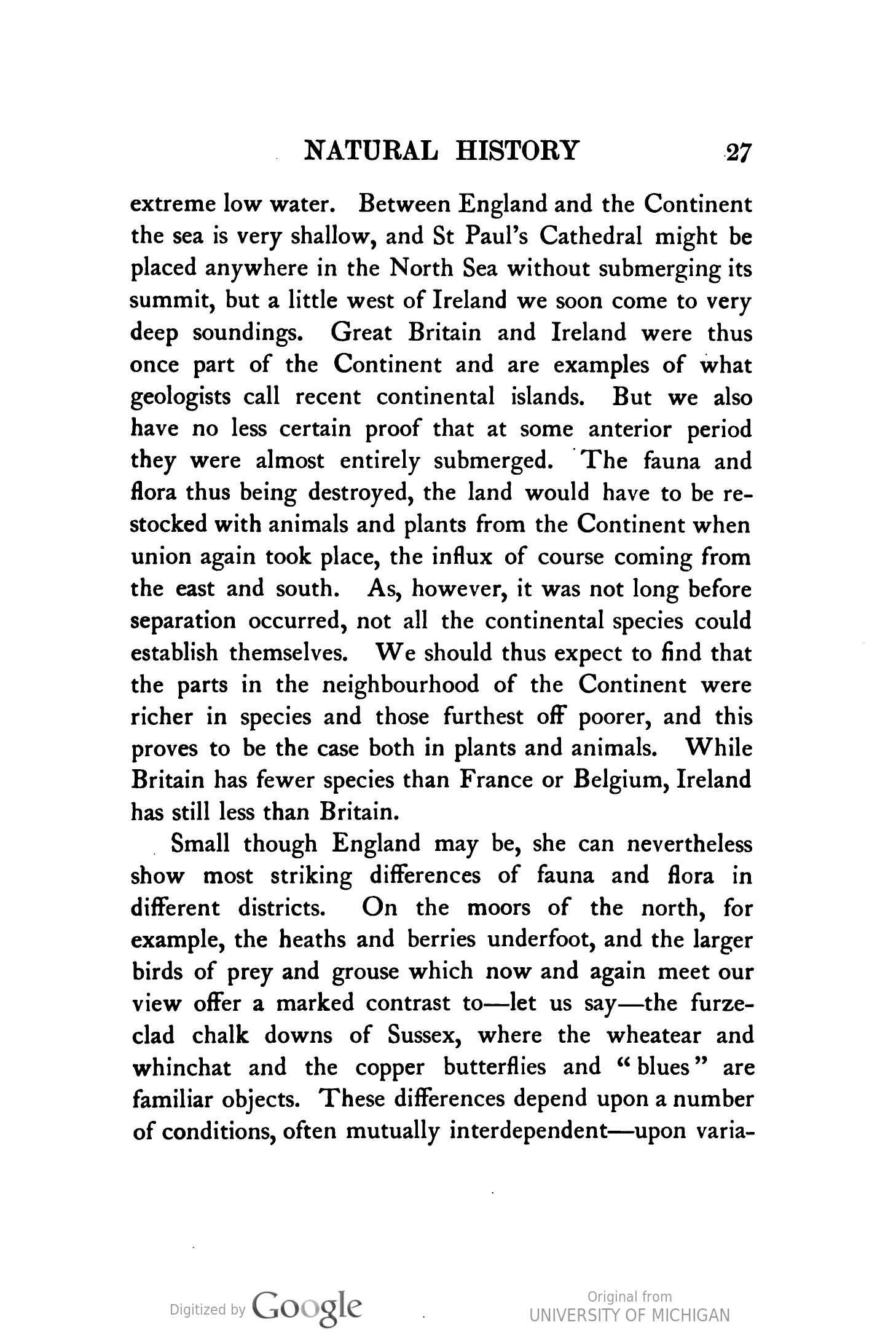
NATURAL HISTORY 27 extreme low water. Between England and the Continent the sea is very shallow, and St Paul's Cathedral might be placed anywhere in the North Sea without submerging its summit, but a little west of Ireland we soon come to very deep soundings. Great Britain and Ireland were thus once part of the Continent and are examples of what geologists call recent continental islands. But we also have no less certain proof that at some anterior period they were almost entirely submerged. The fauna and fora thus being destroyed, the land would have to be re- stocked with animals and plants from the Continent when union again took place, the influx of course coming from the east and south. As, however, it was not long before separation occurred, not all the continental species could establish themselves. We should thus expect to find that the parts in the neighbourhood of the Continent were richer in species and those furthest off poorer, and this proves to be the case both in plants and animals. While Britain has fewer species than France or Belgium, Ireland has still less than Britain. Small though England may be, she can nevertheless show most striking differences of fauna and fora in different districts. On the moors of the north, for example, the heaths and berries underfoot, and the larger birds of prey and grouse which now and again meet our view offer a marked contrast to—let us say—the furze- clad chalk downs of Sussex, where the wheatear and whinchat and the copper butterflies and “ blues” are familiar objects. These differences depend upon a number of conditions, often mutually interdependent—upon varia-
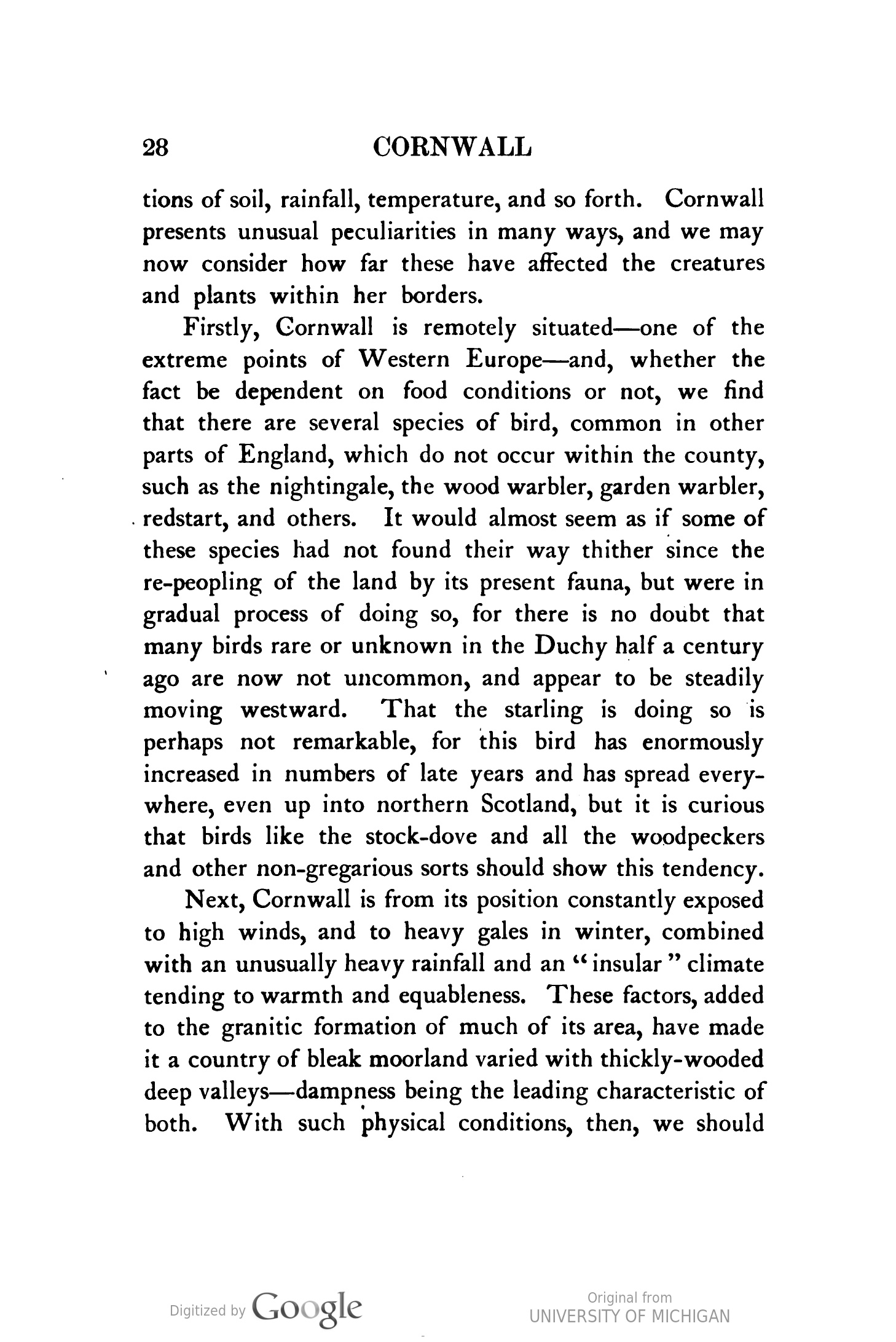
28 CORNWALL tions of soil, rainfall, temperature, and so forth. Cornwall presents unusual peculiarities in many ways, and we may now consider how far these have affected the creatures and plants within her borders. Firstly, Cornwall is remotely situated—one of the extreme points of Western Europe—and, whether the fact be dependent on food conditions or not, we find that there are several species of bird, common in other parts of England, which do not occur within the county, such as the nightingale, the wood warbler, garden warbler, . redstart, and others. It would almost seem as if some of these species had not found their way thither since the re-peopling of the land by its present fauna, but were in gradual process of doing so, for there is no doubt that many birds rare or unknown in the Duchy half a century ago are now not uncommon, and appear to be steadily moving westward. That the starling is doing so is perhaps not remarkable, for this bird has enormously increased in numbers of late years and has spread every- where, even up into northern Scotland, but it is curious that birds like the stock-dove and all the woodpeckers and other non-gregarious sorts should show this tendency. Next, Cornwall is from its position constantly exposed to high winds, and to heavy gales in winter, combined with an unusually heavy rainfall and an "insular” climate tending to warmth and equableness. These factors, added to the granitic formation of much of its area, have made it a country of bleak moorland varied with thickly-wooded deep valleys—dampness being the leading characteristic of both. With such physical conditions, then, we should
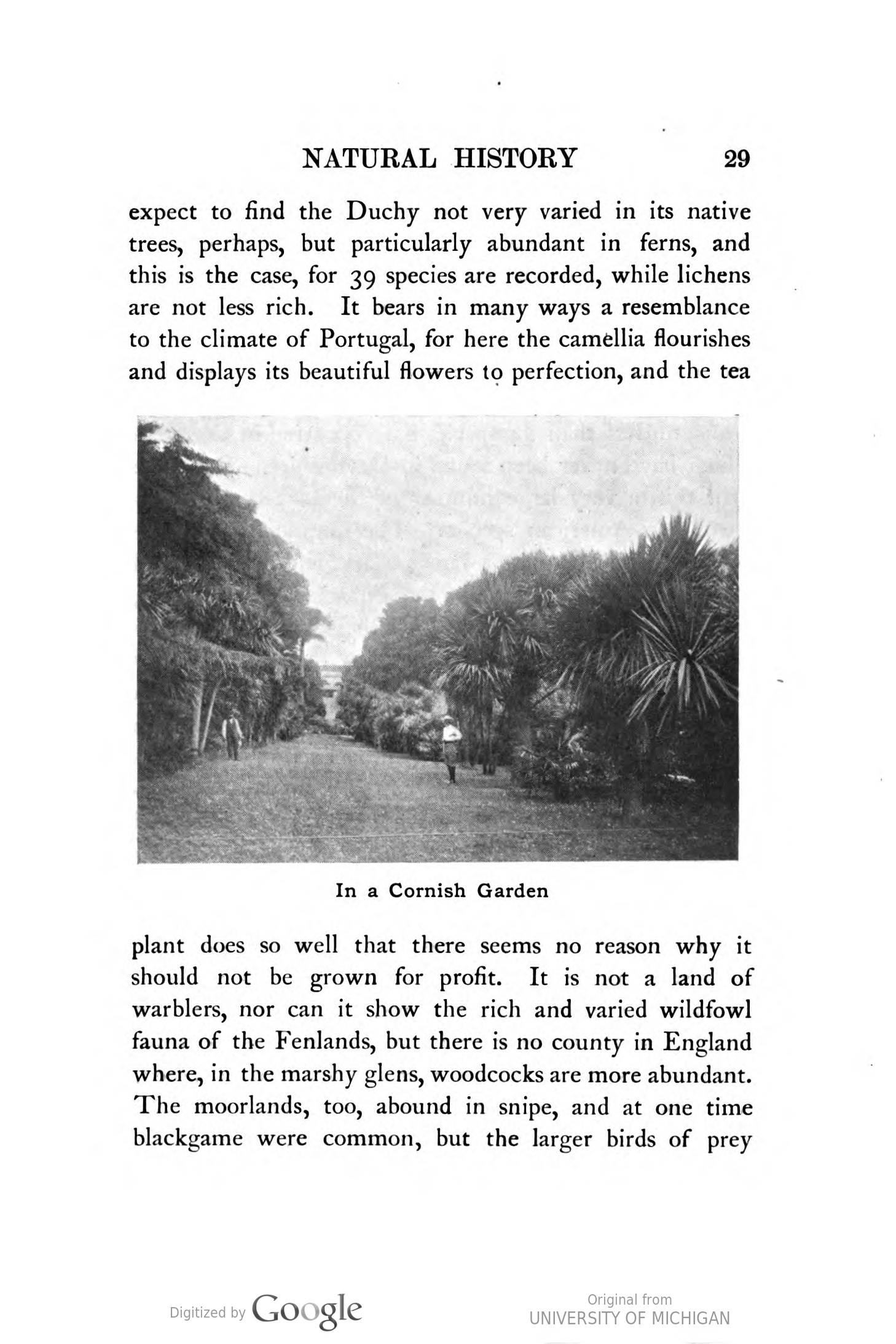
NATURAL HISTORY 29 expect to find the Duchy not very varied in its native trees, perhaps, but particularly abundant in ferns, and this is the case, for 39 species are recorded, while lichens are not less rich. It bears in many ways a resemblance to the climate of Portugal, for here the camellia flourishes and displays its beautiful flowers to perfection, and the tea In a Cornish Garden plant does so well that there seems no reason why it should not be grown for profit. It is not a land of warblers, nor can it show the rich and varied wildfowl fauna of the Fenlands, but there is no county in England where, in the marshy glens, woodcocks are more abundant. The moorlands, too, abound in snipe, and at one time blackgame were common, but the larger birds of prey
[This page contains an image]
28 CORNWALL tions of soil, rainfall, temperature, and so forth. Cornwall presents unusual peculiarities in many ways, and we may now consider how far these have affected the creatures and plants within her borders. Firstly, Cornwall is remotely situated—one of the extreme points of Western Europe—and, whether the fact be dependent on food conditions or not, we find that there are several species of bird, common in other parts of England, which do not occur within the county, such as the nightingale, the wood warbler, garden warbler, . redstart, and others. It would almost seem as if some of these species had not found their way thither since the re-peopling of the land by its present fauna, but were in gradual process of doing so, for there is no doubt that many birds rare or unknown in the Duchy half a century ago are now not uncommon, and appear to be steadily moving westward. That the starling is doing so is perhaps not remarkable, for this bird has enormously increased in numbers of late years and has spread every- where, even up into northern Scotland, but it is curious that birds like the stock-dove and all the woodpeckers and other non-gregarious sorts should show this tendency. Next, Cornwall is from its position constantly exposed to high winds, and to heavy gales in winter, combined with an unusually heavy rainfall and an "insular” climate tending to warmth and equableness. These factors, added to the granitic formation of much of its area, have made it a country of bleak moorland varied with thickly-wooded deep valleys—dampness being the leading characteristic of both. With such physical conditions, then, we should
NATURAL HISTORY 29 expect to find the Duchy not very varied in its native trees, perhaps, but particularly abundant in ferns, and this is the case, for 39 species are recorded, while lichens are not less rich. It bears in many ways a resemblance to the climate of Portugal, for here the camellia flourishes and displays its beautiful flowers to perfection, and the tea In a Cornish Garden plant does so well that there seems no reason why it should not be grown for profit. It is not a land of warblers, nor can it show the rich and varied wildfowl fauna of the Fenlands, but there is no county in England where, in the marshy glens, woodcocks are more abundant. The moorlands, too, abound in snipe, and at one time blackgame were common, but the larger birds of prey
[This page contains an image]
30 CORNWALL have for the most part vanished, though an occasional buzzard may be seen and the raven is not yet extinct. Lastly, it is to be noted that Cornwall is the nearest part of England to America. However difficult it may be of explanation, the fact remains that the Duchy is very rich in rare birds; so rich, indeed, that their recorded occurrence cannot by any possibility be merely accidental. Thus, no less than 24 species have occurred in Cornwall which have never been found in Devonshire. But more than this, a very large number of these—18 or more- are purely American species. The question is, whence do they come ? Professor James Clark, who has discussed the point at some length in the Victoria County History, is, apparently, loth to believe that they can come directly across the Atlantic, and it is by many thought that they are driven back by heavy south-westerly weather when dropping down the English Channel, having come by a circuitous route from Northern Europe. But against this is the undeniable fact that it is in the immediate neigh- bourhood of the Land's End that the chief rarities and stragglers are obtained, while many species have been shot in the Scilly Islands which have never been recorded from Cornwall itself. So far as its botany is concerned, Cornwall does not differ very markedly from Devonshire, but it has a large number of rare or peculiar plants. The highlands and north coast are rather poor in species; it is on the banks and estuaries of the streams that the richest flora is seen. A number of foreign plants are found, mostly in the neighbourhood of Falmouth and other ports. The balsam,
NATURAL HISTORY Impatiens Roylei, from India, grows extremely abundantly between Liskeard and Looe, and near Tintagel, and a species of May-weed (Matricaria discoidea) has become a troublesome pest near Falmouth. Loe Pool in the Lizard district is noticeable for the number of rare and local plants it possesses. The Scilly Islands own certain plants peculiar to them; thus, Trifolium repens, var. Townsendi, and Ornithopus ebracteatus are said not to be found elsewhere in England, and Carex ligerica only in Norfolk. The chief feature of the mammals of the county is that the grey seal, Halichaerus gryphus, is quite numerous in the Scilly Islands; that the polecat, though nearly extinct, it still found ; and that both badgers and otters are very abundant. It is a curious fact that certain freshwater fish common in other parts of England, such as pike, roach, chub, and bream, are unknown. The bird which bears the distinctive appellation, the Cornish chough it is not confined to the county, but is also found in Wales), is now not nearly as common as formerly, but like the raven it still breeds on some parts of the coast. 8. Around the Coast. From Morwen- stow to Land's End. This noble coast—so terrible to sailors—begins with the fine Henna Cliff at Morwenstow. Morwenstow Church contains an early font and has fine Norman arches.
NATURAL HISTORY 27 extreme low water. Between England and the Continent the sea is very shallow, and St Paul's Cathedral might be placed anywhere in the North Sea without submerging its summit, but a little west of Ireland we soon come to very deep soundings. Great Britain and Ireland were thus once part of the Continent and are examples of what geologists call recent continental islands. But we also have no less certain proof that at some anterior period they were almost entirely submerged. The fauna and fora thus being destroyed, the land would have to be re- stocked with animals and plants from the Continent when union again took place, the influx of course coming from the east and south. As, however, it was not long before separation occurred, not all the continental species could establish themselves. We should thus expect to find that the parts in the neighbourhood of the Continent were richer in species and those furthest off poorer, and this proves to be the case both in plants and animals. While Britain has fewer species than France or Belgium, Ireland has still less than Britain. Small though England may be, she can nevertheless show most striking differences of fauna and fora in different districts. On the moors of the north, for example, the heaths and berries underfoot, and the larger birds of prey and grouse which now and again meet our view offer a marked contrast to—let us say—the furze- clad chalk downs of Sussex, where the wheatear and whinchat and the copper butterflies and “ blues” are familiar objects. These differences depend upon a number of conditions, often mutually interdependent—upon varia-
28 CORNWALL tions of soil, rainfall, temperature, and so forth. Cornwall presents unusual peculiarities in many ways, and we may now consider how far these have affected the creatures and plants within her borders. Firstly, Cornwall is remotely situated—one of the extreme points of Western Europe—and, whether the fact be dependent on food conditions or not, we find that there are several species of bird, common in other parts of England, which do not occur within the county, such as the nightingale, the wood warbler, garden warbler, . redstart, and others. It would almost seem as if some of these species had not found their way thither since the re-peopling of the land by its present fauna, but were in gradual process of doing so, for there is no doubt that many birds rare or unknown in the Duchy half a century ago are now not uncommon, and appear to be steadily moving westward. That the starling is doing so is perhaps not remarkable, for this bird has enormously increased in numbers of late years and has spread every- where, even up into northern Scotland, but it is curious that birds like the stock-dove and all the woodpeckers and other non-gregarious sorts should show this tendency. Next, Cornwall is from its position constantly exposed to high winds, and to heavy gales in winter, combined with an unusually heavy rainfall and an "insular” climate tending to warmth and equableness. These factors, added to the granitic formation of much of its area, have made it a country of bleak moorland varied with thickly-wooded deep valleys—dampness being the leading characteristic of both. With such physical conditions, then, we should
NATURAL HISTORY 29 expect to find the Duchy not very varied in its native trees, perhaps, but particularly abundant in ferns, and this is the case, for 39 species are recorded, while lichens are not less rich. It bears in many ways a resemblance to the climate of Portugal, for here the camellia flourishes and displays its beautiful flowers to perfection, and the tea In a Cornish Garden plant does so well that there seems no reason why it should not be grown for profit. It is not a land of warblers, nor can it show the rich and varied wildfowl fauna of the Fenlands, but there is no county in England where, in the marshy glens, woodcocks are more abundant. The moorlands, too, abound in snipe, and at one time blackgame were common, but the larger birds of prey
[This page contains an image]
28 CORNWALL tions of soil, rainfall, temperature, and so forth. Cornwall presents unusual peculiarities in many ways, and we may now consider how far these have affected the creatures and plants within her borders. Firstly, Cornwall is remotely situated—one of the extreme points of Western Europe—and, whether the fact be dependent on food conditions or not, we find that there are several species of bird, common in other parts of England, which do not occur within the county, such as the nightingale, the wood warbler, garden warbler, . redstart, and others. It would almost seem as if some of these species had not found their way thither since the re-peopling of the land by its present fauna, but were in gradual process of doing so, for there is no doubt that many birds rare or unknown in the Duchy half a century ago are now not uncommon, and appear to be steadily moving westward. That the starling is doing so is perhaps not remarkable, for this bird has enormously increased in numbers of late years and has spread every- where, even up into northern Scotland, but it is curious that birds like the stock-dove and all the woodpeckers and other non-gregarious sorts should show this tendency. Next, Cornwall is from its position constantly exposed to high winds, and to heavy gales in winter, combined with an unusually heavy rainfall and an "insular” climate tending to warmth and equableness. These factors, added to the granitic formation of much of its area, have made it a country of bleak moorland varied with thickly-wooded deep valleys—dampness being the leading characteristic of both. With such physical conditions, then, we should
NATURAL HISTORY 29 expect to find the Duchy not very varied in its native trees, perhaps, but particularly abundant in ferns, and this is the case, for 39 species are recorded, while lichens are not less rich. It bears in many ways a resemblance to the climate of Portugal, for here the camellia flourishes and displays its beautiful flowers to perfection, and the tea In a Cornish Garden plant does so well that there seems no reason why it should not be grown for profit. It is not a land of warblers, nor can it show the rich and varied wildfowl fauna of the Fenlands, but there is no county in England where, in the marshy glens, woodcocks are more abundant. The moorlands, too, abound in snipe, and at one time blackgame were common, but the larger birds of prey
[This page contains an image]
30 CORNWALL have for the most part vanished, though an occasional buzzard may be seen and the raven is not yet extinct. Lastly, it is to be noted that Cornwall is the nearest part of England to America. However difficult it may be of explanation, the fact remains that the Duchy is very rich in rare birds; so rich, indeed, that their recorded occurrence cannot by any possibility be merely accidental. Thus, no less than 24 species have occurred in Cornwall which have never been found in Devonshire. But more than this, a very large number of these—18 or more- are purely American species. The question is, whence do they come ? Professor James Clark, who has discussed the point at some length in the Victoria County History, is, apparently, loth to believe that they can come directly across the Atlantic, and it is by many thought that they are driven back by heavy south-westerly weather when dropping down the English Channel, having come by a circuitous route from Northern Europe. But against this is the undeniable fact that it is in the immediate neigh- bourhood of the Land's End that the chief rarities and stragglers are obtained, while many species have been shot in the Scilly Islands which have never been recorded from Cornwall itself. So far as its botany is concerned, Cornwall does not differ very markedly from Devonshire, but it has a large number of rare or peculiar plants. The highlands and north coast are rather poor in species; it is on the banks and estuaries of the streams that the richest flora is seen. A number of foreign plants are found, mostly in the neighbourhood of Falmouth and other ports. The balsam,
NATURAL HISTORY Impatiens Roylei, from India, grows extremely abundantly between Liskeard and Looe, and near Tintagel, and a species of May-weed (Matricaria discoidea) has become a troublesome pest near Falmouth. Loe Pool in the Lizard district is noticeable for the number of rare and local plants it possesses. The Scilly Islands own certain plants peculiar to them; thus, Trifolium repens, var. Townsendi, and Ornithopus ebracteatus are said not to be found elsewhere in England, and Carex ligerica only in Norfolk. The chief feature of the mammals of the county is that the grey seal, Halichaerus gryphus, is quite numerous in the Scilly Islands; that the polecat, though nearly extinct, it still found ; and that both badgers and otters are very abundant. It is a curious fact that certain freshwater fish common in other parts of England, such as pike, roach, chub, and bream, are unknown. The bird which bears the distinctive appellation, the Cornish chough it is not confined to the county, but is also found in Wales), is now not nearly as common as formerly, but like the raven it still breeds on some parts of the coast. 8. Around the Coast. From Morwen- stow to Land's End. This noble coast—so terrible to sailors—begins with the fine Henna Cliff at Morwenstow. Morwenstow Church contains an early font and has fine Norman arches.
Original Format
Original Book 1920 pages. Pages 26-31 included here.
Files
Collection
Citation
S. Baring-Gould (1834-1924), “Cambridge County Geographies: Cornwall, Chapter 7: Natural History,” ENGL 433: A Seminar on Virginia Woolf and Modernism, accessed September 6, 2026, https://ctsdh.org/ENGL433/items/show/61.