
Tourism in Cornwall
Dublin Core
Title
Tourism in Cornwall
Description
Newspaper article from 1929 discussing the tourism industry of Cornwall and the changes in accesibility taking place after the way.
Creator
The London Illustrated News
Source
https://link.gale.com/apps/doc/HN3100282041/ILN?u=loyolau&sid=bookmark-ILN&xid=d3c88638
Type
Newspaper Article
Publisher
Gale Primary Sources
Date
6 December 2021
Contributor
Rebecca Miller & Tori O'Dea
Subject
Domestic Servants
Text Item Type Metadata
Text
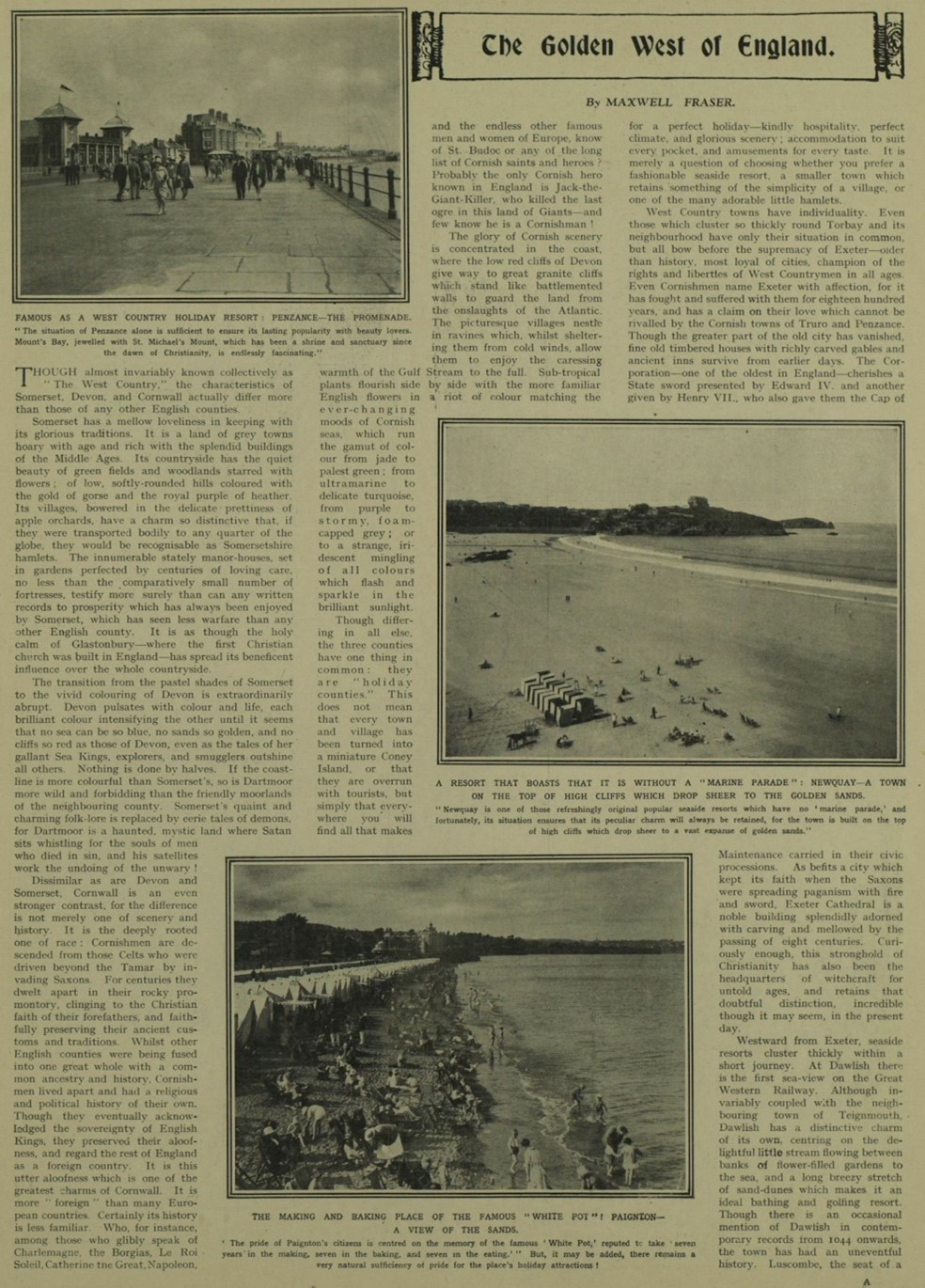
Though almost invariably known collectively as "The West Country," the characteristics of Somerset, Devon, and Cornwall actually differ more than those of any other English counties. Somerset has a mellow loveliness in keeping with its glorious traditions. It is a land of grey towns hoary with age and rich with the splendid buildings of the Middle Ages. Its countryside has the quiet beauty of green fields and woodlands starred with flowers; of low, softly-rounded hills coloured with the gold of gorse and the royal purple of heather. Its villages, bowered in the delicate prettiness of apple orchards, have a charm so distinctive that, if they were transported bodily to any quarter of the globe, they would be recognisable as Somersetshire hamlets. The innumerable stately manor-houses, set in gardens perfected by centuries of loving care, no less than the comparatively small number of fortresses, testify more surely than can any written records to prosperity which has always been enjoyed by Somerset, which has seen less warfare than any other English county. It is as though the holy calm of Glastonbury-where the first Christian church was built in England-has spread its beneficent influence over the whole countryside. The transition from the pastel shades of Somerset to the vivid colouring of Devon is extraordinarily abrupt. Devon pulsates with colour and life, each brilliant colour intensifying the other until it seems that no sea can be so blue, no sands so golden, and no cliffs so red as those of Devon, even as the tales of her gallant Sea Kings, explorers, and smugglers outshine all others. Nothing is done by halves. If the coastline is more colourful than Somerset's, so is Dartmoor more wild and forbidding than the friendly moorlands of the neighbouring county. Somerset's quaint and charming folk-lore is replaced by eerie tales of demons, for Dartmoor is a haunted, mystic land where Satan sits whistling for the souls of men who died in sin, and his satellites work the undoing of the unwary! Dissimilar as are Devon and Somerset, Cornwall is an even stronger contrast, for the difference is not merely one of scenery and history. It is the deeply rooted one of race: Cornishmen are descended from those Celts who were driven beyond the Tamar by invading Saxons. For centuries they dwelt apart in their rocky promontory, clinging to the Christian faith of their forefathers, and faithfully preserving their ancient customs and traditions. Whilst other English counties were being fused into one great whole with a common ancestry and history, Cornishmen lived apart and had a religious and political history of their own. Though they eventually acknowledged the sovereignty of English Kings, they preserved their aloofness, and regard the rest of England as a foreign country. It is this utter aloofness which is one of the greatest charms of Cornwall. It is more " foreign " than many European countries. Certainly its history is less familiar. Who, for instance, among those who glibly speak of Charlemagne, the Borgias, Le Roi Soleil, Catherine tne Great, Napoleon,and the endless other famous men and women of Europe, know of St. Budoc or any of the long list of Cornish saints and heroes? Probably the only Cornish hero known in England is Jack-the Giant-Killer, who killed the last ogre in this land of Giants-and few know he is a Cornishman! The glory of Cornish scenery is concentrated in the coast, where the low red cliffs of Devon give way to great granite cliffs which stand like battlemented walls to guard the land from the onslaughts of the Atlantic. The picturesque villages nestle in ravines which, whilst sheltering them from cold winds, allow them to enjoy the caressing,warmth of the Gulf Stream to the full. Sub-tropical plants flourish side by side with the more familiar English flowers in a riot of colour matching the ever-changing moods of Cornish seas, which run the gamut of colour from jade to palest green; from ultramarine to delicate turquoise, from purple to stormy, foam capped grey; or to a strange, iridescent mingling of all colours which flash and sparkle in the brilliant sunlight. Though differing in all else, the three counties have one thing in common : they are " holiday counties." This does not mean that every town and village has been turned into a miniature Coney Island, or that they are overrun with tourists, but simply that everywhere you will find all that makes for a perfect holiday-kindly hospitality, perfect climate, and glorious scenery; accommodation to suit every pocket, and amusements for every taste. It is merely a question of choosing whether you prefer a fashionable seaside resort, a smaller town which retains something of the simplicity of a village, or one of the many adorable little hamlets. West Country towns have individuality. Even those which cluster so thickly round Torbay and its neighbourhood have only their situation in common, but all bow before the supremacy of Exeter-older than history, most loyal of cities, champion of the rights and liberties of West Countrymen in all ages. Even Cornishmen name Exeter with affection, for it has fought and suffered with them for eighteen hundred years, and has a claim on their love which cannot be rivalled by the Cornish towns of Truro and Penzance. Though the greater part of the old city has vanished, fine old timbered houses with richly carved gables and ancient inns survive from earlier days. The Corporation-one of the oldest in England-cherishes a State sword presented by Edward IV. and another given by Henry VII., who also gave them the Cap of Maintenance carried in their civic processions. As befits a city which kept its faith when the Saxons were spreading paganism with fire and sword, Exeter Cathedral is a noble building splendidly adorned with carving and mellowed by the passing of eight centuries. Curiously enough, this stronghold of Christianity has also been the headquarters of witchcraft for untold ages, and retains that doubtful distinction, incredible though it may seem, in the present day. Westward from Exeter, seaside resorts cluster thickly within a short journey. At Dawlish there is the first sea-view on the Great Western Railway. Although invariably coupled with the neighbouring town of Teignmouth, Dawlish has a distinctive charm of its own, centring on the delightful little stream flowing between banks of flower-filled gardens to the sea, and a long breezy stretch of sand-dunes which makes it an ideal bathing and golfing resort. Though there is an occasional mention of Dawlish in contemporary records from 1044 onwards, the town has had an uneventful history.
Original Format
Newspaper Article
Files
Collection
Citation
The London Illustrated News, “Tourism in Cornwall,” ENGL 433: A Seminar on Virginia Woolf and Modernism, accessed September 6, 2026, https://ctsdh.org/ENGL433/items/show/83.