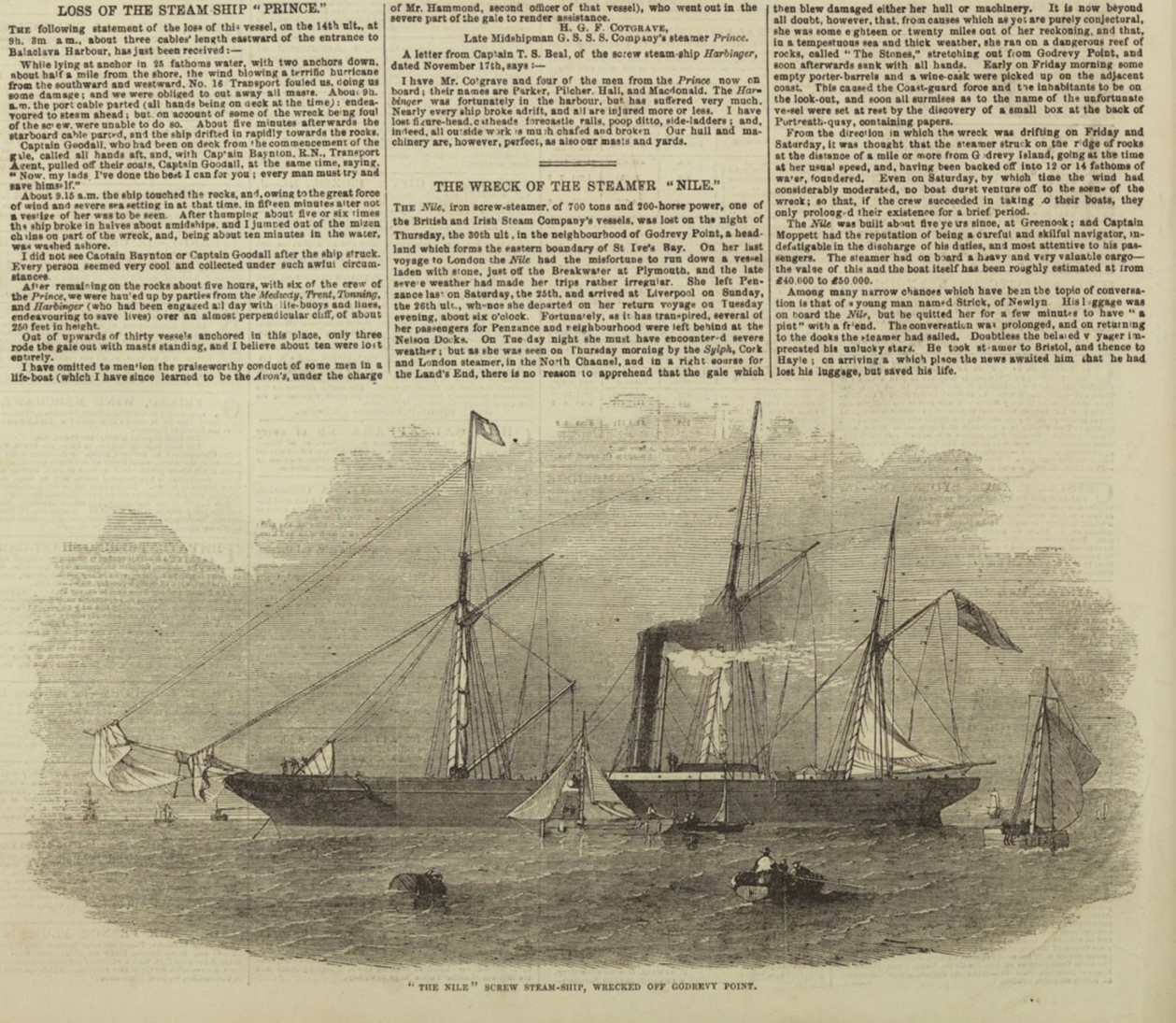
The Wreck of the Nile
Dublin Core
Title
The Wreck of the Nile
Description
A newspaper article explaining how the steamboat Nile was wrecked near Godrevy Island and the coast of Cornwall, prompting Trinity House to build a lighthouse there.
Creator
The London Illustrated News
Source
https://link.gale.com/apps/doc/HN3100038272/ILN?u=loyolau&sid=bookmark-ILN&xid=3d6df687
Type
Newspaper Article
Publisher
Gale Primary Sources
Date
6 December 2021
Contributor
Rebecca Miller & Tori O'Dea
Subject
Lighthouse Keepers
Text Item Type Metadata
Text
THE WRECK OF THE STEAMFR "NILE. THE Nile, iron screw-steamer, of 700 tons and 200-horse power, one of the British and Irish Steam Company's vessels. was lost on the night of Thursday, the 30th alt, in the neighbourhood of Godrevy Point, a headland which forms the eastern boundary of St Ive'd Bay. On her last voyage to London the Nile had the misfortune to run down a vessel laden with stone, just off the Breakwater at Plymouth. and the late severe weather had made her trips rather irregular. She left Pensanoe late on Saturday, the 25th. and arrived at Liverpool on Sunday, the 26th she departed on her return voyage on Tuesday evening, about six o'clock. Fortunately, as it has tran-pired, several of her passengers for Penzance and neighborhood were left behind at the Nelson Docks. On Tuesday night she must have encountered severe weather; but as she was seen on Thursday morning by the Sylph, Cork and London steamer, in the North Channel, and in a right course for the Land's End, there is no reason to apprehend that the gale which,then blew damaged either her hull or machinery. It is now beyond all doubt, however, that. from causes which as yet are purely conjectural, she was some eighteen or twenty miles out of her reckoning, and that, in a tempestuous sea and thick weather, she ran on a dangerous reef of rocks, called "The Stones," stretching out from Godrevy Point, and soon afterwards sank with all hands. Early on Friday morning some empty porter-barrels and a wine-osak were picked up on the adjacent coast. This caused the Coast-guard force and toe inhabitants to be on the look-out, and soon all surmises as to the name of the unfortunate vessel were set at rest by the discovery of a small box at the back of Purtreath quay, containing papers. From the direction in which the wreck was drifting on Friday and Saturday, it was thought that the steamer struck on the ridge of rooks at the distance of a mile or more from Godrevy Island, going at the time at her usual speed, and, having been backed off into 12 or 14 fathoms of water, foundered. Even on Saturday, by which time the wind had considerably moderated, no boat durst venture off to the scene of the wreck; so that, if the crew succeeded in taking o their boats, they only prolong.d their existence for a brief period. The Nile was built about five year since, at Greenock: and Captain Moppett had the reputation of being a careful and skilful navigator, indefatigable in the discharge of his duties, and most attentive to his passengers. The steamer had on board a heavy and very valuable cargo the value of this and the boat itself has been roughly estimated at irom £40,000 to £50,000. Among many narrow chances which have been the topic of conversation is that of a young man named Strick, of Newlyn. His Iuggage was on board the Nilre, but he quitted her for a few minutes to have " a pint" with a friend. The conversation was prolonged, and on returning to the docks the steamer had sailed. Doubtless the belaed v yager imprecated his unlucky stars. He took steamer to Bristol, and thence to Hayle; on arriving at which place the news awaited him that he had lost his luggage, but saved his life.
Original Format
Newspaper Article
Files
Collection
Citation
The London Illustrated News, “The Wreck of the Nile,” ENGL 433: A Seminar on Virginia Woolf and Modernism, accessed September 6, 2026, https://ctsdh.org/ENGL433/items/show/79.