Formative Years
The term “war cloud” was used by the Americans to refer specifically to the accumulating tension in Europe during the mid-19th century. As early as in 1859, an article published in the Chicago Tribune refers to the political tensions in Southern and Western Europe as clouds that are “big with tempests.” The accumulative nature of clouds—amorphous, abstract, and almost impossible to pin down—resonates the sudden and unpredictable death of Andrew Ramsay in Woolf’s To the Lighthouse. The minimal presentation of Andrew’s death in a column reflects Woolf’s attitude about war in the sense that for Woolf, deaths and human mortality, like the outbreak of warfare, albeit part of human existence, remains fundamentally out of human control. Instead of investing a certain reason or cause to the outbreak of war, Woolf’s presentation of the looming, violent political tension, not unlike her other political stances, remains elusive.
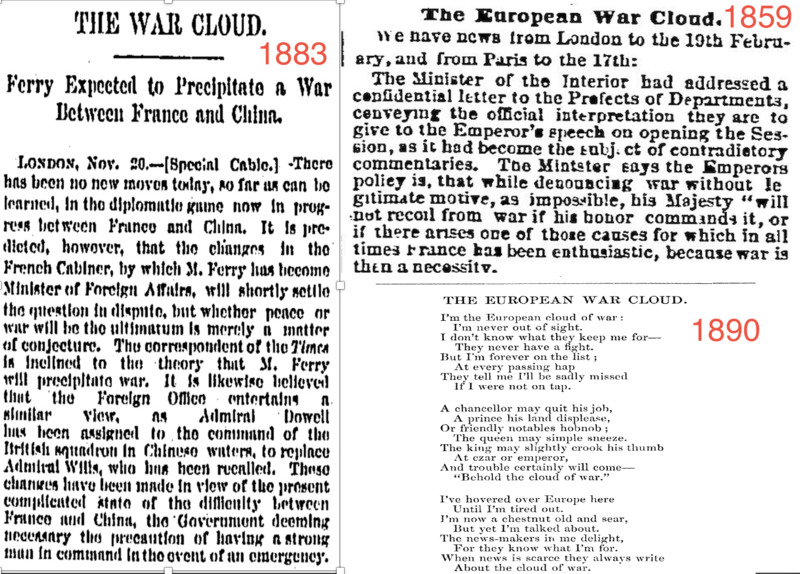
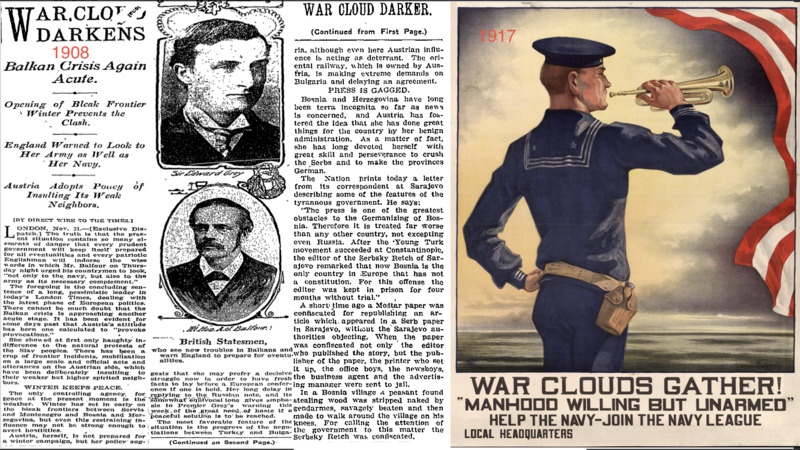
The collage presented above includes a selection of newspaper articles that are directly centered around “war cloud” rather than “the war.” The focus of the collage is to signify the unpredictable nature of wars and to capture the cumulative stages that eventually led to what we now refer as “World War I.” The first part of the collage contains newspaper clips before 1890; in this part of the collage, we see the Jules Ferry, a French politician who served twice as the prime minister of France, an ardent advocator of colonial expansion during his time, precipitates a war with China that will fuel the imperial desire of the Third Republic. The collage also present a poetic rendition of “the European War Cloud” which aptly personifies the war cloud as an ominous and looming entity without a clear agenda—“I don’t know what they keep me for [...] For they know what I’m for” ("The European War Cloud," 1890). The second part of the collage contains newspaper articles from the early 1900s to 1917, the year Andrew Ramsay died in France. We see from these clips that the description for the War Cloud has been specified and narrowed-down: the amorphous “European War Cloud” has now darkened and been identified specifically as the “Balkan Crisis.” These clips also showcase the patriotism which, along with the ambition of colonial expansion, provided the war with even more propellant.
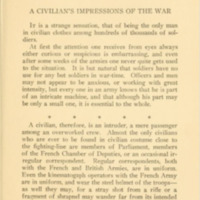
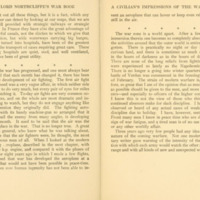
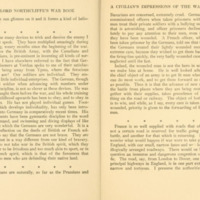
Also included in this part of the appendix is an excerpt from Lord Northcliffe’s wartime notebook. Published in the major year of 1917, Lord Northcliffe's wartime notbook provides a firsthand account of how it was for the British to enter a total war. Lord Northcliffe, born Alfred Charles William Harmsworth (1865-1922), was one the most understated influences of WWI. As the owner of The London Times, The Daily Mail and other media firms, Lord Northcliffe had enormous political sway during the formative years of the war. His influecene on poblic opinion and his donation resulted from his control over the two major newspaper publication during the time when Britain enter WWI. Although Lord Northcliffe's reputation plummeted overnight after he attacked British national hero, Horatio Herbert Kitchener (1850-1916), for the munition shortage on the Western Frontline, Lord Northcliffe remained a significant figure in early twentieth-century British history. Without doubt, Woolf must have been familiar with Lord Northcliffe’s political stance when she was writing To the Lighthouse as Woolf’s composition years overlap the years during which the British people relied on the news produced by Lord Northcliffe and his companies to apprehend the war.