
Imperial Shadows
“Time Passes,” that enigmatic section of To the Lighthouse which can be read alternately as a bridging or a breaking, opens its final section with the declaration that “Then indeed peace had come. Messages of peace breathed from the sea to the shore.”1 This statement is reflective of idealizations of the ‘post-war period’ in which the book is written and the final section, “The Lighthouse,” is set. As we know retrospectively, this was not to be a post-war period, for World War II loomed on the horizon. The second world war began a dozen years after the publication of this novel. Instead of a book of after-war, this becomes a book of the interwar period, the 20 or so years between the two World Wars. While this perhaps seems like a retrospective classification, as Paul Saint-Amour understands in Tense Future “Surely a period can only be called interwar in hindsight, after a subsequent war ends it; to refer to moments between November 11, 1918, and September 1, 1939, as interwar is to read the middle always by the black light of the terminus.”2 As is indicated by the title of his book, however, Tense Future is opposed to the conventional notion that the late teens and early 20’s of the twentieth century represented an idyllic post-war period that existed as a respite from total war, in which no continuation thereof was anticipated. However, Saint-Amour refuses to read those years, and 1922 in particular, as a period finally unburdened of the post-war complications of the 'Great War'. Rather, 1922 is “…a year in which two international conferences failed to set up effective laws of warfare; in which new theories of air power’s military future were being read alongside speculative fictions about a catastrophic next war…”3 Of even greater importance for this contextual reading of To the Lighthouse, Saint-Amour remarks that “1922 was also the inaugural year of Britain’s experiment in the air control of Mesopotamia (now Iraq) … as a tool for coercing noncombatants…”4. Specifically, this interwar time “meant the cessation of hostilities for some, [but] for others it meant the inception or continuation of hostilities stripped of the name and legal protections of war”5.
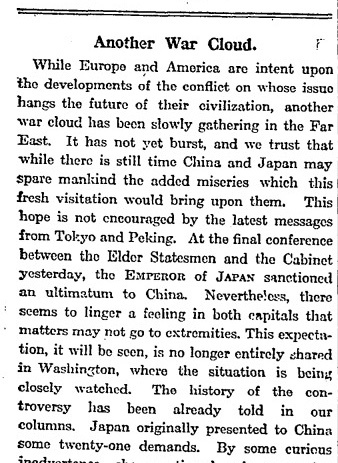
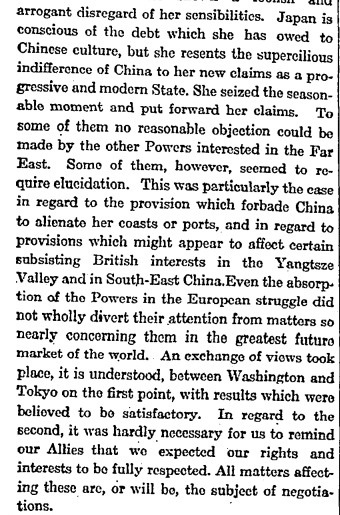
The war cloud then, was far from having dissipated. It had merely relocated. This relocation had already begun just one year into the war. As Europe and, at that point, America were “intent on the developments of the conflict on whose issue hangs the future of their civilization,” China and Japan were embroiled in their own conflict – and one that had particular implications for Great Britain. Although this article in The Times begins with concern for the “added miseries” that a ‘far-eastern’ war would cause, it rapidly moves to a concern with the limitation of British and European colonial interests, particularly “the provision [from the Japanese] which forbade China to alienate her coasts or ports,” that is to say, which would forbid ‘alien’ or foreign interests to conduct trade there. Indeed, although a great amount of concern is expressed over conflict in the area, Britain itself had waged the First Opium War (1839-42) and Second Opium War (1856-60) there less than a century earlier, resulting in a total of 15 ports opening to European trade and the British gaining two cities, Hong Kong and Kowloon.6 These economic interests are thus clearly implicated in the anxiety over war in the East. Economic reasons are certainly central to the imperialistic politics of Britain, up to this point and beyond (Hong Kong would remain under British control until 1997).7
Woolf directly implicates the image of kingdom, empire, and colonialism in the “messages of peace breathed from the sea to the shore.”8 The “beauty of the world” which breathes and murmurs these messages of peace entreats the sleepers “to lift the blind and look out. They would see then night flowing down in purple; his head crowned; his scepter jeweled…”9 Placing the messages of peace and the crowned and sceptered king clothed in the (royally) purple night moves peace into something imperial, an imperialism that asks the sleepers “why not accept this, be content with this, acquiesce and resign?”10 But what are the sleepers acquiescing to? Surely these messages of peace do not carry this strange implication of resignation? It is the night which clothes the mysterious king, and it is the night “with several folds of blackness over their eyes” that entreats them to ‘acquiesce and resign.’11 The king was not only the head of the kingdom, but also of the empire, and empire that was deeply entrenched in continuing conflicts. Just because peace has been attained ‘at home,’ that is to say that the direct sounds and images of war were no longer visible from the shore, did not mean that the world would be at peace.
The linearity of past recollection allows for a certain kind of binarization – war or peace. World War I brought the advent of total war – “a conflict from which nothing and no one is exempt.”12 For the residents of the British Isles, war and peace were strictly delineated because they no longer felt the effects of this total war. For those in British Colonies, however, subject to “colonial air policing” which saw bombing of civilians as policing action, “outside the legitimate context of declared war or open rebellion,” the effects of total war were still (and increasingly) very much felt.13 As Urmila Seshagiri points out, “Of Woolf’s major novels, To the Lighthouse is the least explicitly about race or Empire,” yet “Each of the novel’s three sections questions the stability of English identities rooted in the ideals of a racially exploitative Empire.”14 In the first section particularly, imperialism is entwined with economy and consumption, as “the Ramsay household, filled with artifacts of imperialist exploitation, emblematizes the transformation of peoples and cultures into commodities for English consumption.”15 Although it makes for a quiet background, this context is essential for the understanding of the political atmosphere of Britain and thus of To the Lighthouse. Just as the war is an understated but splintering force in the novel, the imperial power of Britain is a fundamental foundation to the characters and the author of the novel. Although the European war brings conflict closer to the homes and lives of British citizenry than is usual, this does not mean that political decisions were not constantly being informed by conflict, though this may or may not have been under the label of war, and often occurred far from home rather than near it. Just as conflict in the Middle East today provides a sometimes disregarded but ever-present inflection to the daily lives of Americans, so too would this foreign, imperial conflict. The outbreak of World War One brought these conditions into sharp and proximate focus.
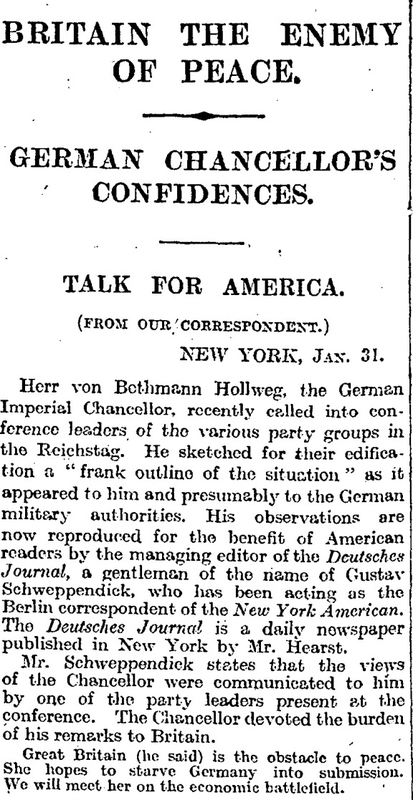
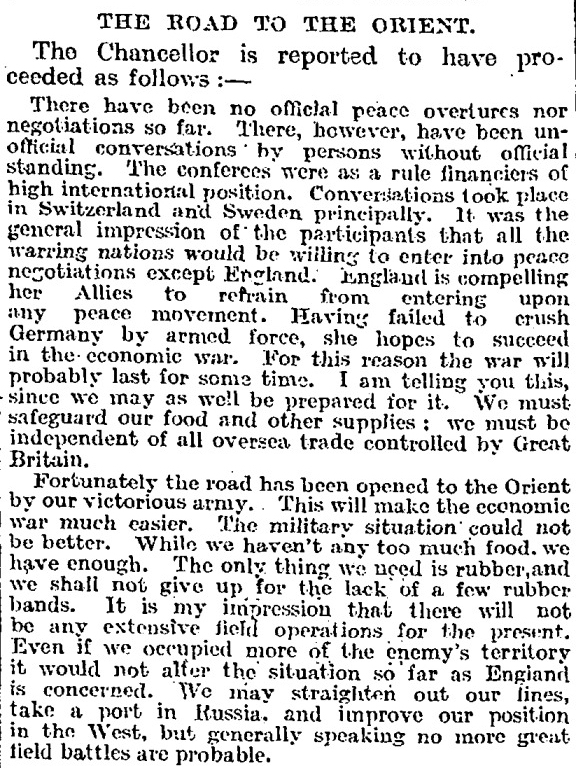
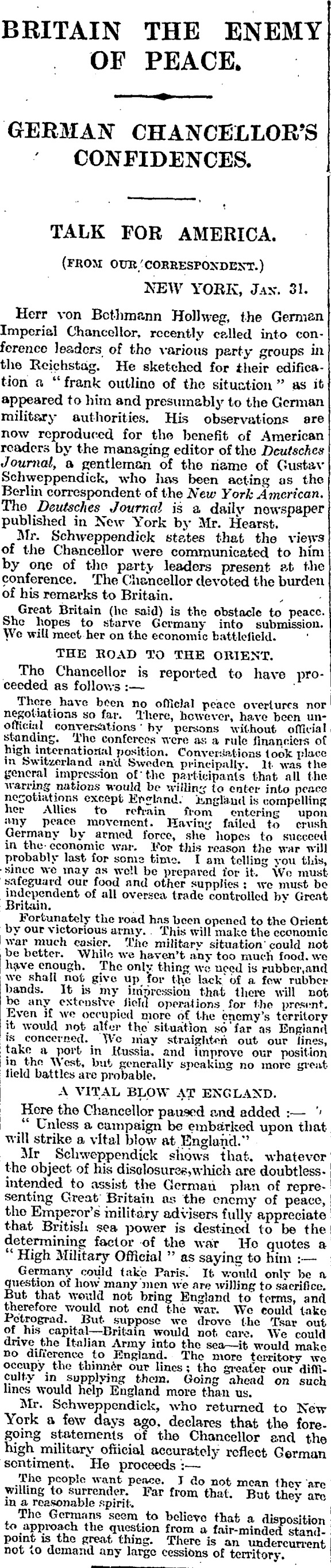
The ‘war-cloud’, which travels from Crimea, to France and Prussia, to Europe, to the ‘far east’, to Arabia provides a suitable narrative for the lack of linearity to the war. There is no proper narrative that moves from war into peace, especially considering that each of the places under this shadow of conflict had in some manner a link to the British Empire, upon which it was famously said that “the sun never set.” Furthermore, the colonial interests held by Britain and other European powers had a direct effect on the maintenance of the war effort. As is reported by The Times in 1916, Germany perceived Great Britain as “the obstacle to peace,” with the German Imperial Chancellor stating that in informal conversations “it was the general impression of the participants that all the warring nations would be willing to enter in peace negotiations except England” who, according to him, “hopes to starve Germany into submission.” The political sphere of war is thus very much entrenched in the economic power that having colonies or access to those resources provides. While the Imperial Chancellor warns that England “hopes to succeed in the economic war. [And] For this reason the war will probably last for some time,” it is the fact that “the road has been opened to the Orient” that the Chancellor believes will make the economic war a success. It can only be assumed then, that the reverse is also true – that the economic and power provided by England’s colonies across the world motivated a decision in the first place to enter into this ‘economic war’.
The accumulation of colonial power fueled the willingness to enter into longer and more drawn out European wars, which in turn fueled the need to bring violence upon colonies - a violence that often went without the name of war, even though that is what it was. The British Empire was huge, and although this was not seen, per se, in the day to day lives of those living in the British Isles, this does not mean that it did not exist. The advent of total war merely brought war closer to the non-colonial British subject than it had been in recent memory. These war time inclinations did not operate as linear cause-and-effect, but rather as something, much like weather systems themselves, that were cyclical and reappearing. The atmosphere in which Virginia Woolf wrote To the Lighthouse was not one of jubilant peace time celebration (though certainly that existed) but also one of tension. Her work directly addresses this, looking ahead to the 'acquiesence' and closing of the eyes that the British people will need to do in order to accept the idea that peace had come at last.
1. Virginia Woolf, To the Lighthouse (Harcourt Brace Jovanovich, 1981), 142.
2. Paul Saint-Amour, Tense Future (Oxford University Press, 2015), 33-34.
3. Saint-Amour, Tense Future, 36.
4. Saint-Amour, Tense Future, 36.
5. Saint-Amour, Tense Future, 36.
6. Roger D Long, "Empire, British, in Asia and Pacific." In Encyclopedia of Western Colonialism since 1450, edited by Thomas Benjamin, Vol. 1. (Detroit, MI: Macmillan Reference USA, 2007), 371
7. Long, “Empire” 372.
8. Woolf, To the Lighthouse, 142.
9. Woolf, To the Lighthouse, 142.
10. Woolf, To the Lighthouse, 142.
11. Woolf, To the Lighthouse, 142.
12. Saint-Amour, Tense Future, 47
13. Saint-Amour, Tense Future, 50-51.
14. Urmila Seshagiri. “Orienting Virginia Woolf: Race, Aesthetics, and Politics In ‘To the Lighthouse.’” Modern Fiction Studies Vol. 50, no. 1 (2004): 67.
15. Seshagiri. “Orienting.” 68.