
About the Collection
About the Collection and May Weber:
This collection is a subset of a large mass of cultural arts Dr. May Weber, a late Chicago psychiatrist and collector, had collected over her lifetime. Weber collected objects from her own travels and worked with art dealers. Her particular interests were in Latin America, Africa, and Asia, and she was especially fond of masks.
During her lifetime, Dr. Weber had a museum of her cultural arts in downtown Chicago. She also often set up traveling exhibits across the country, frequently at Fermilab and the Benton Museum of Art.
Dr. Weber had a longstanding relationship with professors at Loyola and frequently expressed wishes to give her collection to Loyola upon her death. With the help of Dr. Weber's husband, Gerald Hoffman, the university finally received a subset of the collection shortly after Dr. Weber's death in 2012.
In 2014, Loyola Anthropology Professor Dr. Catherine Nichols curated pieces of ethnographic art from this subset of the May Weber Ethnographic Art Collection. Pieces of this collection had previously also been part of Loyola University Museum of Art.
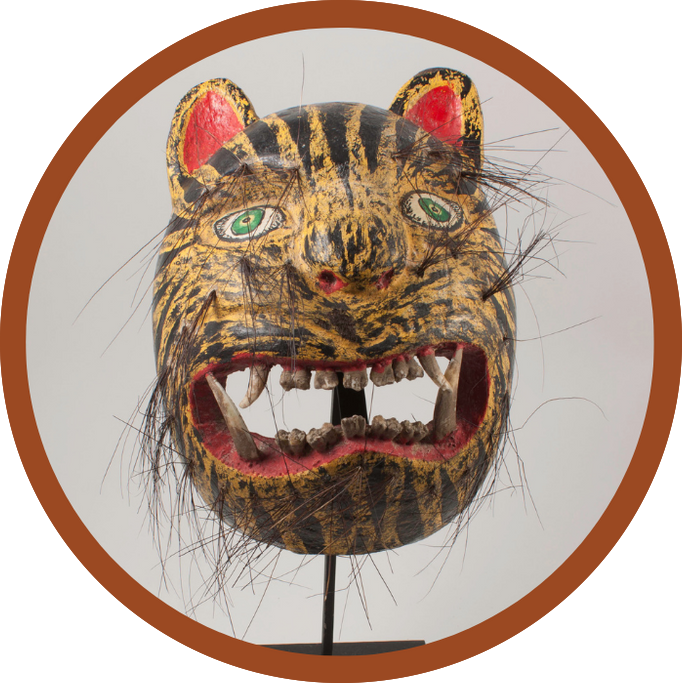
The collection comprises around 3000 items amassed during the latter half of the twentieth century by Dr. May Weber. She was fascinated with arts outside of the United States. She travelled extensively and made longstanding connections with tribal art merchants, resulting in the cultivation of a personal collection from around the world. This collection largely consists of: masks, figurative sculptures, textiles, and functional artifacts. Masks from Mexico are the most numerous and diverse pieces of this collection. The collection is housed at the Mundelein Center.
Above is the specifics of how the collection came to be and what it contains. The number one thing to understand about this collection is it came from the fascination of one woman -- Dr. May Weber. That is the thread that holds this 3000 piece collection together. And that is an important fact to keep in mind when working with this site of the masks from Mexico specifically. Each mask on this site has a record. However, each varies in its level of completeness. May Weber was a very eclectic record keeper, and was not consistent in what information she recorded where. While we have included other voices, the largest voice in the records is Dr. Weber's as this was her collection. She also contradicts herself in some records. These objects travelled from place to place and therefor a series of records were created for them at many different institutions in attempts at completeness. However, none of these attempts were successful and therefor the information for the records on this site are a synthesis of all these attempts.
Collection director Dr. Catherine Nichols has done extensive research on this collection and is a reliable source of information. Please contact us if you have questions or comments about the information present on this site.
Description of Metadata Fields in the order they appear:
Title:
Non-preferred name of mask
How Acquired:
How May Weber acquired the mask
When Acquired:
When May Weber and/or The May Weber Foundation acquired the mask
When created:
When the mask was created
Created by:
Who created the mask
Dance(s)/Festival(s):
Dance(s)/Festival(s) the mask is associated with
Character:
Character the mask portrays in the dance
May Weber's comments:
Attributes given to the mask by original collector May Weber on her original inventory records (May Weber Inventory Records: MW001 (Weber Number)) and/or attributes given to the mask by original collector May Weber to LUMA (Loyola University Museum of Art)
Dr. Catherine Nichols' comments:
Attributes given to the mask by Dr. Catherine Nichols, director of the May Weber Ethnographic Collection
Consultation Comments:
Attributes given to the mask during mask consultation sessions in May 2018 by Oaxacan Artist Carlos Orozco and three LUC graduate students (Victoria Duran, Marina Alvarez, and Sammy Hernandez), later edited by LUC undergraduate student Hector Centeno in Spring 2023 for reader clarity
Exhibition History:
Exhibits the mask was displayed in while in May Weber's collection
State:
State in Mexico where mask may have originated
City/Town/Region:
City/town/region where mask may have originated
Culture/people:
Indigenous group associated with the object
Techniques:
Art technique used to construct the mask
Primary Material:
Primary material used to construct the mask
Secondary Materials:
Other materials used to construct the mask
Dimensions:
height x depth x width (in centimeters)
Marks/Labels:
Marks or labels made on the physical object at some point during its life
May Weber Ethnographic Study Collection: "ANTH number"
This number follows a contemporary convention standard of the tripartite number: YEAR.LOT.OBJECT. Objects donated by Gerry Hoffman on behalf of May Weber will all share the same accession number: 2014.001
Each individual object will carry a unique identifying number: .0001
Objects that have been catalogued by LUC (under Nichols's direction as part of the 'May Weber Ethnographic Study Collection') are identified by a 1x2" manila tag with a 2014.001.0001 number. There are analog (paper) records in Mund 419 (in archival boxes, see photo left) and they are being entered into the CollectiveAccess database.
May Weber Inventory Records: MW001 (Weber Number)
These records correspond to hand-written records created by May Weber (in her own handwriting). There are two standard forms for these kinds of records and they usually contain hand-written information (in some cases, especially for the lower numbers), and an affixed
Old Numbers:
Past Perfect Catalogue: 'WMO001°
This catalogue number format was created by Pamela Ambrose, who was responsible for inventorying the objects that were legally and physically transferred to Loyola University Chicago as a gift/donation. Working with two graduate student assistants, "Svedman and Escobar," she developed a cataloging convention ("WM0001") specific to the material. The first letter "W" stands for "Weber", and is followed by one of the following letters "M, C, P, T, F, S." The second letter refers loosely to material or technique: Material, Ceramic, Painting, Textile, Furniture, Sculpture.
Ambrose purchased the PastPerfect collections management system (CMS). PastPerfect is a low-cost, off-the-shelf museum catalogue database program. It comes with pre-set fields for different kinds of collections: historical, art, natural history.
Svedman and Escobar performed a rapid inventory/cataloguing process for about 4600 objects (individual catalogue records). It is unclear how the information about each object was generated. In many cases, the information is correct and specific. In other cases, it is dead wrong.
Note that the "Old Number" field contains several different kinds of catalogue numbers. It is curious how these numbers, many of which are correct, were associated with the record. There are physical/paper copies of these in Mundelein Center room 419, there are also digital files xls.
Willoughby Associates Catalogue Record: "W0001"
Willoughby Associates, a company based in Winnetka that provided collections management, web publishing, handheld inventory, and custom software applications to museums, archives, private collections, universities, and historical societies. The company seems to be now defunct.
May Weber seems to have contracted their services to inventory her collection around 2002.
W001 numbers (which are confusing, because they look close to PastPerfect numbers), have a corresponding (sometimes) paper/analog record that usually contains a photograph, and a description of the object's function. It usually does not contain cultural/provenience information.
2006 Records: 06-0000
In some cases, there are 06-0000 old numbers (maybe even 05-0000). These may be temporary numbers assigned by LUMA when objects were on loan. There are two white binders in Mundelein Center room 419 that contain paper records. There is very little information on these sheets.