
About the Dances and Festivals
Click a link below to jump to section
A brief history of masks in Mexico Dance dramas of the Moors and Christians Dance of Los Tres Potencias (Three Powers)
Malintzin (Malinche) The Conquest Dances Pastorelas Pascola Masks La Judea/Semana Santa Cora
Tigre/Jaguar Mask Dance of the Jardineros Dance of Los Viejos African influence in Mexican dance dramas
A note about language and racially assigned categories
This site strives to treat the masks with the highest level of cultural sensitivity. We aim to describe our materials in a way that is respectful to, and informed by, the communities who use, create, and are represented in the collection. However, as you read and browse the masks on the site, you may encounter language that is harmful, offensive, or misrepresentative. Due to the nature of the materials, there will be occurrences of language, positions, and values that do not align with our current values. Many descriptions of the masks and the dances were reported to May Weber as such by peoples in Mexico in the 20th century, and we decided to retain the names as we are not in the position to change how the masks and the dances are represented by their people.
When the creator or donor of the original materials supplies language that is harmful, offensive, or misrepresentative to describe or name them, it is considered best practice to preserve such information. This is done to avoid censoring or altering the historical record and to uphold an understanding of the context of creation. Here are some instances where offensive or harmful language may be retained:
- Titles of masks
- Descriptions of dances and festivals
- Comments from May Weber in records
A concerted effort has been made to incorporate modern scholarship and new language where it is appropriate to do so. Each description is accompanied with modern day examples of the dances and some with historical contextual scholarship for further reading.
We also recognize that there are instances where it is appropriate and necessary to amend archival descriptions and language. As language, conventions, and best practices in archival work continually evolve, what may have been considered appropriate for describing archival materials in the past may no longer be acceptable. All users are welcome to contact us with any comments!
A brief history of masks in Mexico
Pre-Contact:
Dancing and pageantry - including the wearing of regalia and masks - have long been part of ceremonial practice in Mesoamerica. There were processions, dancing, choreographed theatrical performances, usually followed by large public feasts and social entertainment - playing games, and dancing.
Different ethnic groups hosted a range of festivals that take place at different times of the calendar year. Many festivals were meant to honor and entertain deities in order that the community would be blessed with rainfall, good harvests, good health and wellbeing. They also brought people together to enjoy each others' company.
There was an enormous amount of variation and characters in what the masks represent, such as deities, warriors, powerful animals, old men and women, and masks that might make fun of community members or neighboring ethnic groups.
Spanish conquest in 1521:
Europeans dismantled the political and religious empires and banned pre-Hispanic religious practice. European Catholics established churches with patron saints, and these saints were integrated into Indigenous belief systems. Festivals remained an important part of community identity, and the long-standing tradition of masquerades were used as a tool of assimilation. Priests working in these communities instructed the Indigenous populations to practice the annual Catholic festival cycle - Christmas, Holy Week, All Saints and Souls Day. Some previously celebrated agricultural rituals were integrated in with these.
Spanish dramas were also introduced to teach Christianity. An example of this is the Moor and Christian drama, which recounts the Reconquista and the expulsion of Moors from Spain and triumph of Christianity.
In terms of creation, some masks were made by santeros, (Christian saint makers), some by craftsmen, and some by the dancers themselves. There is a wide range of quality, materials, and styles. Throughout colonization we see edicts outlawing masquerading at different points in time, but it persisted.
1821 - Mexican independence:
Most masked festivals appear largely today in states with large indigenous populations: Guerrero, Oaxaca, Michaocan, Jalisco, Chiapas, Nayarit, Veracruz, etc.
A mix of the pre-contact tradition of masking and post-conquest additions is what remains today. Many masquerades continue on Christian feast days and saints days to celebrate good crops and community well-being. Dance dramas are very much current and reactive to the current world. Some dances and themes are well known, some are specialized to particular communities or barrios, and there is much variation in how popular dances are interpreted locally.
The dance dramas of today are flexible and reactive, incorporating long standing pre-contact and post-Spanish invasion influences while mixing in aspects of pop culture. The books Dancing with Life: Recontextualizing Mexican masks by Pavel Shlossberg and Theatrum Mundi: Masks and Masquerades in Mexico and the Andes by Anthony Shelton do a great job of expanding on how masquerades continue to thrive and adapt in present day Mexico.
The masks on this site were collected during the mid-to-late 20th century, and some predate even that. The descriptions that follow remark largely on dance dramas of that period, while the accompanying videos and articles attempt to bring in a 21st century perspective. Dancing with Life and Theatrum Mundi should be considered in conjunction with these present day examples for a fuller contextualization of how the masquerades have persisted and existed into the 21st century.
19th and 20th century Mexican masquerades:
- Performances derived from Catholic plays, directly brought from Spanish/Iberian conquest and used to impress on Indigenous populations the importance of the Catholic faith and its values about the ideal life.
- Examples found on this site: Los Tres Potencias, Pastorelas, Carnival and Easter ceremonies (La Judea/La Semana Santa) from the Cora, Mayo, and Yaqui peoples.
- Combat plays brought from Spain
- Examples found on this site: Dance dramas of the Moors and Christians, dances of the conquest, Dance of the Matachines, Dance of the Plumes, the Dance of Cortez
- Dance dramas that more clearly hybridize pre-conquest Mexican history with later history
- Examples found on this site: Dance of the Tlacololeros, Dance of the Tecuanes, Dance of the Fishermen, Dance of the Old Men
Citation:
Descriptions of Festivals and Dances
Dance dramas of the Moors and Christians
The Dance dramas of the Moors and Christians began in the north of the Iberian Peninsula, prior to the 12th century. They originate from the concept of the "reconquest" of the Iberian Peninsula, "freeing" it from Muslim caliphate rule. The festivals re-enact battles between the 'Moors' and the 'Christians'. The core of each performance was the triumph of "good" over "evil". The designation of moro (moor) and cristiano (christian) do not necessarily refer to distinct ethnic groups, but rather constructed faith communities. Moor originated to include Jewish people, berbers, Romans, and even Spanish conquistadores, while Christian refers to the Portuguese, and inhabitants of different Spanish provinces (inhabitants of the Americas they invaded).
It is likely the first Christian dance introduced into Mexico, first recorded in 1524. For historical context, the 'Moors' had been expelled from Spain thirty years before the Conquest of Mexico, making the theme prominent in the minds of the Spanish involved in the assimilation efforts in Mexico.
There are many variations, but the basics always begin with: the encounter between the armies of the 'Moors' and the 'Christians', and representatives from each meet to discuss theological differences. This results in a few series of combat. After this series, the 'Christians' are victorious with the help of an angel or saint's intervention. After this, either the 'Moors' convert to Christianity or they are killed. St. James or Santiago is a common character in the dance drama, originating as the idea of a 'Moor killer', and an example of to whom the Christian characters of the dance seek divine assistance. The devil is also a common character, and is an 'aid' to the Moors. The size of the dance dramas and specifics of the story differ from city to city, and from country to country.
Citation:
Recommended further reading:
Gianaris , Kristen. “Moroccan Scholar Explores Racist, Imperialist Roots of Moorish Identity.” Moroccan Scholar Explores Racist, Imperialist Roots of Moorish Identity, June 27, 2020. https://www.moroccoworldnews.com/2020/06/306911/moroccan-scholar-explores-racist-imperialist-roots-of-moorish-identity.
Video of Moors and Christians dance drama:
Dance of Los Tres Potencias (Three Powers)
Citation:
Video of Danza de los Tres Potencias:
Malintzin (Malinche)
Citation:
Recommended further reading:
Purcell, Ryan. “Life Story: Malintzin (La Malinche) (ca. 1500-1529).” Life Story: Malintzin (La Malinche) (ca. 1500-1529), February 27, 2024. https://wams.nyhistory.org/early-encounters/spanish-colonies/malitzen/.
Video of Malintzin in a Conquest Dance:
The Conquest Dances
Conquest-themed dances from the conquest group are performed all over Mexico, from Nayarit to Chiapas, usually on the town or city's Saint day. This group of dances are various representations of the Spanish Conquest of Mexico.
There are many conquest/combat dance dramas, but two of the largest are the Dances of the Tastoanes and the Plumas.
In the Dance of the Tastoanes, it is a fight between two groups: Santiago and his followers and the Tastoanes. The dance of the Tastoanes is limited to Tonala and the five nearby towns of Nextipac, Ixcatan, Santa Ana Tepetitlan, San Juan de Ocotan, and to nearby settlements in southern Zacatecas. Those representing the Tastoanes often wear animal-like creature masks. It is a long fight, but eventually the Tastoanes dislodge Santiago from his horse and take him to his death. Eventually Santiago resurrects and the ceremony ends with all participants returning the statue of St. James (Santiago) to the church. Interestingly and differently, in Zacatecas, the story ending was changed in 1821 to represent Santiago's defeat. It lines up with the defeat of the Spanish colonizers in the Independence War. Therefor, there are now many versions that end with the defeat of Santiago and the Spanish, portraying an indigenous victorious history.
Similar is the Dance of the Plumes which begins with Malintzin (Malinche) suggesting to Motecuhzoma that he consult an oracle to learn the nature of the Spanish that are sailing towards them. Eventually Cortez and his soldiers burst into the palace and demand conversion of the emperor. Motecuhzoma receives various omens during the play, telling the end of his empire. There are many meetings between Cortez and Motecuhzoma's messengers and soldiers, but eventually they meet on the battlefield. Motecuhzoma triumphs. However, there are other versions in which Cortez is the triumphant one, such as the Teotitlan version.
The general theme of conquest dances and the characters are drawn from the Indigenous point of view. The characters may include Motecuhzoma, the king of the Aztecs of the time of the conquest; Malintzin, the Nahua woman who became the interpreter and slave of Cortez; Hernan Cortez, the lead Spanish invader of Mexico; indigenous and Spanish soldiers.
There is much variation in the interpretations of conquest performed in these danzas. The character depicting Malintzin is almost always masked; she is one of the most popular mask motifs throughout Mexico and dance dramas, and is subject to wide divergences in her portrayal.
Citation:
Recommended further reading:
Brown, Rachel, and Ramiro Durán Rentería. “This Colorful Mexican Dance Has a Hidden History.” Go Inside a Complex Mexican Dance, August 7, 2018. https://www.nationalgeographic.com/travel/article/photos-tastuan-festival-dance-zacatecas-history-culture.
Video of Dance of the Tastoanes:
Video of the making of a Tastoan Mask:
Video of a Conquest dance:
Pastorelas
Citation:
Description by Dr. Catherine Nichols, Mexican Masks by Donald Cordry, pages 232-7 and Masks of Mexico by Barbara Maudlin, page 3.
Video of Las Pastorelas in Colima:
Pascola Masks
Citation:
Shelton, Anthony. Theatrum Mundi : Masks and Masquerades in Mexico and the Andes. Vancouver ; Figure.1, 2021.
Recommended further reading:
Kolaz, Thomas M. Yoeme Pascola Masks, 2007. http://www.yoemecarver.com/aiam07.pdf.
“What Is a Pascola?” What is a Pascola? | Arizona State Museum. Accessed April 15, 2024. https://statemuseum.arizona.edu/online-exhibit/masks/what-pascola.
Video of Deer Dance:
Video of Holy Saturday for Yaqui:
La Judea/Semana Santa Cora
The festival for Cora people has its roots in Jesuit attempts at evangelization of Cora from 1570-1767. The Cora long resisted colonization but missions were built and conversion began after 1722. Missionaries acted out the passion of Christ (Christ's trial under Pilate and Jewish leaders, conviction to death, crucifixion, and resurrection) as an attempt at conversion.
The Festival today is a convergence of Catholic tradition and native religion. Jesus is represented by the sun god. A child plays this role. The masks are worn by men who represent the Jews who called for Jesus' death. Jesus is depicted in the form of the sun god, and the Jews are depicted in the form of 'night demons', or evil itself.
Each individual is responsible for making his own mask. The cast is made in advance, then a cardboard and papier mache mask is made, then adorned with various things especially cactus fiber for hair, antlers, foil teeth, etc.
On Holy Thursday, the masks (and the men's bodies, swords, etc.) are painted black and white. They run through the town, searching for the Sun God/Jesus. They generally wreak havoc on the town.
On Good Friday morning, the masks (and bodies and weapons, etc.) are decorated with bright colors, bringing them to the colorful form we see in these masks. On Good Friday, the demons successfully capture and "kill" Christ.
On Holy Saturday, "Christ"/sun god returns and banishes the demons to the river where the colors are washed off their bodies and the masks are disposed of. According to ethnologists who wrote about the masks in the 1970s, the only part of the masks that are saved are the antlers, if authentic.
Citation:
Video of La Judea Cora:
Tigre/Jaguar Masks
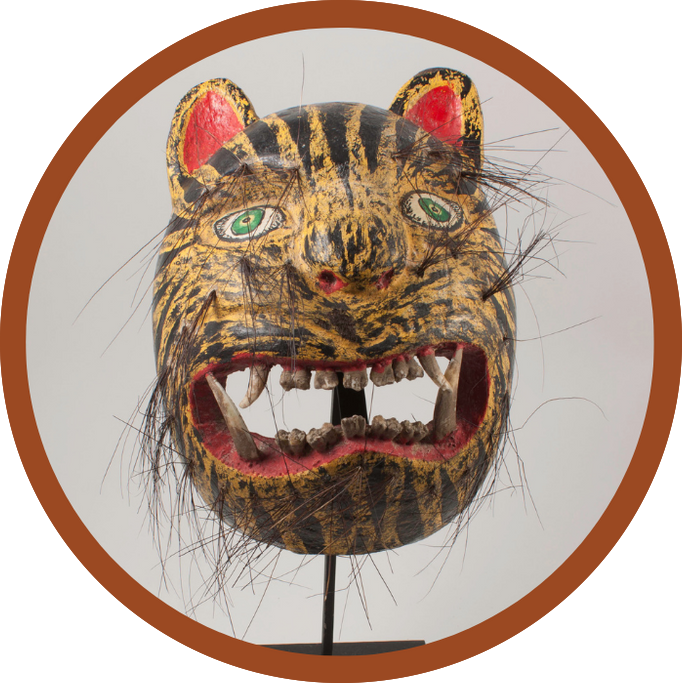
The Jaguar/Tigre masks are distinct in style but can be identifiable by their feline features like a snout, whiskers, and ears. At times they can have a black print painted on top of the yellow, orange, or green base that resembles one of a jaguar or tiger. These masks are commonly seen in various Mexican states like, the eastern state of Puebla, the southern state of Guerrero and Oaxaca, and the southeastern state of Chiapas. These masks are used in various dances. The performances have symbolism relating to rain, fertility, and a good harvest season (Mauldin, 21). The usage of the Tigre/Jaguar imagery can also be tied to the pre-Hispanic Olmec indigenous group (Ruben, 94). In Puebla and Guerrero, the Tigre masks are used in the drama Danza de los Tecuanes (Tecuanes meaning wild beast). In Puebla, it is performed for the November Day of the Dead and for the day of saint San Raphael (Mauldin, 19). The Tigre masks used in Puebla are large and the tiger character participates in a hunting scene with a dog. In Guerrero, the dance depicts the Tigre attacking local animals and, in the end, gets killed by a person.(Mauldin, 43). The Tigre masks in Guerrero vary, there are wooden ones painted yellow with black circles (Mauldin, 54). At times there are also jaguar masks made of leather which are painted green or yellow. The jaguar masks are used from May 3rd to the 5th in the Zitala community and fighting competitions are done during those days (Mauldin, 55). Oaxaca has a Tigre drama called Tejorones. The southern part of Oaxaca performs such a drama on November 4th, days after day of the dead. The masked individuals go from home to home expelling the spirits of the dead (Mauldin, 59). The Tejorones dance has the Tigre trying to kill animals and cause chaos. The masks have mirror for eyes, and it is worn on the top of the head. A scarf is used in order to cover the exposed parts of the dancer’s face (Mauldin, 61). In Chiapas, there is a pre-Lenten carnival that coincides with the beginning of the planting season there. The dances done then are related to animals and hunting. The Tigre masks are used for El Calalá dance in which a tiger interacts with a deer; the tiger being the aggressor. The mask consists of a helmet made with a gourd or sculpted wood. There is also painted cloth that is attached to cover the face and neck of the dancer (Mauldin, 12).
Citation:
Video of Danza de los Tecuanes:
Dance of the Jardineros
This is a variation of the dance drama of the Moors and Christians, distinguishable by its own sub-narrative. This dance drama is performed for the feast day of the Virgin of Rosario and on January 2nd and 8th. In this variation, the Moors and Christians are led by their respective kings and queens and are accompanied by their courts. In the end, the Moors accept Christianity.
Citation:
Dance of Los Viejos
These dances are found in the states of Michoacán and Mexico, but are performed widely in Michoacán. The dances always include masks that portray an old, nearly toothless protagonist. Across Mexico, the Viejo/Viejito character can appear in many dances and as many different characters. Some of these masquerades have come to overtly reject Spanish and mestizo values through the story told in the dance.
In the Veracruz Huasteca region and in Puebla, the Viejos represent the dead, and the dances may be performed on Dia de Todos Santos and/or the Day of the Dead.
In Michoacán, it celebrates the cycle of life, the wisdom of old age, and the enduring traditions of Mexican culture. It is a symbol of the country’s rich cultural heritage and an essential part of its identity. It is also performed in celebrations honoring the birth of Jesus on December 24th.
Citation:
Video of Los Viejos during Day of the Dead celebration:
Video of Dance of the Viejos:
African influence in Mexican dance dramas
African influence on dance and masquerade is strong in the coastal states of Mexico. Afro-Mexican communities are mainly located in the states of Guerrero, Oaxaca, and Veracruz. La danza de los Negros (still widely translated into English by its literal translation, Dance of the Negros), is a dance commonly performed in Michoacán, Oaxaca, and the Sierra de Puebla. It is widely varied depending on local historical traditions and ethnicity of participants. Often, these masks are associated with wealth, good fortune, and magical powers. The dance characters are not based solely on racial categories, but are a synthesis of pre-Hispanic symbolism and the memories of the presence of enslaved peoples in the region.
In Michoacán, the dance is performed between December 25th and January 6th as part of winter ceremonies. It is often associated with the birth of Christ. In Oaxaca, the black-painted masks with upturned tusks are part of the Dance of the Conquest and Dance of the plumes.
Citation:
Dance of the Fisherman
This dance is an Afro-Mexican fishermen, wearing black-painted masks, against a supernatural caiman, supposedly identified with Tlaloc, the pre-Hispanic rain-making god.
Citation:
Negritos Masks
These masks can be identified by the black paint base, prominent human nose, mouth, and mustache. Occasionally they have a goatee and eyebrows. These masks are stylistically distinct to a certain degree considering it is a very common mask seen throughout various Mexican states in distinct regions. Those states being Michoacán (West-Central), Chiapas and Puebla (East), Guerrero (South), and Oaxaca (South). At times the Negrito character is used to represent fertility for crops. In other instances, they can be used in a more humorous way.
The concept of these masks is controversial. The features seen on the masks are exaggerated and unrealistic. They seem to stereotype this image of what Black people look like. It is said that Mexicans have imitated the Cubans and North American blackface concept (González, 91). This in turn can cause the audience to form an opinion based off of their cultural beliefs and not the actual reality. This causes the further perpetuation of possible existing archetypal myths and stereotypes towards the Afro-Mexican community (González, 93). At the same time, it is said that these Negritos masks are inspired by the enslaved persons from Africa that were brought there by the Spanish from the sixteenth to eighteenth century (Mauldin, 5). This could be so considering the Negrito dance and masks are the most popular in the coastal states which is where most enslaved persons settled (Cordy, 38). The Africans are depicted with respect considering the high esteem the indigenous people in Mexico would have for these slaves; they were able to tend the land well and managed to maintain their dignity (Mauldin, 5).
In the mountain villages of Uruapan, Michoacán there is a performance done during the Christmas season with the Negritos mask, it is considered to be the most prestigious or important dancer for that performance (Mauldin, 81). The Negritos masks for the most part is black in color and have fine facial features but can differ a bit throughout the state, in some areas the mask can be light in color, or the Negritos character would wear large sheepskins on their head and shoulder. (Mauldin, 81).
Chiapas, the Negritos masks are seen in the Pre-Lenten festival as well as the day of Saint Sebastian, January 20th (Mauldin, 9). They carry stalks of corn, this being a symbol of fertility for the crops (Mauldin, 7). The costumes used with the masks are made out of fur and plant fibers that have close ties to the Pre-Hispanic costume traditions (Mauldin, 9).
The highland area of Puebla has various Negrito dances. One of them has the Negrito characters wear elegant clothing and hats that are decorated with strings and glass beads. The dance usually has twelve men, two of them wear masks and hype up the audience with the goal to make them dance (Mauldin, 19). The Negritos interact with the female character Malinche that carries a snake. That snake bites a Negrito and only revives once the snake is killed. The implementation of the snake relates to symbolism of rain and fertile crops (Mauldin, 20). The mask used seems to be made of wood and has a black coat of paint. The mask also doesn’t have eyebrows but does have a mustache and goatee (Mauldin, 23).
Guerrero has a variety of mask types and dances considering that there is a diverse and big population of indigenous peoples. (Mauldin, 43). The Nahuas have masked pageants where the Dance of the Snakes is performed. This dance involves the Negritos masks made out of black papier mâché and the character wears elegant clothing with colorful ribbons. Near the border that is near Puebla communities from both sides also celebrate with one another, their Negritos masks are wooden. (Mauldin, 44). In the Teronsillo pageant ranch life is the prevalent theme. The Negritos are portrayed as cowboys. The Teronsillo dance depicts the killing of a bull. The Negritos masks used for this dance are quite particular, They contain puffy hair and there is a hole in the center of the lips so that the dancers can smoke and imitate the character of a cowboy (Mauldin, 58).
Oaxaca is best known for their version of the drama Danza de Pluma, the characters that do wear masks are the exception of a few Negritos (Mauldin, 59). The style of the Negritos masks can vary for this dance. There are masks with exaggerated African facial features. The mask itself is black in color. The cheekbones are prominent as well as the nose and lips being large in size. The lips and eyebrows are red and create a contrast. On the other hand, there are also more realistic masks considering that the facial features are more to human proportion. The mask is completely black and doesn’t have any exaggerated aspect to it. There is also another dance that is humorous. The mask used is not realistic at all considering the tusks and protruding mouth. The color palette for the mask being black, white, and red. The masks are suggested by scholars to be a pre-Hispanic representation of supernatural beings that are disguised with animal features (Mauldin, 67).
Citation:
Recommended further reading:
Deaderick, Lisa. “Latina Professors Discuss Use of ‘Negrito’ and ‘Negrita’ in Latin Culture, after J.Lo Controversy.” The San Diego Union Tribune, November 1, 2020. https://www.sandiegouniontribune.com/columnists/story/2020-11-01/latina-professors-discuss-use-of-negrito-negrita-in-latin-culture-after-j-lo-controversy.
Video of Danza de Negritos:
Video of Danza de la Pluma: