
About the Project
Goals of the Project:
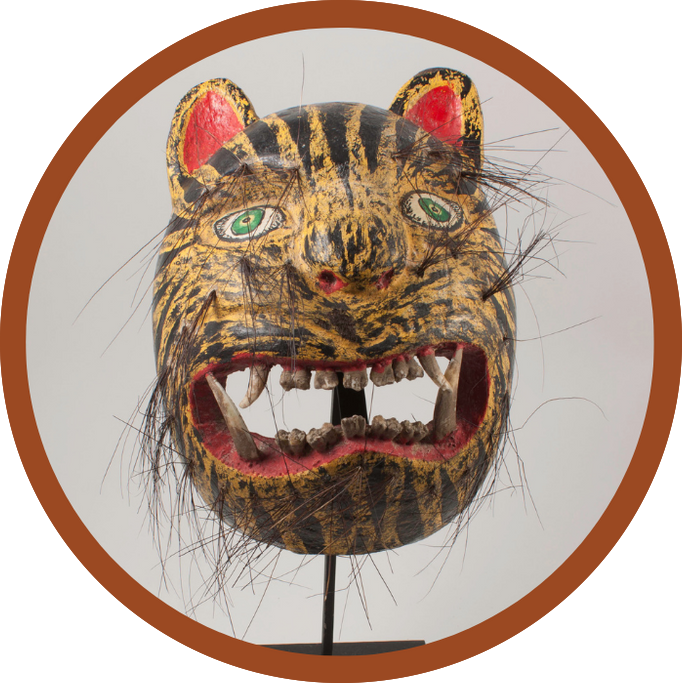
This project is a digital archive of the Mexican masks of the May Weber collection.
This site aims to be a place of exploration. The collection houses nearly 500 masks, each unique and with a unique story to tell. So, above all else, we want users to engage with the masks and learn about them and from them.
This site also aims to be a teaching resource. There is a collection of further reading secondary sources under the lessons plan page. The festivals and dances page has a collection of descriptions of the most populous dances as well as present day examples of each. The two pre-made lesson plans are examples of how to pull together the primary and secondary sources available on the site to use the masks in a classroom.
Additionally, by getting pictures and information about each of these masks online, we hope it can be used as a collection of comparables for those doing research.
History of the Project:
This project is a collaboration between Loyola University of Chicago Digital Humanities Master's student Caroline Houser and the May Weber Ethnographic Study Collection of Loyola University of Chicago, directed by Dr. Catherine Nichols.
All of these masks were collected originally by Dr. May Weber, and her information is what mainly populates each record associated with masks. Further information and research provided for the masks were given by Dr. Catherine Nichols, Oaxacan artist Carlos Orozco, and three graduate Loyola students.
In May of 2018, Oaxacan artist Carlos Orozco came to Loyola University of Chicago and did a consultation on the Mexican Mask collection. A similar consultation session was done with three graduate students at Loyola, Victoria Duran, Marina Alvarez, and Sammy Hernandez.
This site does not seek to be an authority. Our mission is to make the collection available to all for users to use and comment on however they choose. We aim to put all the information we have available on the site to best contextualize the masks without presenting the site as an authority, but rather as a resource for professors and students, as well as for people searching for comparable masks.
We accept any comments and critiques. All will become incorporated into the site to make the records living records.
Many, if not all, of the records on the site are incomplete as we do not have all the information. May Weber was an eclectic record keeper and often did not record anything on her own inventory sheets, so many questions cannot be answered, such as: Where did she get them from? How did she get them? Who gave her the information about them?
If you have questions or comments about the blank spaces on the records, we do as well. Please feel free to contact us on the contact page. We want this site to open dialogue not just about the masks themselves, but also the impacts, implications, and ethics of collecting as a whole.
Editorial Choices:
The title of each mask is the unconventional name and therefor was created by someone working with the masks at some point during their time at Loyola. Some of the masks were titled by undergraduate students when cataloging them, and some were named by Caroline Houser, based on my subjective observations. Many of the titles are based on something unique and easily identifiable from May Weber's description of the mask (e.g. Luzvel mask). Using titles like this allows a user browsing through the gallery to quickly know what the mask might be about. Other titles are created (e.g. Mask with long hair) when there is no identifiable information available about the mask. The decision was made to create titles that describe physical attributes about the mask.
Another point to be explained is May Weber's comments in the records. Caroline Houser edited them into sentences for clarity for the user. No information was left out and her words remain. Examples of what was done are: changing an equals sign into words, changing colons into words, etc. Further, Carlos's comments were edited into sentences by Hector, an undergraduate Anthropology student.
About Us:
We acknowledge that our knowledge is shaped by our biases and past experiences. We strive to be transparent and accountable for our work. We will make mistakes, and we want to be held accountable for those. This site is not and does not aim to be an authority on these masks. We know that we are not the most knowledgeable about these masks, and we are open to any and all comments, questions and critiques. Research has been done and will continue to be done about these masks. This site is not the ending point for the information about them; it is hopefully a starting point.
Based on the work of Data Feminism, we want to let our users know the learning contexts from which we come:
Caroline Houser is a graduate of the Digital Humanities Master Program at Loyola University of Chicago. Before that, she graduated from Loyola with a B.S. in Anthropology and a B.A. in Global and International Studies, with minors in French and Spanish. Since the beginning of her academic career at Loyola, she has had an interest in all areas of Anthropology, but with a particularly vested interest in material culture and museum anthropology after taking a few classes with Dr. Catherine Nichols. After the global shutdown caused by COVID-19, she was further interested in how the digital can further the mission of cultural institutions: to be resources for the communities in which they exist. This lead her to the Digital Humanities program at Loyola, and thus this project was born. Outside of academics, Caroline is a native of Portland, Oregon but has been a transplant in Chicago for over 6 years. She experiences significant privilege from her whiteness, ability, and education, among other things.