Butterflies and Rooks: Non-human subjects in To the Lighthouse
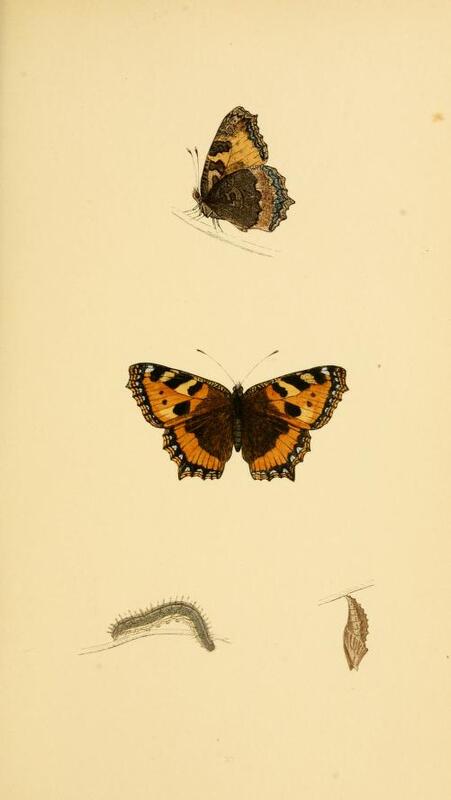
By considering Woolf’s blending of realism, memory, and fantasy in the environment of To the Lighthouse and by using Marlan’s slow reading method, it is possible to begin to draw connections between the non-human subjects of the novel, and wider conversations that concern Woolf. In section nine of “Time Passes,” nature reclaims the house in the absence of human occupants. “Tortoise-shell butterflies burst from the chrysalis and pattered their life out on the window-pane.”[1] These butterflies are another convergence between memory, fantasy, and nature. In her memoir, A Sketch of the Past, Woolf details many early memories of her time in St. Ives, including a mention of the children’s Entomological Society, and her role as the name finder for the insects they trapped. She notes that she used a copy of “Morris’s Butterflies and Moths” for this job that was gifted to her by Jack Hills, her half-sister Stella Duckworth’s fiancé. Editor Jeanne Shulkind notes that Francis Orpen Morris wrote several books on natural history including A History of British Butterflies (1853) and the four-volume A History of British Moths (1859-70), but that he wrote no book titled Butterflies and Moths.[2]
In Morris’ A History of British Butterflies, the entry on the small tortoise-shell butterfly begins:
"This is one of our most common species, and therefore but little thought of in comparison with others of greater rarity. It is, however, a handsome insect, and in its general markings very much resembles the Large Tortoise-shell, though the difference of colour instantaneously distinguishes the two.
"The perfect insect, there being two broods, appears in the beginning of July, and the latter end of August or September. The second brood often survive the rigours of even our northern winter, and is seen again the following spring, flitting gaily among the early flowers of the garden, or along the grassy 'Banks and Braes;' and anon borne away by some fitful breeze of the uncertain season (72)."[3]
The reference to “Banks and Braes” as well as to northern winters, implies that, like the garden plants, this common species of butterfly thrives in both Cornwall and in Scotland. Even though this book presents as a scientific record of species, it is not free of whimsy, commenting on the beauty of the insect, and offering a romanticized representation of its life cycle. Like Woolf’s novel Morris’ taxonomy blends fantasy and reality in its discussion of natural history. This butterfly also connects Woolf’s biography, her childhood experiences, and her fiction, without reducing the plot or characters into autobiographical facsimiles. The butterfly thus actively draws attention in multiple directions, reinforcing the multiplicity of interwoven threads active within the novel.

One of the persistent topics of discussion in Environmentalism and by extension Ecocritical literary studies, is the exploration of how humans relate, or fail to relate to natural non-human subjects. Only recently have critics begun to question patterns of anthropocentrism baked into the humanism that is so foundational, especially in Western thinking. “Anthropocentrism, as an ideology, functions to maintain the centrality and priority of human existence through marginalizing and subordinating nonhuman perspectives, interests, and beings.”[4] Importantly, anthropocentrism, as a deeply ingrained ideology, is often linked by environmental sociologists and critics to other ideologies of marginalization, othering, and oppression. If humans are able to easily justify superiority over animal and other non-human subjects, then we are also more easily able to justify superiority over one another.
Woolf expresses concerns about anthropocentrism in To the Lighthouse in discussions about the rooks living in the Ramsay’s garden. Mrs. Ramsay watches two rooks she has named Mary and Joseph from the window while she dresses for dinner in section sixteen of “The Window,” and challenges her young son’s patterns of violence against the birds. It disturbs Mrs. Ramsay that her son, Jasper, shoots birds for fun in the garden. She asks him, ‘“Don’t you think they mind...having their wings broken?”’[5]. Mrs. Ramsay understands these birds as co-occupants of the house and garden, with names and feelings.In contrast, Jasper Ramsay feels distinctly separate from the birds he hunts. In response to his mother’s question:
"He shuffled a little on the stairs, and felt rebuked, but not seriously, for she did not understand the fun of shooting birds; and they did not feel; and being his mother she lived away in another division of the world, but he rather liked her stories about Mary and Joseph. She made him laugh."[6]
Jasper, even as a small child, already operates within strict guidelines imposed by cultural patterns and expectations. In this passage, he is drawing boundaries, not only between himself and the birds, but also between himself and his mother. For Woolf, Jasper’s patterns of separating himself from animal concerns and his learning to separate himself from women’s concerns are related.
Mrs. Ramsay is joined in anti-anthropocentric feeling by the anonymous contributor of this article to the Times in 1918, who also describes rooks using very human language.
The correspondent writes:
"Gregarious birds never sing, for singing is with birds an expression of defiance, But rooks undoubtedly converse, if we do not use that term in an exacting sense; they prate aloud in company, and appear to feel all the better for it. What wonder if birds of such temper have occasionally been credited by the sympathetic race of men with more of our own attributes than they perhaps possess?"[7]
The correspondent challenges the anthropocentric division between the birds and humans, describing the two species as “Allies of Civil Life.” Near the end of WWI , when this article was printed, the term “Ally” would have carried the connotation of military allies, and yet, the correspondent specifically labels the rooks as civil allies. This distinction aligns the rooks with a kind of home-front mentality, depicting them as preservers of a pre-war, peaceful English countryside. This article connects and relates humans and rooks in order to leverage a hopeful tone during a difficult national crisis. The non-human subjects, the rooks, become like humans in their behavior and feelings as a message of solidarity. In her last novel, Between the Acts, Woolf also associates rooks with the English pastoral.
[1] Woolf, Virginia. To the Lighthouse, edited by Mark Hussey, Harcourt Brace, 2005, pp. 141
[2] Woolf, Virginia. “A Sketch of the Past.” Moments of Being, edited by Jeanne Schulkind, 2nd ed. Harcourt Brace Jovanovich, 1985. p. 104.
[3] Morris, F.O. “Small Tortoise-shell.” A History of British Butterflies. Groombridge and Sons, 1853, p. 72. Biodiversity Heritage Library, https://www.biodiversitylibrary.org/item/51338#page/142/mode/1up
[4] Weizenfeld, Adam and Melanie Joy. “An Overview of Anthropocentrism, Humanism, and Speciesism in Critical Animal Theory.” Counterpoints, vol. 448, 2014, p.4. JSTOR, : https://www.jstor.org/stable/42982375
[5] Woolf, Virginia. To the Lighthouse, edited by Mark Hussey, Harcourt Brace, 2005, pp. 84.
[6] Woolf, Virginia. To the Lighthouse, edited by Mark Hussey, Harcourt Brace, 2005, pp. 84.
[7] A Correspondant. “Rooks and Men: Allies of Civil Life." The London Times, 26 Mar. 1918. The Times Digital Archive, Gale Primary Sources, https://link.gale.com/apps/doc/CS152636026/TTDA?u=loyolau&sid=bookmark-TTDA&xid=de813217