The Fishing Economy
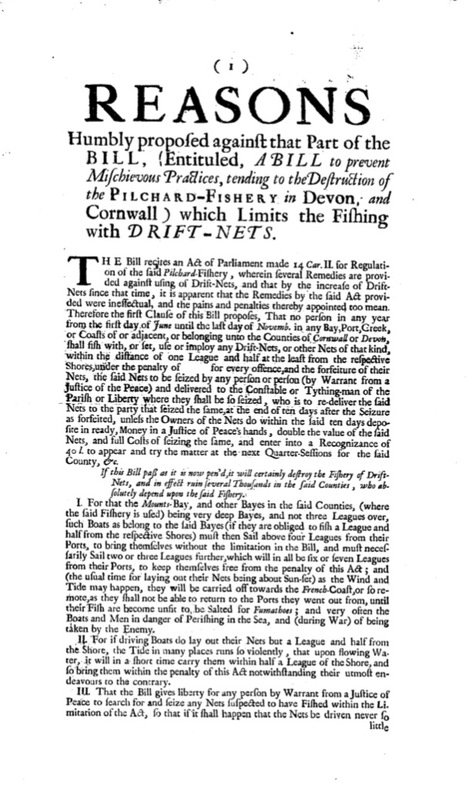
Woolf’s impression of a town untouched by time would have been particularly accurate in regard to the fishermen who made their living in the coastal communities. At the turn of the twentieth-century, the fishing industry was central to the economies of villages located along the British coast, as it had been for generations. Fishermen contributed to both the local and national economy with the fruits of their labors from the time of William the Conqueror to Woolf’s own time. Indeed, the autumn herring season off the coast of Yarmouth was so essential in the eleventh century that the king announced a “cessation of hostilities” between armies at Dover on the eastern coast to accommodate the fishermen’s catch.1 In the late seventeenth century, a change was proposed to a bill in Parliament that would restrict the use of “drift-nets” in coastal fishing, arguing that “If this bill passes as it is now pen’d, it will certainly destroy the Fishery of Drift-Nets, and in effect ruin several Thousands in the said Counties, who absolutely depend upon the said Fishery.”2 Even inland citizens became particularly dependent on the fishing industry during wartime, when there were often rations on agricultural foodstuffs and interruptions to imported food.3 Additionally, during war fishermen frequently joined the military service, providing a ready supply of skilled naval personnel.4 Fishing was thus one of the oldest and most essential industries of the British economy, long recognized as such by the highest levels of government in times of peace and war.
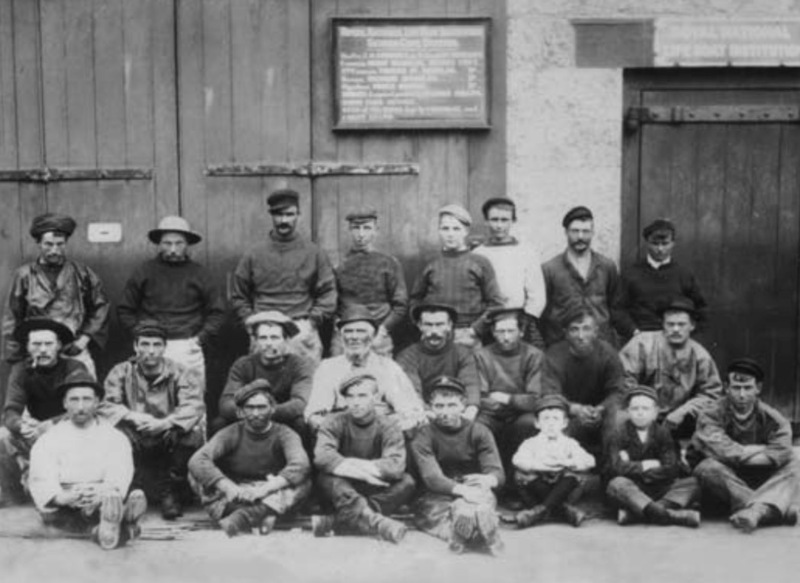

Fishing communities were founded along the coastline in areas that were originally “cellar settlements” where seasonal fishing lodges or cabins were constructed to temporarily house fishermen.5 The seasonality of fishing impacted every aspect of local life, from the timing of marriages to births that occurred nine months after the fishermen returned home.6 More than just an occupation or way to earn a living, fishing has long been considered a “way of life” in coastal villages.7 Fishing was a highly specialized industry that required extensive training and a large labor force, as such it was often passed down as an occupation from one generation to the next. Woolf portrays those close kin relationships in the novel through the characters of Macalister and his son, simply called “Macalister’s boy,” who convey Mr. Ramsay, James, and Cam on the long-anticipated journey to the lighthouse.8 Efforts were made to retain each subsequent generation in order to maintain the labor force needed to sustain the local economies of seaside villages.9 In the late nineteenth-century, census records show that in one Cornish fishing village, 96.8 percent of the fishermen had been locally born and raised.10 This made many of the communities both close-knit and insular. Prior to mass transit systems, such as railways, many coastal villages would have had limited interaction with outsiders. Fishermen and their families would have formed strong emotional attachments to their hometowns, which would have contributed to the unique cultures that developed in their remote locales and gave rise to a sense of self-sufficiency on the peripheries of the British Isles.11
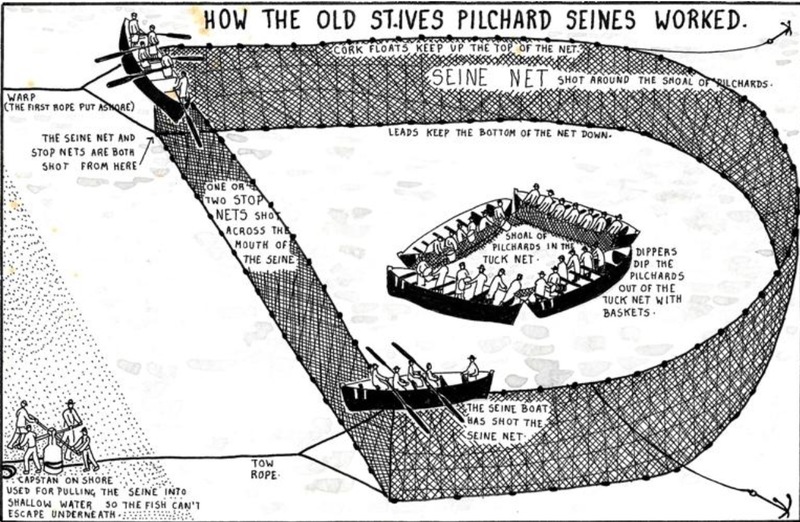

The fishing method used by fisherman in Cornwall, which Woolf would have seen first-hand during her summers in St. Ives, is considered the oldest method for bulk fishing in the sea.12 In Cornwall, a shoal of pilchards––also known as sardines––would be surrounded by a net called a “Cornish pilchard seine” that reached from the surface of the sea to the bottom of the bay.13 Once the shoal was surrounded by the net, the fishermen would guide it closer to the coast where smaller seines could be used as scoop nets to haul in the catch.14 Given the scale of such an operation, it’s no surprise that a large and highly trained labor force was required to execute the complicated choreography of the catch. Over time, larger gear led to larger catches, but it was also expensive to produce large seine nets and to operate them.15 The Cornish pilchard seines were one of many fishing methods used along the Cornish coast and throughout Britain to catch a variety of fish including herring off the west coast of Scotland. Export and domestic demand for herring fell in the inter-war period following the first World War in part because of political upheaval in Russia in 1917 and changing taste preferences at home.16 The economic well-being of fishing communities thus often depended on factors outside their control.
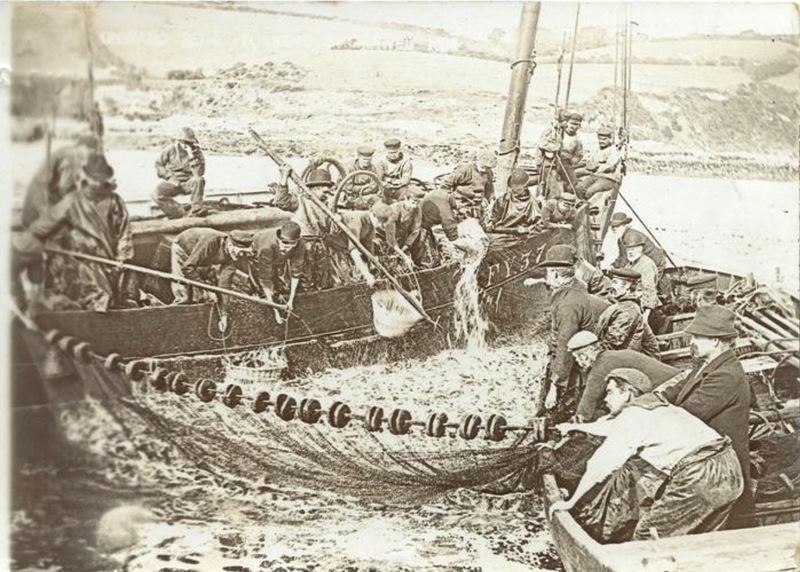

Woolf most clearly remembers the pilchard nets and boats from her time at St. Ives. In “A Sketch of the Past,” Woolf describes how a watchman known as the “Huer” would sit with his telescope, “looking for a purple stain of pilchards to come into the bay” so he could announce their arrival with a “long high clear hoot of sound.”17 Yet, she recalls that “year after year the boats lay in the bay. The seines were never shot. The fishermen grumbled that the steam trawlers at Newlyn (perhaps) had disrobed the pilchards; driven them out to sea.”18 Even as a child, Woolf recognized the precarity that governed the lives of the fishermen of St. Ives Bay. The fishing community across Britain was dependent on numerous external variables, such as climate conditions, that could negatively impact the catch in any given year.19 During the dinner party in To the Lighthouse, the men insist that “the fishing season was bad; that the men were emigrating. They were talking about wages and unemployment.”20 This scene is reminiscent of Woolf’s memories of her own father, who had “a curious sympathy for the poverty of the fisher people: a respect for fishermen.”21 Increasingly low yields in the late nineteenth and early twentieth centuries threatened the economic well-being of coastal towns, and it threatened their very existence when fishermen felt compelled to move away in search of economic security. This would have been particularly true in Scotland, where political evictions known as the Clearances were issued in the decades following Scottish rebellions in the eighteenth century, driving a forced resettlement of Scottish natives to the rocky coast.22 Famine and lack of opportunity would have led to emigration, which would severely impact such small and close-knit communities.3 In many cases, though, fishermen chose to continue living and working in fishing communities in spite of hardships because their “relation to fishing [was] expressive and existential.”24 For villages like St. Ives and so many others, fishing was more than a mere livelihood, it was a longstanding and hard-earned cultural identity.
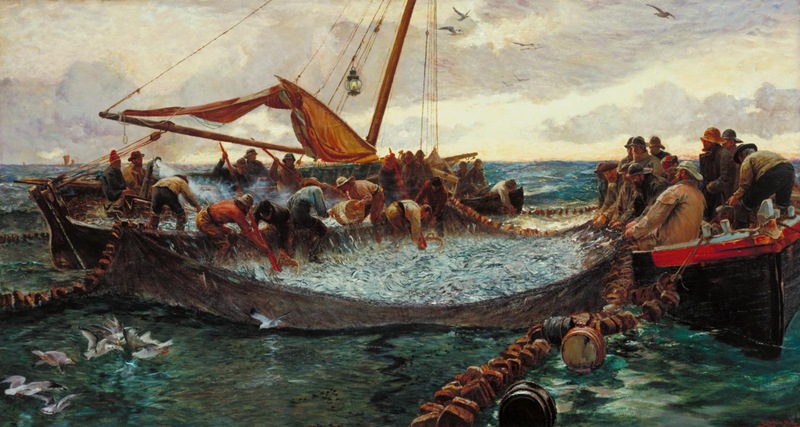

The keen sense of self and sense of place exemplified by fishermen might explain why so many visual artists were keen to use them as the subjects of their paintings. Several artists colonies were established in Cornwall in the final decades of the nineteenth century as part of a movement to “liberate” art into the open air.25 The artists Charles Napier Hemy (1841-1917) even chose to go a step further in pursuing his inspiration, choosing to take his work onto the open water.26 Hemy converted a seine barge into a floating studio, “equipped with skylights and picture windows to maximise the light” so he could sketch the fishermen at work.27 Hemy’s painting Pilchards, on display at the Tate Britain, was the product of fourteen years of sketches and a frenzied ten days of painting culminating in a monumental oil painting measuring nearly seven feet wide. It depicts fishermen scooping pilchards trapped by a seine net, a fruitful harvest that would have left the crew “excited and jubilant.”28
Much like visual artists, Woolf was occasionally drawn to fishing metaphors in her own writing. Woolf describes her childhood experience of fishing in St. Ives Bay as a “passion” unlike anything else, “for the thrill and the tug had been perhaps the most acute I knew then.”29 It’s easy to imagine that Woolf encountered the same “thrill and tug” in her writing process. Upon finishing a draft of The Waves, her seventh novel, in February of 1931, Woolf wrote in her diary that she had “reeled across the last ten pages…I have netted that fin in the waste of waters.”30 The process of writing could be just as precarious as the process of fishing, waiting for the conditions to be right to reel in the fish or net the long-awaited inspiration.
1 Maryanne Kowaleski. “The Seasonality Of Fishing In Medieval Britain,” in Ecologies and Economies in Medieval and Early Modern Europe, vol. 1 (2010): 118.
2 Reasons most Humbly Proposed Against that Part of the Bill (Entituled, A Bill to Prevent Mischievous Practices, Tending to the Destruction of the Pilchard-Fishery in Devon and Cornwall) which Limits the Fishing with Drift-Nets. s.n, 1680.
3 E. E. D. Day. “The British Sea Fishing Industry.” Geography 54, no. 2 (1969): 165.
4 Day, 165.
5 Kowaleski, “The Seasonality of Fishing,” 118.
6 Kowaleski, 118.
7 Julie Urquhart and Tim Acott. “A Sense of Place in Cultural Ecosystem Services: The Case of Cornish Fishing Communities.” Society & Natural Resources 27, no. 1 (2014): 7.
8 Virginia Woolf. To the Lighthouse. (Orlando, FL: Harcourt, 1981), 162.
9 Michael John Ireland. “Tourism, Kinship, and Social Change in Sennen Cove, Cornwall,” in Contesting the Foreshore, vol. 2 (2019): 111.
10 Ireland, 112.
11 Urquhart, and Acott. “A Sense of Place in Cultural Ecosystem Services,” 5.
12 Otto Gabriel and Andres von Brandt. Fish Catching Methods of the World. 4th ed. (Oxford, UK: Blackwell Pub., 2005), 439.
13 Gabriel, and von Brandt, 449.
14 Gabriel, and von Brandt, 449.
15 Gabriel, and von Brandt, 432.
16 Day, “The British Sea Fishing Industry,” 172.
17 Virginia Woolf. "A Sketch of the Past," in Moments of Being: Autobiographical Writings, ed. Jeanne Schulkind. (London: Pimlico, 2002), 135.
18 Woolf, “A Sketch of the Past,” 135
19 Ireland, “Tourism, Kinship, and Social Change,” 117
20 Woolf, To the Lighthouse, 93-94.
21 Woolf, “A Sketch of the Past,” 136.
22 Thomson, David. “Hebrides and west coast of Scotland: The social and cultural importance of the coastal fishing communities and their contribution to food security,” in Understanding the Cultures of Fishing Communities: A Key to Fisheries Management and Food Security. Food and Agriculture Organization of the United Nations, 2001. <https://www.fao.org/3/Y1290E/y1290e0i.htm#bm18>.
23 Thomson.
24 Urquhart, and Acott. “A Sense of Place in Cultural Ecosystem Services,” 7.
25 Catherine Dinn. “Artists Afloat: Tuke and Hemy at Sea," The British Art Journal 18, no. 1 (2017): 102.
26 Dinn, 102.
27 Dinn, 104.
28 Woolf, “A Sketch of the Past,” 135.
29 Woolf, “A Sketch of the Past,” 139.
30 Virginia Woolf. Selected Diaries, ed. Anne Oliver Bell. (London: Vintage, 2008), 297.