What is Post-Impressionism?
Aptly named, Post-Impressionism succeeded Impressionism as an artistic movement, diverging from the latter with a new heightened attention to form and a rejection of naturalism. Balancing the relationships between the various elements of an artwork and organizing them into an overall composition – in sum, a work’s form – became the primary motivating principle behind a Post-Impressionist piece of art.[2] Post-Impressionists sought a sense of order, harmony, and proportion between the formal elements of a work, such as linear rhythm, mass, space, light, shade, and color.[3] Lily Briscoe herself wrangled with such aesthetic questions, as she pondered “how to connect this mass on the right hand with that on the left. She might do it by bringing the line of the branch across so; or break the vacancy in the foreground by an object (James perhaps). But the danger was that by doing that the unity of the whole might be broken.”[4]
In this way, form for the Post-Impressionists became the very content or subject of an artwork. Impressionism, despite its innovation with brushstrokes and the interplay between color and light, still sought to capture the realism and naturalism of a subject; Post-Impressionism, on the other hand, challenged the assumed necessity of narrative or representational content in art. For Lily Briscoe, James is an “object”[5] whom she can insert into her painting to balance its composition, rather than the central subject of a realistic portrait. Similarly, it is a “triangular purple shape” which represents Mrs. Ramsay and her son on Lily’s canvas, unidentifiable in this abstracted, geometric form to Mr. Bankes.[6] Rather than restricting themselves to literal renderings of objects, the Post-Impressionists experimented with formal elements and pushed the boundaries of representation: in so doing, this “enable[d] the individuality of the artist to find completer self-expression in his work than is possible to those who have committed themselves to representing objects more literally.”[7] The primacy given to form and composition in Post-Impressionism thus equipped a new generation of artists with modern tools to explore, embody, and express modern emotions.
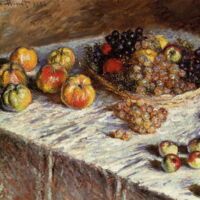

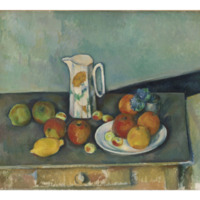

To better illustrate this ground-breaking departure from Impressionism’s naturalism and the new orientation towards formalism which Post-Impressionism undertook, we can compare and contrast artworks from their respective movements. Many are familiar with the haystacks or waterlilies of Monet, Impressionist par excellence; fewer, perhaps, with the work of Paul Cezanne, one of the first Post-Impressionists to gain renown in England and even referred to as “the Christopher Columbus of a new continent of form.”[8] In his Still Life with Apples and Grapes, Monet produced a careful rendering of his impression of this moment: his short brushstrokes suggest the complex folds and texture of the tablecloth; the reflection of light off the surface of fruit – even off of each individual grape – and delicate shadows depict the realistic three dimensionality of each object. But to a modern, Post-Impressionist eye, a still life with fruit represented a prime opportunity to instead examine the relations between the shapes, masses, and colors of each component and compose an orderly scene: at the Ramseys’ dinner table, Lily’s “eyes had been going in and out among the curves and shadows of the fruit, among the rich purples of the lowland grapes, then over the horny ridge of the shell, putting a yellow against a purple, a curved shape against a round shape, without knowing why she did it, or why, every time she did it, she felt more and more serene.”[9] In Cezanne’s Still Life (with Milk Pot and Fruits on Table), the fruit and tablecloth clearly distinguishable as such in Monet’s piece have begun to be abstracted. Cezanne has disregarded the conventional use of light and shadow in creating the illusion of space, instead generating overlapping perspectives of the flattened, geometric objects: viewers see the tabletop from above and various fruits from each their own perspective. The delicately realistic fruits of Monet’s work have become, for Cezanne, masses of bold color; it is the composition and the internal relations between its elements that take center stage in Cezanne’s work.
[2] Caroline Boyle-Turner, “Post-Impressionism,” Grove Art Online, 2003. Accessed 13 Nov. 2021. https://doi.org/10.1093/gao/9781884446054.article.T068996
[3] Roger Fry, “An Essay in Aesthetics,” in Vision and Design (New York: Peter Smith, 1947), pg. 22.
[4] Virginia Woolf, To the Lighthouse (New York: Harcourt, 2005), 56-57.
[5] Ibid, 56.
[6] Ibid, 55.
[7] Desmond MacCarthy (attributed), “The Post-Impressionists,” in Manet and the Post-Impressionists (London: Ballantyne and Co, Ltd., 1910), 7. Accessed 7 Nov. 2021. https://archive.org/details/manetpostimpress00graf
[8] Clive Bell, Art, (New York: Capricorn Books, 1958), 189.
[9] Woolf, To the Lighthouse, 110.