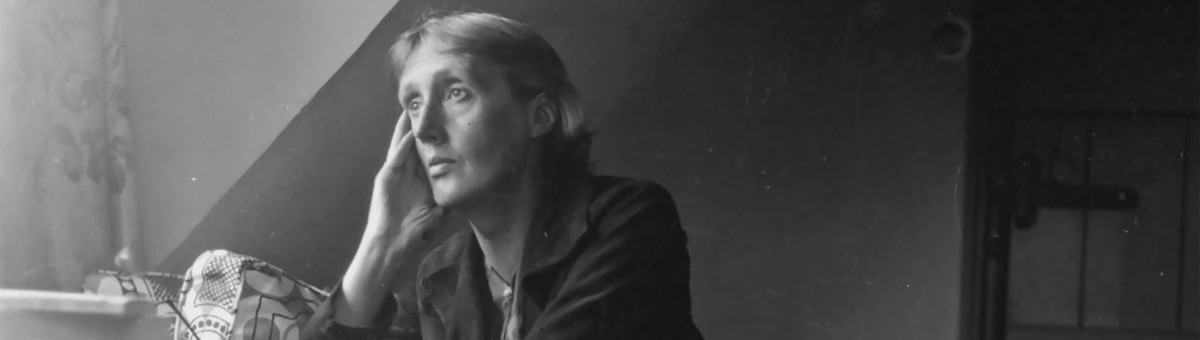
Vanessa Bell and Lily Briscoe
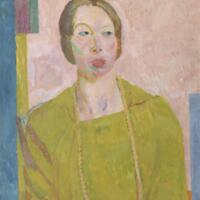
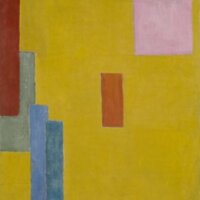
Upon visiting and participating in these Post-Impressionist exhibitions, Bell radically became one of the first artists in Britain to explore entirely non-representational art, and her willingness to experiment placed her among the forefront of the aesthetic avant-garde. The exhibitions “radically altered Vanessa Bell’s life and art” as “[h]er painting, boldly simplified, was now shorn of all detail and intrusive sentiment.”[23] Her artworks became more abstract and their compositions increasingly relied on simplified forms, as can be seen by some of her post-exhibition work including Studland Beach (1912), Abstract Painting (1914), and Mrs. St John Hutchinson (1915).[24]
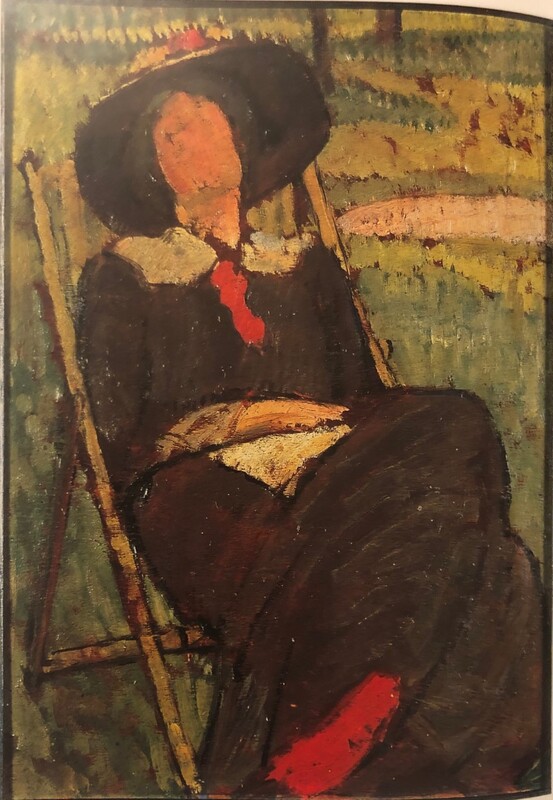
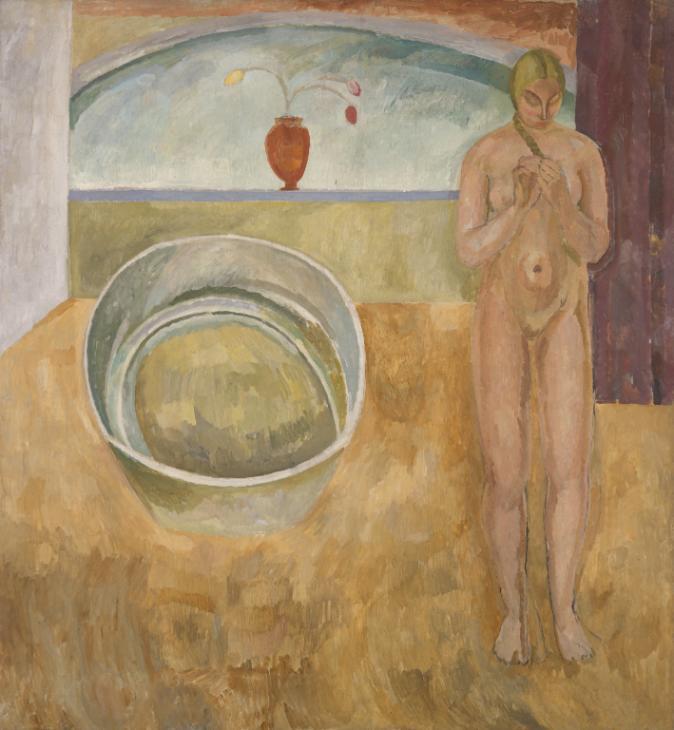
Bell’s artistic style, skill, and challenges are all mirrored in To The Lighthouse by Woolf’s fictional painter, Lily Briscoe. In a portrait of her sister, Virginia Woolf in a Deckchair, Bell famously left her sister faceless, challenging the representational tradition by sacrificing individual details in order to prioritize larger visual patterns.[25] Woolf’s character Lily Briscoe similarly concludes that “‘one way of knowing people’ is by ‘the outline, not the detail’.”[26] Furthering the kinship between the painters is their artistic struggle with form, space, and composition. Throughout the novel, Lily agonizes over her composition, specifically its components’ arrangement in space, as we see when her mind wanders at the dinner party: “Yes, I shall put the tree further in the middle; then I shall avoid that awkward space. That's what I shall do. That’s what has been puzzling me.”[27] Bell struggled similarly with space, with Woolf writing to her in a letter that “I expect the problem of empty spaces, and how to model them, has rather baffled you."[28] A critique of Bell’s work as it appeared in an exhibition at the Leicester Galleries charged her with “flat passages, so that the design is not completely comprehended.”[29] We may consider Bell’s The Tub as a case study of her struggle with space; as we can see below, though the figure and the tub are visually united by the curving lines, as well as ground below and the wall behind them, the large, flat sections of the painting interfere with the viewer’s ability to make sense of the image.[30]
[23] Frances Spalding,”Bell, Vanessa," Grove Art Online, 2003. Accessed 15 Nov. 2021. https://doi.org/10.1093/gao/9781884446054.article.T007587
[24] Naomi Blumberg, "Vanessa Bell," Encyclopedia Britannica, 26 May 2021. Accessed 15 Nov. 2021. https://www.britannica.com/biography/Vanessa-Bell
[25] Diane F. Gillespie, “Virginia Woolf, Vanessa Bell And Painting,” in The Edinburgh Companion to Virginia Woolf and the Arts, ed. Maggie Humm, 121–39. (Edinburgh: Edinburgh University Press, 2010), 127.
[26] Woolf, To the Lighthouse, 195.
[27] Woolf, To the Lighthouse, 88-89.
[28] Letter from Virginia Woolf to Vanessa Bell, quoted in Henry R. Harrington, “The Central Line down the Middle of ‘To the Lighthouse,’” Contemporary Literature 21, no. 3 (1980): 371. Accessed 15 Nov. 2021. https://doi.org/10.2307/1208247
[29] Quoted in Henry R. Harrington, “The Central Line down the Middle of ‘To the Lighthouse,’” Contemporary Literature 21, no. 3 (1980): 373. Accessed 15 Nov. 2021. https://doi.org/10.2307/1208247
[30] Harrington, “The Central Line,” 373.