Theorizing Form
It is on such experimentations with form and composition as we have seen above which both Roger Fry and Clive Bell theorized and published, contributing to art advocacy, criticism, and theory that shaped British perceptions of modern art and galvanized discussions on form.
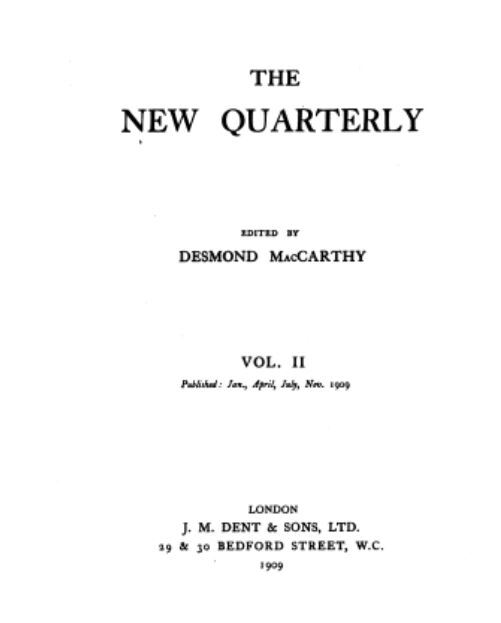
Though Fry was also himself an artist, it is largely the impact of his criticism and theory which fashioned his legacy among British culture and art history. He was a prolific writer, but it was his 1909 “An Essay in Aesthetics” (published in The New Quarterly, which was edited by fellow Bloomsbury Group member Desmond MacCarthy) that largely introduced British society to concepts of formalism in modern visual art. Continuing to promote the fundamentally nonmimetic function of modern art, Fry proposes that art represents “the expressions of the imaginative life rather than a copy of actual life”.[31] For in our day-to-day existence, our focus narrows in on the objects in our immediate vicinity as we are required – often instinctively – to act and respond to “necessary external conditions,” at the cost of being able to dwell on our emotional states;[32] however, in the imaginative life we may spend time in emotional spaces and subsequently “come to notice a number of appearances and relations of appearances” that otherwise would have gone unnoticed.[33] Art, as the “chief organ of the imaginative life,” thus grants us access to the “greater clearness of its perception, and the greater purity and freedom of its emotion”:[34] we reach new modes of perception and emotion when we engage with the imaginative life through art. It is “purposeful order” and “unity” – and, critically, the formal elements of a work which comprise them – that arouse more substantive emotions.[35] Fry then outlines these elements of form which an artist and spectator must consider: rhythm of line, mass and inertia – both the “power of resisting movement, or communicating its own movement to other bodies” – space, light and shade, and color.[36] The significance of art as a formal endeavor, as Fry elaborates in a later essay, is that emotion derived from “the contemplation of formal relations” is more “pure,” more nuanced, and more likely to persist beyond the momentary encounter with an artwork.[37]
Expanding upon Fry’s influential essay – which he called “the most helpful contribution to the science [of art criticism and history] that had been made since the days of Kant”[38] – Clive Bell also considered the relationship between form and emotion in art. Bell begins his interrogation into aesthetics by asking “[w]hat quality is shared by all objects that provoke our aesthetic emotions.” His answer, a phrase he coined himself, is the “significant form” of an art object: the ways in which “lines and colours [are] combined… certain forms and relations of forms, stir our aesthetic emotions.”[39] Thus it is the composition of an artwork’s formal elements which “move us in a particular way, and… it is the business of an artist to combine and arrange them that they shall move us.”[40] Echoing Fry on the implications of form, Bell also asserts that formalist artwork transcends “the accidents of time and place”:[41] rather than art merely imitating a particular moment in history, form and relationships between formal elements enable art to resonate with something more universal.
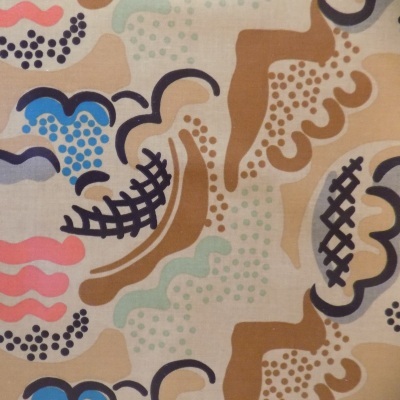
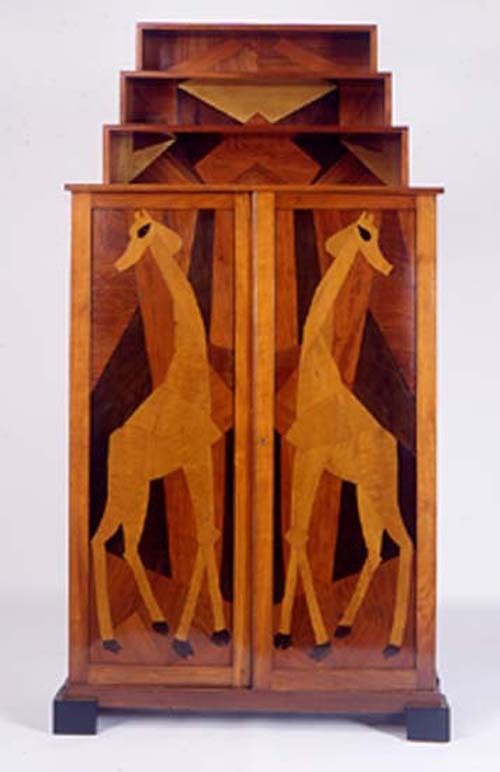
Additionally, much of the Post-Impressionist articulations of form and aesthetics are grounded in interpretations of non-Western or so-called “primitive” art, which gave Western artists a new visual vocabulary to explore. Many European artists identified in “primitive” art an intuitive, uncluttered aesthetic vision – as Fry described it, an “ultra-primitivist directness of vision”[42] – one more attuned with the raw human spirit and inner emotional world.[43] After trade with Japan reopened in the 1850s, a “Japonisme” “craze” for Japanese art and design exposed modern artists to the flatness, stylization, and bright colors of Japanese prints and other art objects;[44] similarly, increased representation of African and Oceanic art in European museums and even artists’ travels outside Europe – perhaps most infamously, Gauguin to Tahiti – exposed them to new patterns, shapes, and iconography which they incorporated into their work.[45] For example, many of the decorative objects made in Fry’s Omega Workshops – studios that sought to incorporate the aesthetics of “fine art” into functional, decorative art objects – bear the influence of non-Western design elements: Duncan Grant’s cloud textile resembles the flat, graphic lines and colors of Japanese ukiyo-e prints, while Roger Fry’s giraffe cupboard echoes the bold geometric forms of African masks and textiles.[46] In this way, “Primitivism” provided the Post-Impressionists a new way to critique and transcend stagnant European traditions of painting – just as Lily Briscoe and her “little Chinese eyes”[47] embodied Woolf’s criticism of British patriarchal and societal expectations.
However, the non-Western influences of Post-Impressionism may represent not only an innocuous inspiration or interest, but also a more harmful appropriative or racist conception of non-Western aesthetic traditions. While the catalog to the first Post-Impressionist exhibition lauds Cezanne, Gauguin, and Matisse for their elevation of modern art with a return to “primitive” forms, it also demonstrates an ignorant, impersonal understanding of those forms by conflating them with barbarism: the revelatory “coherent, architectural effect” and the “significance of gesture and movement” of Post-Impressionism stems from a return “to primitive, even perhaps… barbaric, art.”[48] Similarly, Fry refers to “nameless savages,” generalizing that a tokenized “negro enjoyed making his pot or cloth”;[49] it is this “spontaneous freshness of primitive or peasant work” which the Omega Workshops attempted to capture and express.[50] Their appropriation of non-Western aesthetic elements was thus often lacking an appreciation and understanding of the native culture. It is important to remember the discrepancy in power between Western imperial powers and largely colonized non-Western countries which surrounded cultural exchange, and to not “underestimate or elide the role of race in those [modernist] innovations”[51]
[31] Fry, “An Essay in Aesthetics,” 14.
[32] Ibid, 16.
[33] Ibid, 13.
[34] Ibid, 16.
[35] Ibid, 20.
[36] Ibid, 21.
[37] Roger Fry, “The Artist and Pscyho-Analysis,” Hogarth Essays, First Series, No. 2. (London: Hogarth Press, 1924), quoted in Mark Hussey, introduction to To the Lighthouse, by Virginia Woolf ((New York: Harcourt, 2005), lviii.
[38] Bell, Art, 8.
[39] Ibid, 17
[40] Ibid, 19.
[41] Ibid, 33.
[42] Roger Fry, “The Art of the Bushmen,” in Vision and Design (New York: Peter Smith, 1947), 64.
[43] “Primitivism,” The Art Story, Accessed 4 Dec. 2021. https://www.theartstory.org/movement/primitivism/
[44] “Japonisme,” Tate, Accessed 4 Dec. 2021. https://www.tate.org.uk/art/art-terms/j/japonisme
[45] “Primitivism,” National Galleries Scotland, Accessed 4 Dec. 2021. https://www.nationalgalleries.org/art-and-artists/glossary-terms/primitivism
[46] Urmila Seshagiri, Race and the Modernist Imagination (Ithaka, NY: Cornell University Press, 2010), 157.
[47] Woolf, To the Lighthouse, first appearance on 21. Repeated throughout the novel as “Chinese” or “oriental” eyes.
[48] MacCarthy (attributed), “The Post-Impressionists,” 10-11.
[49] Fry, ““The Art of the Bushmen,” 66.
[50] Roger Fry, preface to Omega Workshops Catalog, quoted in Urmila Seshagiri, Race and the Modernist Imagination (Ithaka, NY: Cornell University Press, 2010), 159.
[51] Seshagiri, Race and the Modernist Imagination, 12.