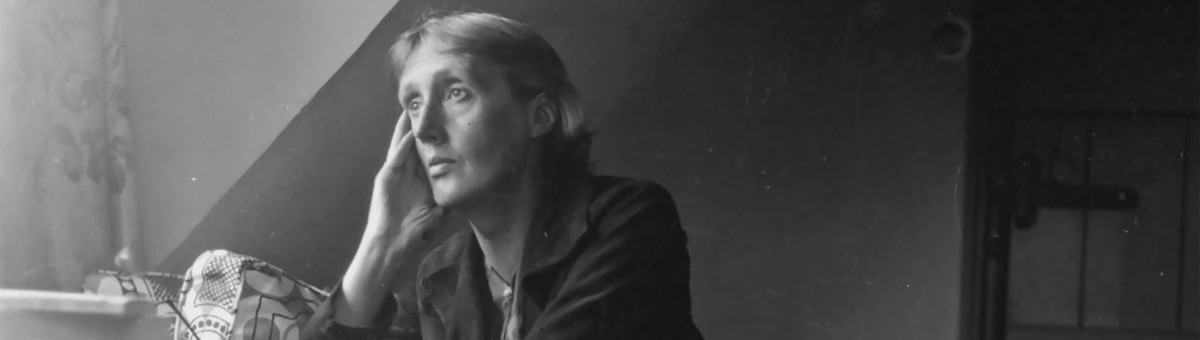
Post-Impressionism in Britain
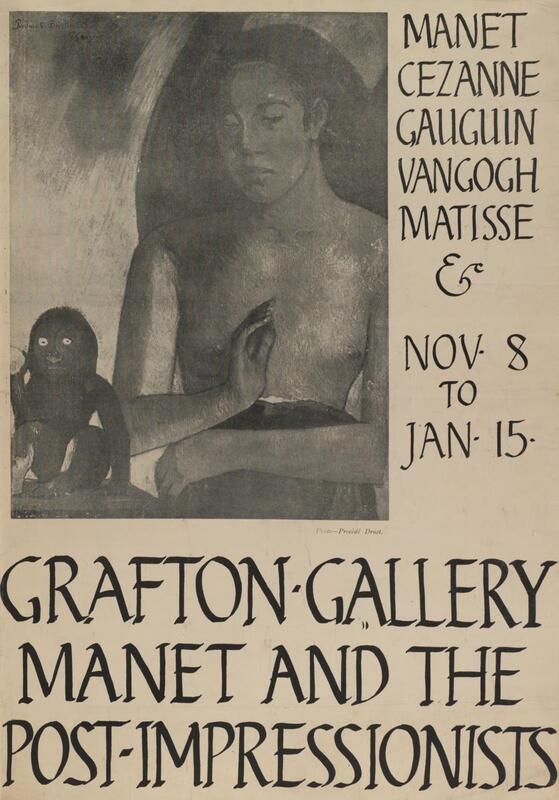
It was Virginia Woolf’s friend and Vanessa Bell’s one-time lover, in fact, who introduced the British public to such radical artistic innovations posed by Post-Impressionism and aesthetic formalism: Roger Fry. He even coined the label “Post-Impressionism” as part of his infamous exhibition "Manet and the Post-Impressionists," held in 1910 at the Grafton Galleries in London.[10] With this new term, Fry highlighted the shared significance of form and changing artistic motivations among modern artists like Gauguin, Matisse, van Gogh, and Cezanne, the last of whom Fry considered to be leading the formalist charge of the French avant-garde.[11] More than 25 artists showed around 250 works, with attendance to the show numbering about 25,000 from November 1910 to January 1911. The exhibition irrevocably changed the course of art history;[12] for some, it even changed the horizons of the human spirit, as Virginia Woolf herself declared that “on or about December 1910” – the midpoint of Fry’s exhibition – “human character changed.”[13] Vanessa Bell, finding inspiration in her fellow modernist artists, noted after her visit to the exhibition “[h]ere was a possible path, a sudden liberation and encouragement to feel for oneself, which were absolutely overwhelming,”.[14] However, with its provocative ideas about representation (or lack thereof) and aesthetic values in art, the show generated immense uproar and outrage among much of the lay British public: responses ranged from a general puzzlement at the perceived bizarreness of the works to accusations against the artists’ psychological stability.[15]
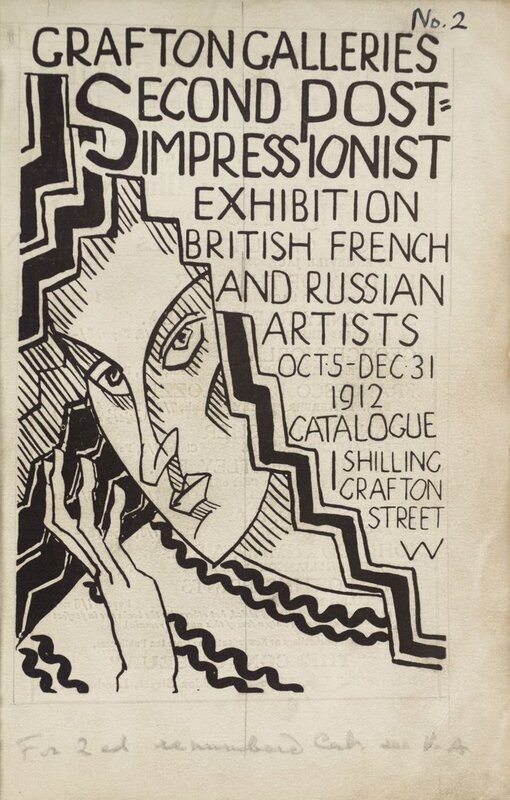
Despite this response to the first Post-Impressionist show’s boldness in form and color, Fry mounted the “Second Post-Impressionist Exhibition” from October to December of 1912. After presenting the British public with the (largely French) Post-Impressionist “old masters”[16] in his first exhibition, Fry introduced the next generation of Post-Impressionism and its representatives among British artists, casting the movement as a modern, global aesthetic evolution in which Britain took part. In the catalog to the second exhibition, Fry recognized previous criticisms as “spring[ing] from a deep-rooted conviction, due to long-established custom, that the aim of painting is the descriptive imitation of natural forms” – and herein lies the revolution of Post-Impressionism, for the artists in both exhibitions “d[id] not seek to imitate form, but to create form; not to imitate life, but to find an equivalent for life.”[17] Clive Bell, Vanessa Bell’s husband and Virginia Woolf’s brother-in-law, further challenged the naturalism of previous art movements by asserting the new forms of emotional resonance offered by Post-Impressionism: “We have ceased to ask, ‘What does this picture represent?’ and ask instead, ‘What does it make us feel?’”.[18] This second exhibition included works that pushed the boundaries of even Post-Impressionism to their extremes, and later branched off into recognizable modernist aesthetics of their own: spectators would have seen both the sharply abstract geometric forms of Picasso and Braque’s Cubism and the bright, bold colors of Matisse’s Fauvism. Even precursors to the British analog of the Italian Futurist movement, Vorticism, which extolled the dynamism and power of modern industry and society, could be found in the works of Vorticist co-founder, Wyndham Lewis.[19]
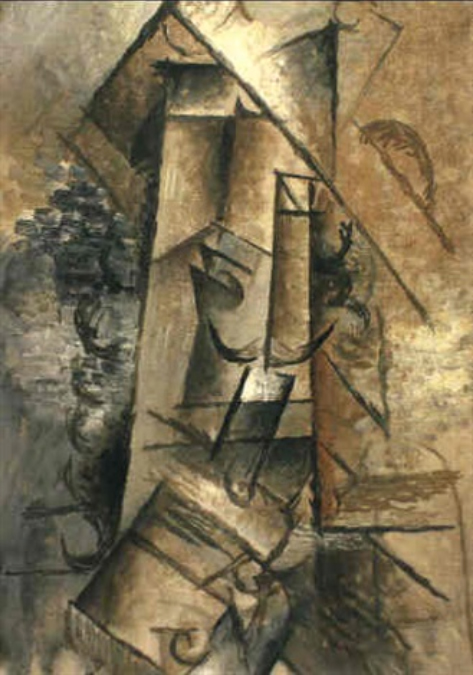
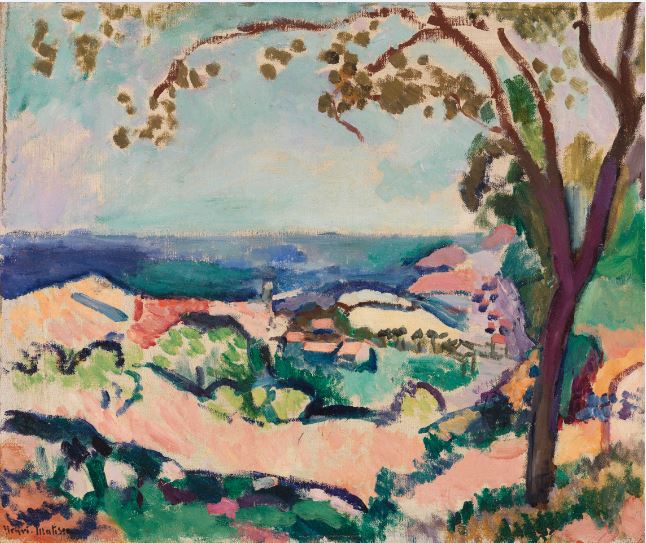

See "Primary Source C: The Grafton Galleries Neatline Exhibit" for an interactive look at some of the works which were featured in both the 1910 and 1912 exhibitions:
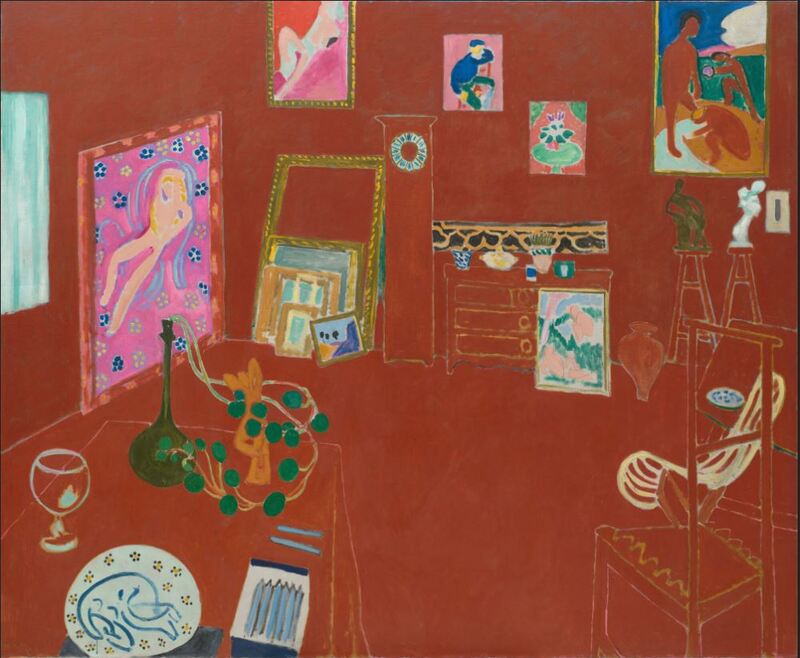
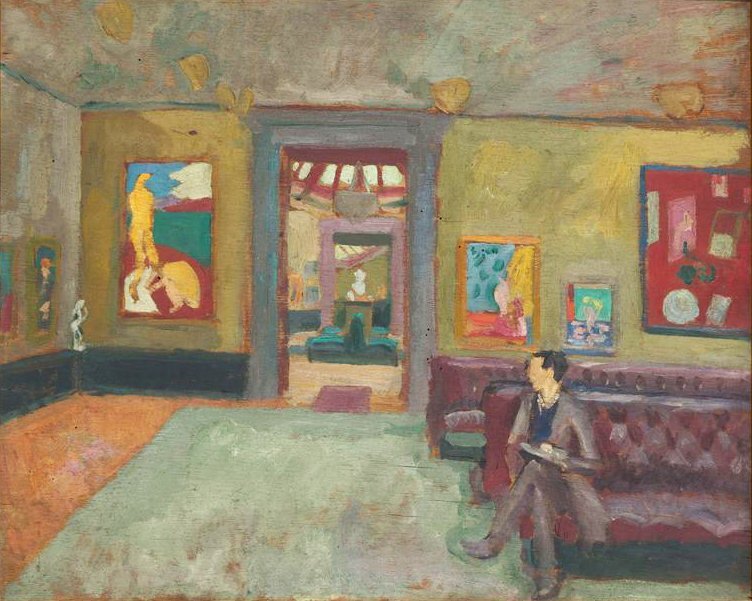
Critically, the second exhibition also introduced the contributions of British artists to this aesthetic revolution. Bell, who selected the British artists and works which would be included in the show, cast these Post-Impressionists Brits as elevating Britain’s role in art history: they had “expelled or reduced to servitude those romantic and irrelevant qualities that for two centuries have made our art the laughing-stock of Europe.”[20] Roger Fry himself, in addition to Duncan Grant – who with Virginia Woolf and both Clive and Vanessa Bell were all members of the Bloomsbury Group, a loose collective of intellectuals and artists working in or around Bloomsbury, London – both showed works. Grant’s The Dancers echoes the bright colors and simplified figures of Matisse, while Fry’s Angles sur L’Anglin abstracts the details of the French commune into blurred masses and geometric forms. One of only a few women to present works at the exhibition, Vanessa Bell – referred to merely as “Mrs. Bell”[21] in the exhibition’s catalog – showed four pieces, including The Spanish Lady. In a work inspired by the exhibition (and often misattributed to Fry), she depicted the view through the Large Gallery, paying homage to Post-Impressionist works, including the bold red plane and brightly colored masses in Matisse’s The Red Studio (Le panneau rouge).[22]


[10] Anna Gruetzner Robins, “‘Manet and the Post-Impressionists’: A Checklist of Exhibits,” The Burlington Magazine 152, no. 1293 (2010): 782–93. Accessed 13 Nov. 2021. http://www.jstor.org/stable/25769877.
[11] Beverly H Twitchell, Cezanne and Formalism in Bloomsbury (Ann Arbor: UMI Research Press, 1983), 29.
[12] Bruce Altshuler, Salon to Biennial : Exhibitions That Made Art History. Vol. 1, 1863-1959 (London: Phaidon, 2008), 83.
[13] Virginia Woolf, Mrs. Bennett and Mrs. Brown (London: The Hogarth Press, 1924), 4.
[14] Vanessa Bell, Sketches in Pen and Ink (London: Chatto & Windus, 1997), quoted in Richard Shone, The Art of Bloomsbury: Roger Fry, Vanessa Bell, and Duncan Grant (Princeton: Princeton University Press, 2002), 130.
[15] Jane Goldman, The Feminist Aesthetics of Virginia Woolf: Modernism, Post-Impressionism, and the Politics of the Visual (Cambridge: Cambridge University Press, 1998), 116.
[16] Benedict Nicholson, “Post-Impressionism and Roger Fry,” The Burlington Magazine 93, no. 574 (1951): 11. Accessed 16 Nov. 2021. http://www.jstor.org/stable/870622.
[17] Roger Fry, “The French Group,” in Second Post-Impressionist Exhibition (London: Ballantyne and Co, Ltd., 1912), 26. Accessed 30 Nov. 2021.
[18] Clive Bell, “The English Group,” in Second Post-Impressionist Exhibition (London: Ballantyne and Co, Ltd., 1912), 21. Accessed 30 Nov. 2021.
[19] “Vorticism,” Tate, Accessed 15 Nov. 2021. https://www.tate.org.uk/art/art-terms/v/vorticism
[20] Bell, “The English Group,” 23.
[21] Roger Fry, et. al. Second Post-Impressionist Exhibition (London: Ballantyne and Co, Ltd., 1912), 44. Accessed 30 Nov. 2021.
[22] Claudia Tobin, “Test for Chrome Yellow: The Eloquence of Colour,” in Grace Brockington (ed), In Focus: Abstract Painting c. 1914 by Vanessa Bell, Tate Research Publication, 2017. Accessed 20 Nov. 2021. https://www.tate.org.uk/research/publications/in-focus/abstract-painting-vanessa-bell/test-for-chrome-yellow